
From Horses to her early poetry, these are the places to start exploring Patti Smith’s music and writing.
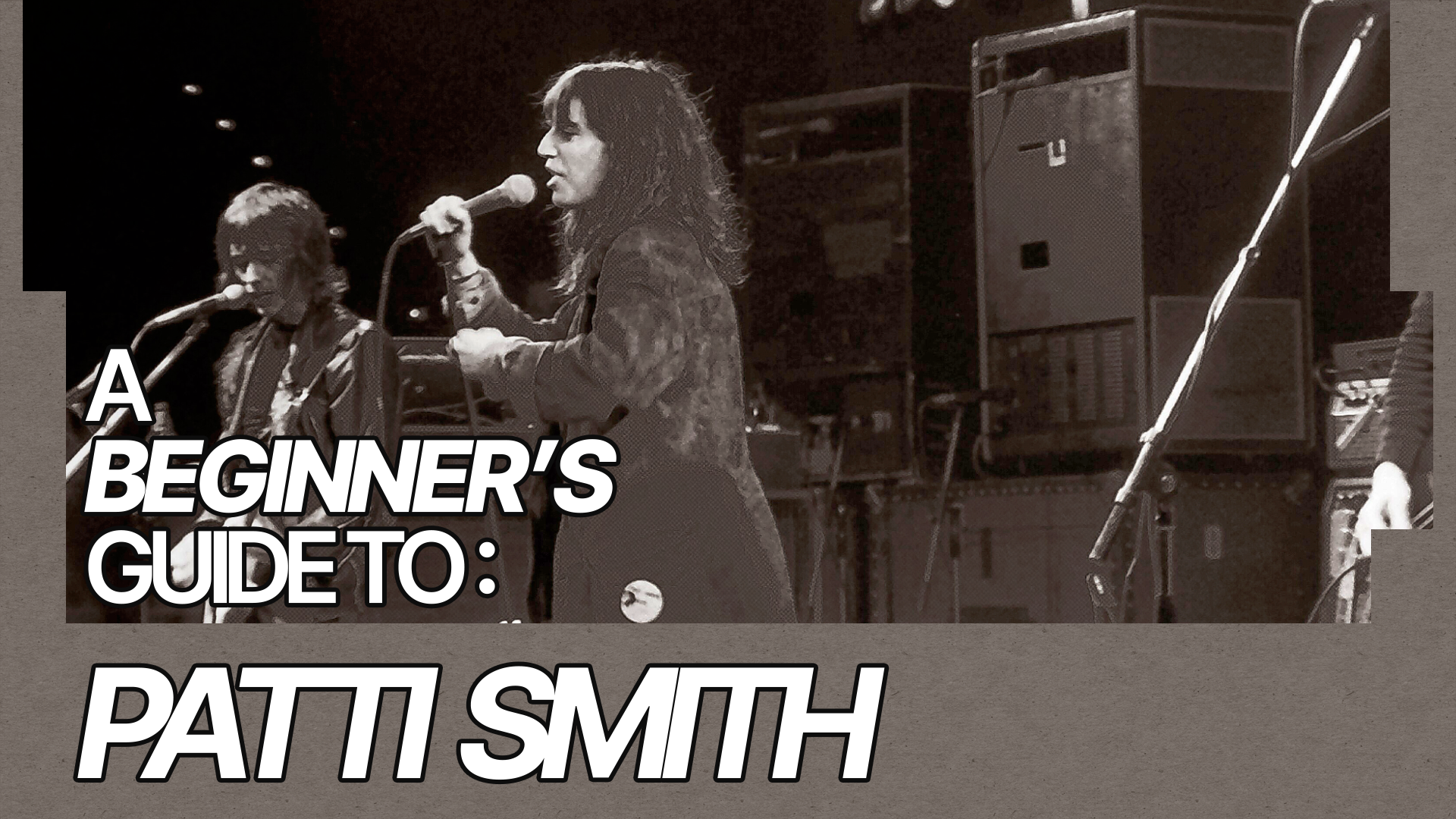
So you’ve seen the image of the renegade rockstar: shirt unbuttoned, tie outstretched. Or maybe you’ve witnessed countless copies of Just Kids pulled from dishevelled totes on the underground. Or perhaps your friend has a sudden interest in New York’s Greenwich Village (or at least back in ‘its heyday’), and you’re wondering what all the fuss is about? Maybe you’re asking yourself: who is this Patti they keep mentioning? Well, look no further; this beginner’s guide to Patti Smith will satisfy your intrigue.
Album: Horses
For Smith aficionados, Horses may seem an obvious choice, perhaps even overdone. But it remains celebrated in Patti’s oeuvre for good reason. Released in 1975, her debut album brims with punk grit, fantastical imagery, melancholic ballads and impassioned cries. Reflecting the previous decades’ unprecedented rock transformation and her propensity for improvisation, Smith exposed the possibilities of the avant-garde. Shaped by her spoken-word lyricism (a feature that would become a staple of Smith’s music) and her poetic roots, Horses was at the cutting edge of alternative punk-rock. Without Patti’s dangerous liaison with rock, we wouldn’t have the likes of The Slits, Siouxsie and the Banshees, KT Tunstall or even R.E.M. Patti’s first album was a call for musicians to wake the hell up, embrace their radicality and let the horses loose.
The opening track (always a good place to start), ‘Gloria: In Excelsis Deo’, encompasses the spirit that still lingers in all of Patti’s creative pursuits. Few lines make a more captivating opening to a debut than: ‘Jesus died for somebody’s sins, but not mine.’ Sinner, egoist, vagabond, abhorrer and flaunter: Patti is all these things and more, spitting out her lyrics with aggressive tenacity. Bursting forth with her band’s bold harmonies and pummelling guitar, Patti’s hymnal cry ‘G-L-O-R-I-A (Gloria)’ is a mocking reclamation of religiosity, both against and in its name. This is the paradox of Patti Smith: untethered from a dogmatic relationship with God, yet immersed in all its spirituality.
It is almost impossible not to feel completely wild, free, and (excuse the pun) unbridled while submerged in Patti’s riotous album. ‘Land: Horses/Land of a Thousand Dances/La Mer (de)’ remains the fan favourite from her debut. This elegiac epic of grief, suffering, desire, and angst shifts between perspectives, all running to the pace of this silver-studded white stallion. Patti’s central protagonist ‘Johnny’ is the epitome of the rockstar: a fledgling spirit ‘pushed against the locker’, threatened, disbelieved, yet dangerous, unlimited, with the ‘eyes of the horse’. Under the heavy shadow of her lost contemporaries, notably Jim Morrison, Janis Joplin and Jimi Hendrix, Patti offers a glimpse into resurrection.
For an album celebrated for revitalising punk, it is surprisingly full of genre experimentation. Take, for example, the reggae-inspired beat that traverses along ‘Redondo Beach’. All the while, Patti unveils this disparaging tale of betrayed lovers, broken hearts and suicide. Or perhaps, the spoken-word poem in ‘Birdland’. Drawing from Wilhelm Reich’s psychoanalytic theories, Patti tells us the story of a young boy reconciling with his father’s death, a death that leads to a UFO abduction. This is the Patti special, captivating you with imaginative fantasies, clever instrumentation and the constant anticipation of where she will go next.
Song: ‘Pissing In a River’
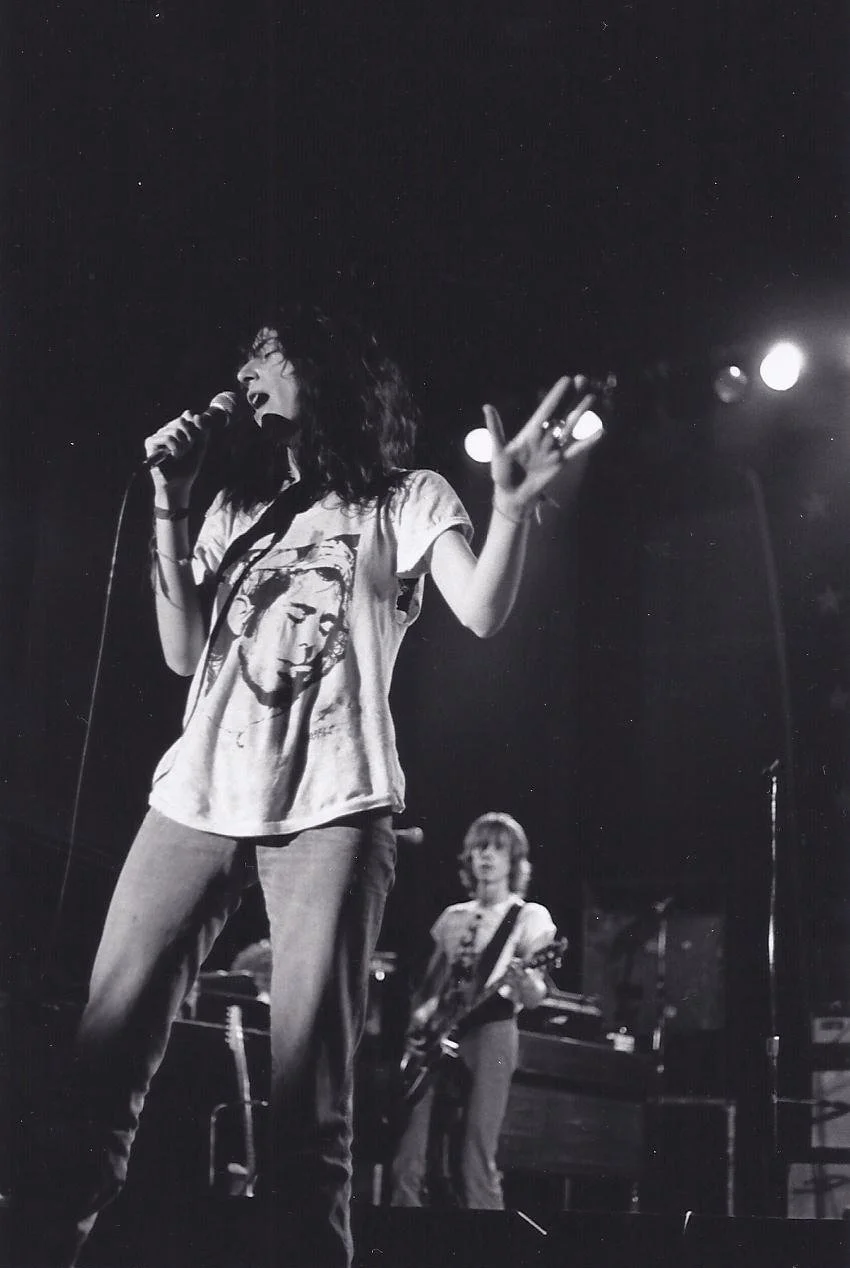
I could have chosen any number of songs to demonstrate the immensity of Patti Smith’s artistry. Any of the songs mentioned from Horses are an excellent place to start. Yet, the grandiosity, griminess and dinginess of ‘Pissing In a River’ truly capture who Patti Smith is, musician and writer alike. Released as the lead single for her second album, Radio Ethiopia (1976), the track overflows with anguish, soaring electric solos, and Patti’s characteristic crying harmonies. It is as much a prayer for desire as it is a tempestuous reckoning with devotion, a hunger to give yourself away while reining in your fervency.
In Patti’s words, this love is not easy; it does not enter calmly. Instead, she declares that her ‘bowels are empty, excreting your soul’. As the track draws to its propulsive conclusion, Patti devolves into these endless rhetorical questions: ‘Should I pursue a path so twisted? // Should I crawl defeated and gifted?’ She receives no response; her love goes unanswered. Rather, her band becomes fuelled by Patti’s torment, perpetually crescendoing until her eventual submission: ‘I’m pissing in a river.’
Literature: Early Work: 1970–79
One would assume when providing a ‘Beginner’s Guide to Patti Smith’ the literature chosen to encompass her work would be Just Kids. This is not to say Just Kids isn’t a fantastic portrayal of Smith’s emergence into the New York underground, with endearing moments with her long-time compatriot, Robert Mapplethorpe. (Subtly, I’m suggesting you choose both options provided.) Instead, I’d like to propose her poetry collection, Early Work: 1970–79, as an apt introduction to the world of Patti Smith. That’s exactly what it is: a complete world, fashioned by her unshackled imagination, daring to be uncouth, unpleasant and confrontational in her unconventionality.
These poems were my initiation into Patti Smith, before any of her records. Full of fervent anger, I saw in these works an unbridled rage I’d never seen so expertly put into words. Patti depicts the dirge, deluge, and grime of living in New York City during the ’70s. Her poems reveal an unquenchable thirst to create, to be seen, to be an artist. This energy bleeds into every record she’s made, performance she’s done, the strange, whimsical Substack post she now publishes; it is Patti Smith’s burgeoning force on full display. In ‘Jeanne d’Arc’ she is the martyred trailblazer staring at the face of death. She wrestles with pleasing and pleasure in ‘The Ballad of Hagan Waker’ and warns of bad boys and evil gods. Patti is ‘drunk on tequila, thinking of you’, ‘embracing Eve’ and firing Christ and sacrificing everything she has to be everything she can. Unburdened by expectation, this is as angry, desperate, virile and grotesque as Patti ever gets, and what better place to start than there.