
A collaboration with Daft Punk gave Parcels more than a story to tell, offering lessons in songwriting they carried into a career of their own.
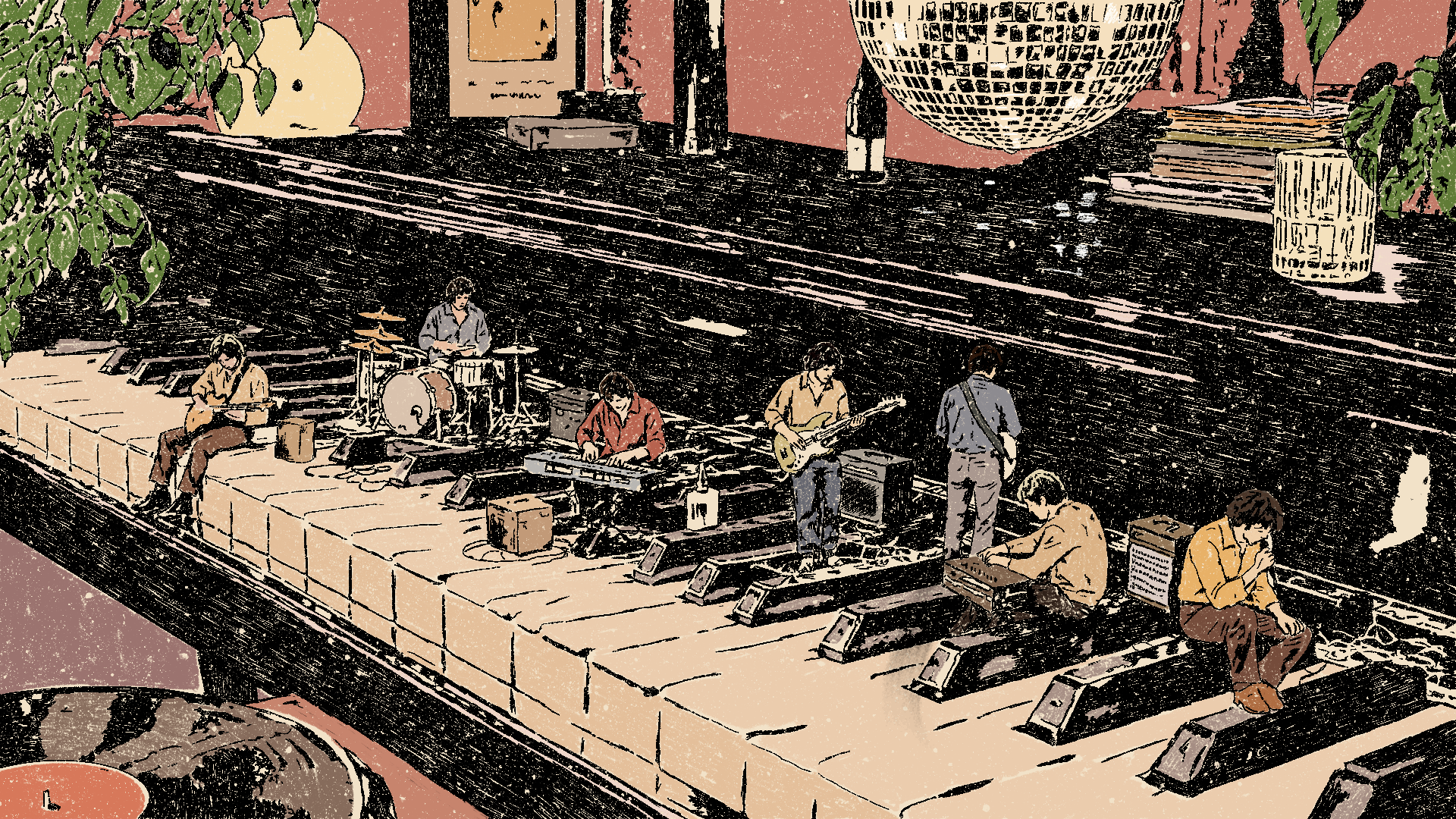
There’s something special about seeing a band live and realising that, yes, they really do sound like that. The harmonies are there. The grooves are there. The little details you’ve listened to a hundred times are all happening in front of you, played by actual people with actual instruments. Imagine!
Parcels are a band that make me think about this a lot. Their music feels warm, polished and impossibly effortless, drawing on disco, funk and soft rock without sounding like they’ve dug up a few old records and decided to have a go themselves. And, perhaps unsurprisingly, they have a connection to a certain French electronic duo who spent a significant part of their career thinking about exactly that.
In 2017, Daft Punk co-wrote and produced ‘Overnight’ with Parcels, after seeing the band perform in Paris. It’s a remarkable story, really. You’re a young band playing a show, two of the most influential figures in electronic music happen to be in the audience, and suddenly you’re in a studio with them. Normal Tuesday stuff.
But the best part isn’t just that Daft Punk helped Parcels make a song. It’s what the collaboration tells us about both acts, and what Parcels did with the experience afterwards.
People making music with people.
By the time Daft Punk released Random Access Memories in 2013, they had spent years becoming synonymous with electronic production. Yet the album was, in many ways, an attempt to return to something more physical. Rather than relying primarily on samples and machines, they brought in musicians, recorded live instruments and worked in studios with people whose performances became part of the record’s identity.
As Thomas Bangalter explained at the time, they wanted to do what they had previously done with machines and samplers, but with people. The point wasn’t to declare electronic music dead or insist that older ways of recording were inherently better. It was to explore what happened when you put musicians in a room and give the recording process itself a role in shaping the music.
And then they met Parcels.
Parcels have always occupied an interesting space between the old and the new. There’s the disco bass, the soft-rock guitars, the layered harmonies and the synths, all wrapped up in something that feels their own. Their music can sound like it belongs to another decade, but it doesn’t feel like a costume; it feels lived in.
But there’s more to the Daft Punk connection than a good bit of trivia. It wasn’t just a case of two French robots passing the torch to five Australians. (Although, admittedly, that is a pretty good sentence.) It was a meeting between artists who shared an interest in what makes a record feel alive.
Finding the song.
In an interview with The Stranger, Parcels’ Patrick Hetherington spoke about how working with Daft Punk changed the band’s approach to recording live music and, perhaps more importantly, songwriting. He described learning to focus on ‘digging out the song and unearthing what’s inside it’, an idea that sounds simple enough until you think about how much can go into making a song work.
There’s a difference between making a song sound good and figuring out what the song actually needs. More layers? Fewer? A tighter arrangement? A bit of space? Sometimes the best thing you can do is stop adding things.
After ‘Overnight’, Parcels went on to produce their own debut album. Hetherington told mxdwn the band went in confident but very ignorant, and that going through the process themselves mattered. They wanted to make things their way.
It would be easy to frame Parcels as the band Daft Punk discovered, or to treat ‘Overnight’ as the defining moment of their career. But the collaboration makes more sense as a starting point than a finish line. And what does a band do when it gets the chance to learn from artists it admires, then has to figure out what to do with all that knowledge?
So what did they actually take from it? My theory is that it wasn’t a sound so much as a habit. Daft Punk could have handed Parcels a template, a few tricks and a very good story for interviews. Instead, they seem to have left with a different way of listening to their own songs. Ask what the song needs. Believe the answer. Then, the hard bit, leave it alone.
It sounds obvious. It isn’t. Plenty of bands given that kind of break would have gone home and made a Daft Punk record, helmets optional. Parcels made a Parcels one: loose in places, roomy in others, with the sense of a group of people in a room making decisions together and occasionally disagreeing. (I can’t prove the disagreeing. I’ve chosen to believe it.) The harmonies are there, the grooves are there, and underneath all of it, you can hear people making every choice.
A little bit of melancholy.
There’s another thing I love about Parcels: they’re secretly a bit sad. ‘Withorwithout’ sounds like a rooftop bar in July, but listen closely and something nervy is going on underneath. You can be dancing and still be having a terrible time. In fact, sometimes the dancing helps.
It’s a contrast that makes their music feel more human. The sound doesn’t have to tell you exactly how to feel. A song can be catchy without being shallow, nostalgic without being stuck in the past, and meticulously arranged without losing the feeling that someone is trying to work something out.
That might also be what ties Parcels to Daft Punk. Both understand that how music gets made matters, but only if it leads somewhere. Nobody leaves a gig raving about the mic placement. (Some people do. Not the fun ones.)
So no, Parcels didn’t become the next Daft Punk, and they didn’t need to.
‘Overnight’ was a Tuesday with Daft Punk. Everything since has been Parcels.
Illustration Design: Elsa Mira Russo