
Gig Review: Greetings V At Vespers
The basement beneath Rye Lane proved an unlikely setting for an evening that revealed just how much intimacy and invention still survives within London's underground music culture.
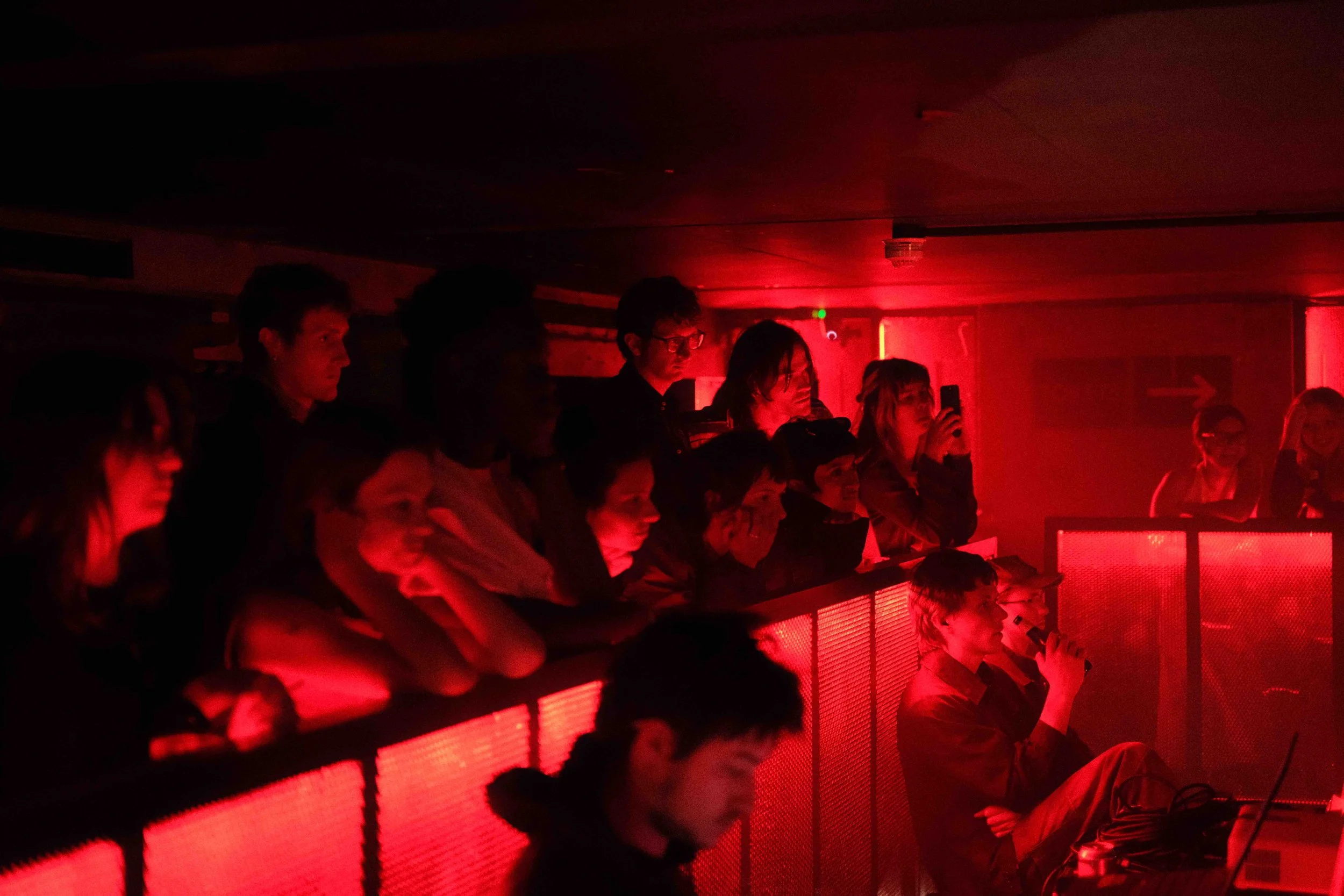
It’s hard to make Vespers sing. The club space, formerly Peckham Audio, is a classic London high street basement sinkhole - broken ceramics and sticky floors paired typically with a baffling array of acts. Over its tenure, the venue (under both names) has hosted Dean Blunt, bod [包家巷], Jane Fitz, Krautrock Karaoke, Evicshen, John Maus, L-VIS 1990, GFOTY, Tek Lintowe, Jackzebra, and so many others. Shows which tend towards inviting the mesmeric chaos you’d associate with 3 cans too many. Squeezed amongst a Tonkotsu franchise and the tragically disappearing legacy shops of the Rye Lane shopping centre, it’s vital that a venue is still chipping away at the brick wall of live music economics, but it can also feel like the graft required to pull off this magic trick produces a frayed and difficult venue experience for the occasional punter. It’s held together by the grit and passion of its staff, and you can feel the knife’s edge in the lovecraftian terror of the toilets and the moderate jank of a ‘green room’ tucked behind a black polyester curtain.
It’s not a place I’d have had in mind for a sensitive Thursday evening of live performances as a heatwave crested the capital, but Greetings’ programming delivered on its promises of “erratic coalitions” and produced a really enjoyable window into a scene that felt fresh in concert with its context.
We began watching SUZY’s video loop Mezzo Forte. I’d arrived just before doors and was nestled in the back, sheltering from the already climbing heat. A montage of found footage, blurry, compressed, reeled around short spoken-word phrases and a set of ambient pads. I could maybe have been in a spa or an art installation - the effect was a mixture of comfort and uncertainty. From where I was sitting the projection played partially through the punched metal railings around the venue’s recessed dancefloor. I could unfocus my eyes, which felt like the correct way to start a gig. Some people shuffled in, arranged themselves around the space, and settled in alongside me. The laptop screen playing the video was inverted, giving the impression that the video was being reflected from a body of very still water somewhere at chest height. I liked losing concentration as snippets of audio fell into place. “…organised by desire…”, “… to love one another…”.
This was followed by the only act i was familiar with heading into the evening - a guitar performance by Christopher Jordan as Pentu. This felt colder than previous performances I’d seen by him; less Cantu-Ledesma or Fennesz and more Fripp/Eno. Notes of pedal steel and what I could only nail down as an “American” sound: plains and nighttime dust, mixed into a really beautiful guitar tone alongside added samples and distinctly digitised aesthetics. Pops, clicks, some synthesis on which to lay down slabs of soft metal. I wrote “Tone !!!” twice in my notes which I think gets to the core of why this performance worked so well. The swells of a slow attack pedal, the pseudo-dampness of a very cold concrete wall, and the compositional care of someone who is (rightly) starting to get booked more often in London. Take note. Mimiko followed, moving softly from tuning to playing. Accompanied by a second guitarist who harmonised, whistled, and chattered during the many breaks to re-tune. The music was quaint - slow waltzes and tender tunes in a distinctly eroded contemporary London style. Nestled between neofolk and neotwee you can find a huddle of artists getting back to songwriting, and it was refreshing to tap directly into this vein and hear what someone has been making in their bedroom, unvarnished and bare. More widely this style can tend towards a totalising aesthetic and produce songs that are both deliberately unfinished and gratingly produced, but Mimiko trod a careful balance, weaving an incredibly-out-of-tune pair of guitars into a shy and dusty setlist.
The evening ended on an “improvised trio” - Isaac Robertson on tenor sax, Anna Adetiba on alto, and Malachy O’Neill on drums. There’s a wider piece to be written about the growing prevalence of improvisation and free improvisation in London’s artschool-adjacent circles. See Grain and Life is Beautiful and Steam Down and countless others, stretched between experimental and jazz nodes. As creatively fulfilling as the act of improvising and learning to listen can be as a musician, the space afforded also often leads to interstitial moments and an uneven experience as an audience: short loops, breaks, forced ambient sections as the group figures out what’s going on and where to go next.
There were some of these moments, but the trio brought a structure to the set which forced a welcome forward momentum. O’Neill’s drums kept a consistency that let the saxophones range widely, while still playing into the reverb his kit was running through, and the trio tended towards a groove instead of wheeling out into space. Adetiba carried melodic tones on the alto, with Robertson playing rhythmically, getting the tenor down into gravel territory without overcooking it (sometimes I have horrifying flashbacks of tenor sax “subway battle” videos where a man in a snapback honks the shit out of a cover of Mister Saxobeat). They connected well together, the uncertain smiles which punctuated the finish refracting the event as a whole as the audience whistled and cheered. Smiles were shared. There’s much to be said about the collapse of music venues and musical cultures, but you can still find moments of intimacy just below the street’s surface.
Photography By: Jacek Broniszewski