
Blondshell – Violins Review
On Violins, Blondshell looks beyond troubled relationships, turning her sharp lyricism towards friendship, femininity and the things that stay with us.
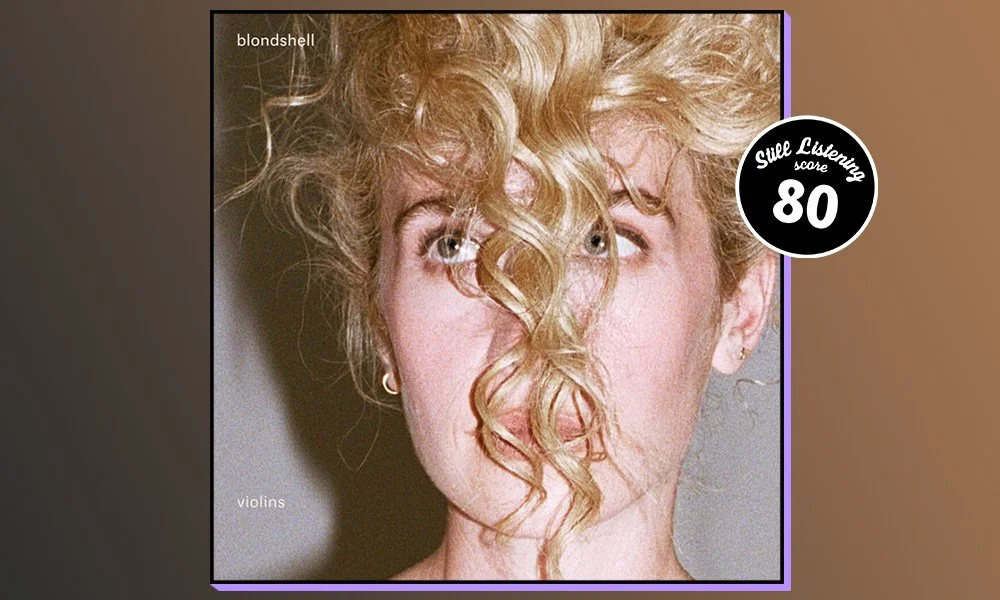
Dissatisfied with her sound and feeling in need of a change, California-based singer Sabrina Teitelbaum found the spark for her desired rebirth over dinner and a casual conversation. Emerging in 2022 with ‘Olympus’, Teitelbaum formally took on the name she and her sister had discussed that evening, allowing BAUM to become Blondshell, and allowing Teitelbaum to fully realise her potential.
She successfully, and purposefully, crossed genres, moving from the more pop-leaning sound of BAUM to her own distinctive take on 90s grunge with an indie influence as Blondshell. She has since released two albums and is set to play London’s Roundhouse this December, with her new album, Violins, to draw from.
There can often be slight apprehension where title tracks are concerned, the need to live up to the focus sometimes meaning that they fall short. This, however, is not the case with the album’s opening track. An angsty introduction of whining guitars and Teitelbaum’s oh-so-indie voice launches us into the beautifully gnarly twist of instrumentation that is ‘Violins’. It’s dense, it’s strong, and loaded with Teitelbaum’s characteristic imagery that you will grow to love throughout the album’s unfolding lyrics. Perhaps to set the scene, you’re sat on a kerb, slightly drunk, and asking when it (whatever it is on your mind right now…) will be over. Teitelbaum focuses on the lifelong commitment to the experiences we have, and the ensuing trauma, as she wraps around you with the declaration that it’s ‘never over’.
The first tune to be released, but the second on the album, ‘Heart Has To Work So Hard’, is agonisingly symbolic: Teitelbaum ‘turn[s] to face the lake’ and the anonymous other ‘twist[s] the knife’. With driving percussion and a more pronounced rock sound than the previous track, the tune turns up the energy and captures Teitelbaum’s distinct style of lyricism, which she has described in an interview as having become ‘less literal’. From the elongated ‘Adenosine’ attempting to reset an erratic heart rhythm to the bloody pursuit of ‘labour’, the track oozes with the mature revelation of hindsight.
The beauty of these less literal lyrics is their openness to interpretation. Teitelbaum commented on the move away from ‘the veil of bad romantic relationships’, which she has previously carefully dissected with songs such as the breakout ‘Olympus’ or the punchy ‘Sepsis’. As the album develops, its themes expand to include war, friendship and femininity. It’s refreshing to hear Teitelbaum discuss her intended subject matter whilst also admiring how her metaphor-rich lyrics allow for an interpretive listening experience. The songs require focus, and Teitelbaum ‘trusts’ her listeners to explore them.
‘Lucky’ enters next, softer and piano-led. There are simple pleasures set against the building undertone of acoustic guitar. It feels best described as affirmations spoken through a ‘beautiful’, ‘sunny’ smile with gritted teeth; a highlight track. Almost Cocteau Twins-esque, ‘Sea Legs’ yet again proves Teitelbaum’s versatility as it welcomes you into a dreamlike exploration of higher powers. There is a feeling of distortion with the sliding instrumentation, almost like the hazy heaviness that comes with wading through water.
The album’s middle is mellow: soft, lulling melodies accompanied by the characteristic sharp edge that Teitelbaum carries off so well. ‘New Shape’ reaches the peak of this calm, a stripped-back tune with the vocals intentionally exposed, much like the blaringly uncomfortable revelations of unhappiness laced throughout. Describing a volatile, contorting relationship, she ‘cut[s] up [her] soles/walking on [their] eggshells’.
In ‘Stone Fruit’, Teitelbaum bites back. It’s twisting, catchy and reeks of uncomfortable self-awareness. ‘Two Fried’ leans more into country and indie rock, with twangs that could almost swerve towards artists like Sam Fender or Wolf Alice. Yet, it’s cut with Teitelbaum’s inescapable presence and careful attention to detail as she splits her vocals from the instrumentation when singing ‘splitting of a tree’. There is maturity, but also an accompanying humour as she utilises such an unconventional metaphor to discuss her body.
‘New Age Trojan Horse’ kicks up, spitting out the harsh observation of men unable to cope with women menstruating, an insight into a man’s hypocritical love for violence. The same men that ‘romanticise war’ can ‘like your body’, but just ‘not [its] blood’. It’s a churning, rocking and exasperated anthem. ‘Knotted’ is the complete opposite of its title, fluid and rolling, a sweet example of Teitelbaum’s softer rock. ‘Reinstall’ repeatedly builds before falling away; it’s difficult to catch, similar to the overwhelming change that can develop between old friends who are no longer able to hold on to one another. It’s a beautiful track, and now, perhaps, we can return to the kerb you were sat on listening to ‘Violins’. It’s colder now, and by ‘Reinstall’, you’re sobering up and contemplating each tune. Teitelbaum herself got sober at 22; now 29, she reflects on this process throughout the album and notes how ‘we’re not like our friends at all’.
‘Fur Elise’ opens with ‘enough’. It’s a hazy grapple with decentring romance and figuring out your life whilst returning to a haphazard vision of a wedding and all it could be. A strong close to an even stronger album. It was easy to imagine listening to this album in so many other places, because its themes weave through all our daily lives. I now like to think none of us will be sitting on the kerb under ‘the veil of bad romantic relationships’, and instead be newly preoccupied with all the ideas that have spilt from Teitelbaum’s songwriting.
Vocally driven and rooted in 90s grunge, Violins is reflective, rich in lyricism and resplendent with complexity.