
Roads, deserted. Towns, sparse. Time, hangs. Doveland is not an album you listen to on a roadtrip; it IS the road trip.
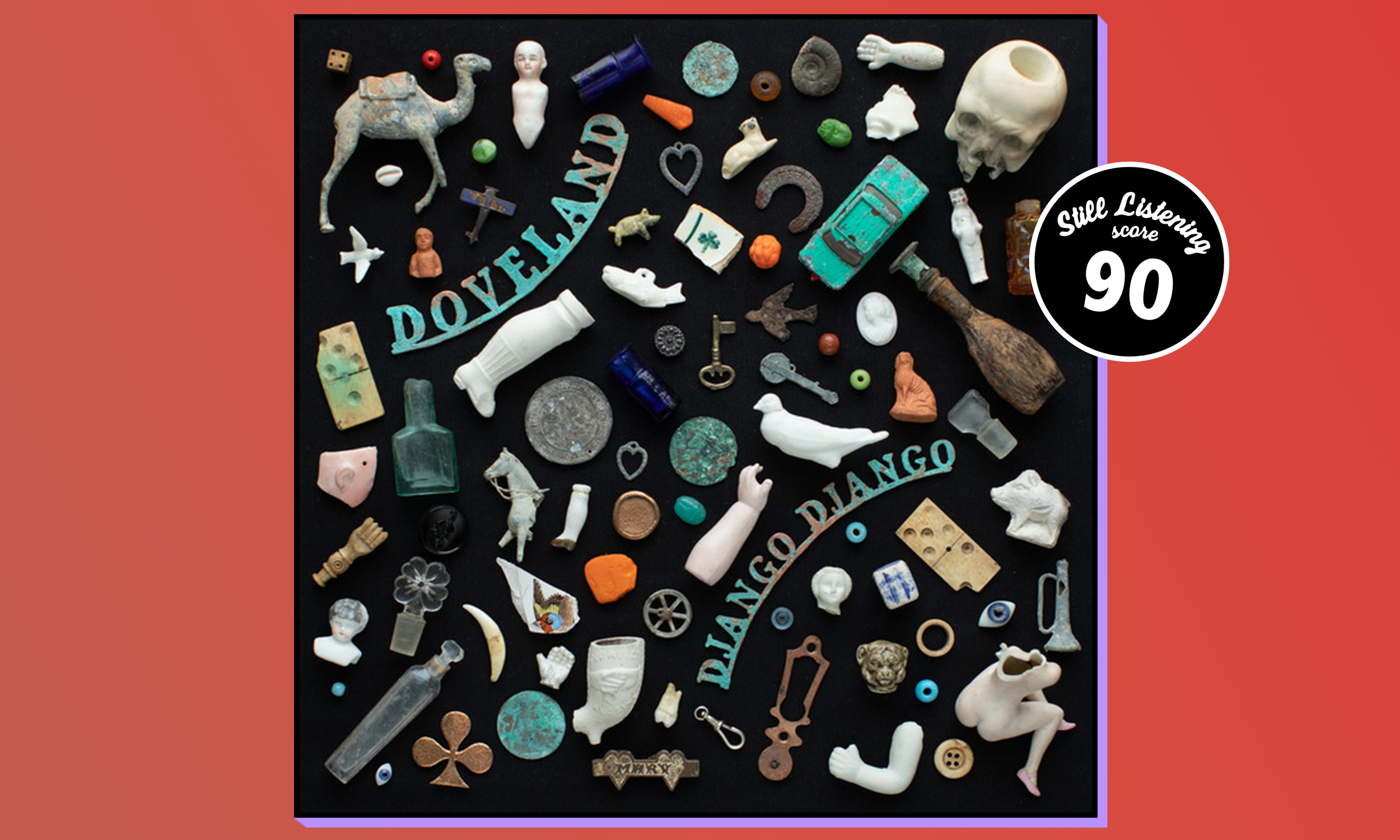
I moved between five countries before I turned twenty, mostly by myself, and the ecstasy of travel and seemingly limitless relocation wore off real quick. I began to yearn for some small, idyllic rest-stop to catch my breath, one where, preferably, nothing ever happens. For me, Django Django’s new indie-folk and art-pop album Doveland (2026) is the search for that very location.
The album takes its name from the urban legend of Doveland, a small Wisconsin town said to have vanished in the 1990s. The band built the record around the initial idea of a girl who finds a postcard of the folkloric town and hitchhikes across the USA trying to find it. Doveland’s inspirations included: David Byrne’s 1986 feature debut True Stories and Daft Punk’s 2006 art-film Electroma; two films made by music artists, in which the music works a lot like the cinematography, driving a continuous story as much as the moving images do. In the words of Django Django’s David Maclean: ‘We’d decided music videos were obsolete – we wanted to make a film with music in it.’ Doveland is that film, a road movie where you drive with your eyes wide shut, through a surrealist faded landscape, all open prairie and small towns. Reality blurred. Its cohesion comes from centering the record around a journey, which inherently builds, so it plays as one continuous road trip (album) rather than a set of individual destinations (songs).
Yet within that unity sits a tension: is the search for Doveland real, or just an excuse to keep running? From opener ‘Meteorite’ to third track ‘Still Life,’ Doveland tilts towards the former camp. Welcoming the listener into the album is ‘Meteorite’s’ stripped acoustic guitar, each musical phrase left unfinished, carrying lines like ‘Black rocks fall’ and ‘I feel light on my feet.’ Combined with talk of falling dominoes and free fall, the opener portrays a psyche itching to pack up and start driving as opposed to continuing to remain still. ‘Cameos’ and ‘Still Life’ accelerate that restlessness, rising in tempo and introducing a drum beat, until the road has a direction and an idyllic Doveland appears as the end-point.
Then, on track four, ‘Little Me (feat. Hak Baker),’ the album pulls over. It’s a rest stop, perhaps a refuel (+ a cheeky snack break), and a moment that subtly pushes the question of whether you’re really looking for Doveland or just looking to evade something a few towns behind you. The record keeps circling back to that tension-point. ‘Year of the Snake,’ one of the album’s most unsettling and moody tracks, is the peak of the keep-moving side: a snake forever sheds its skin and identity. It speaks of being ‘buried under a darker sky’ and being unable to ‘find an easy way out,’ and argues for hitting the road, Jack, and abandoning problems unresolved in the rearview mirror. As its counterweight, ‘Quicksand,’ a spoken word track, and ‘Bird Song,’ an instrumental built on birdsong samples, plead with the record to stop running away. The past always catches up, and the more you evade, the harder it is to keep driving.
The band saves the turning point for the penultimate track, ‘Dirty Hotel Blues.’ This track begins as a brag, a vagabond’s boast about drifting around and ‘leaving all my worries in a one room shack.’ Then the voice shifts. The swagger gives way to something cynical and tired, a narrator recounting what a life on the road costs the body. Disillusionment. A greasy psychedelic keyboard loop spins around over and over, betraying a dislocated limbo. Isolation. A hotel is the epitome of a transient state, and here it stops being a convenient place to dispose of your troubles and becomes a place of suffocation: a room with no permanent identity, in a town you’ll forget. Betrayal. Exhaustion. What you’re running from, it turns out, is partly what the running does to you.
Finally, on closer ‘Feel Alright,’ a collaboration with Max Pope, the car keeps going, but the running stops. Its music video pays homage to True Stories, with Pope in a David Byrne-style cowboy suit almost plucked from the film, and you can picture the song as the rolling credits: the car drives off into the distance, miles of untravelled road still ahead, camera shot fading to black. The fantastical Doveland is never found, but the album realises it was always more about the journey rather than the destination. A perfect road film ending. Pope sings: ‘The more that I try to run, it’s like I’m chasing the sun, but I know in the morning light, I’m going to feel alright.’ You can’t outrun what you carry, and the song knows it: the road’s still going on for miles upon miles upon miles, but the dread has gone out of it.
From here on out, there are no anxious glances in the rearview mirror and no fixation on a destination, only a full embrace of the drive itself.