
Madonna - Confessions II Review
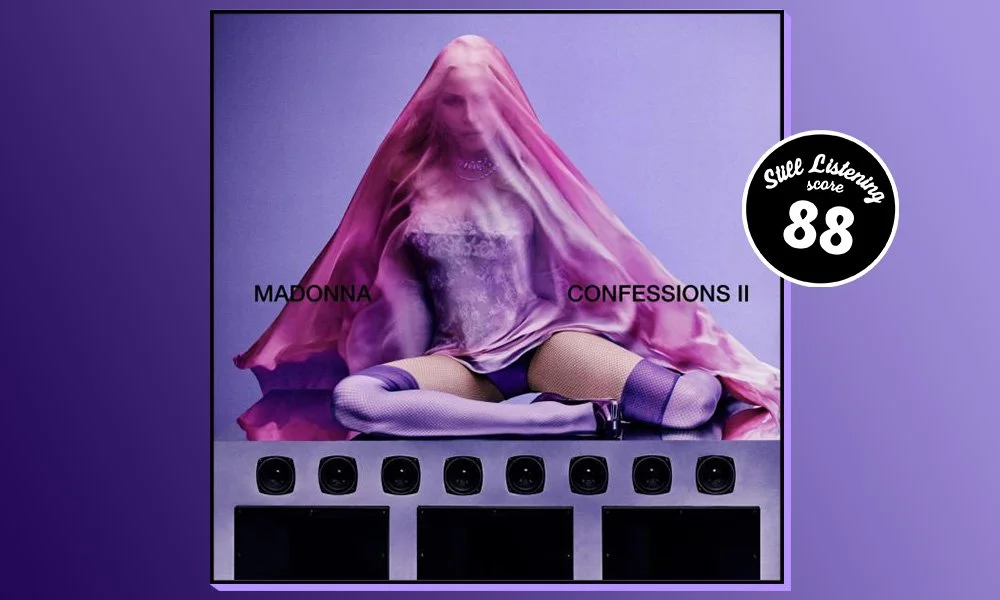
Two decades after the timeless disco-dance tunes of Confessions on a Dance Floor, Madonna’s Confessions II is a fresh, energetic, and transcendent return that immortalises the healing powers of the dancefloor, turning unencumbered joy into an act of resistance.
As an American journalist, Forrest Sawyer succinctly eludicated back in late 1990, “It has become virtually a seasonal affair. The weather changes, and there is a new Madonna controversy.” Thirty years later, the fact remains. It's a feat that at the age of 67, more than four decades into her illustrious career, Madonna still proves to be a controversial figure. Recently sparking divisive debates on what a woman of her age should act and look like post-Times Square promotional performance teasing the release of her highly anticipated 15th studio album, the queen of pop continues to ruffle feathers - albeit in a manner far less scandalous than her actions in the past. Provoking similar sexist and ageist backlash and media mockery following the leotard-clad music video for “Hung Up,” two decades on, Madonna continues to boldly dispute and defy the limiting cultural expectations placed on women in an industry reputable for throwing pop artists away when their youth runs dry.
A second chapter to the momentous 2005 record Confessions on a Dance Floor that reignited and realigned Madonna’s relevance in the 21st century pop music sphere (and also gave her the biggest commercial hit of her career with lead single, “Hung Up”), Confessions II sees the icon reunite with producer Stuart Price, combining elements of electronica, house, techno, and EDM to assemble a joyous yet introspective coherent collection of tracks who take as much inspiration from the past as they do the present.
Arranged like a continuous DJ mix that seamlessly ebbs and flows from one track to the next, Confessions II embodies the transcendent atmosphere of the dance floor. Captivatingly energetic and unrestrained, the first eleven tracks are a relentless, steady pulse of uplifting, blood-pumping danceable grooves that urge the body to move and gyrate in a hypnotic, ephemeral euphoria. Thanking the listener for coming onto the dancefloor with the otherworldly avant-pop opener “I Feel So Free,” the Arca-produced track is a glitchy sonic meditation on themes of freedom and community that are at the very core of the record. Tracks like the infectiously catchy “Good For the Soul,” the throbbing EDM-synthesized beats of “Everything,” or the Latin-infused flair of “Read My Lips” are soon to be nightclub institutions. But “Danceteria,” a song dedicated to the 1980s New York nightclub recounting the night when Madonna first launched her career, is a standout. Seethingly joyous and delightfully poppy with a bouncy waterbed bass line and subtle, brief hums of Lou Reed’s “Walk On The Wild Side,” Madonna’s name-dropping of legendary figures from Andy Warhol, the B52’s and David Bryne to her brief lover, Jean-Michel Basquiat, serves as a fabulous reminder of the extraordinary life she has lived rather than a gauche display of narcissism; the song is simply too good for the famous names to be a pull of focus.
Morphing into a more mesmerizing and introspective set of songs, the final five tracks of Confessions II reconcile with the relationships in her life: mourning her late brother, Christopher (“Fragile”), dissecting her rocky relationship with her step-mother (as apparent in the lines ‘You’ll never take my mother’s place’ on “Betrayal”), as well as her fraught dynamic with her daughter Lola Leon, who is featured on the track “The Test.” But Madonna chooses to close the record with a bittersweet eulogy to her past self - arguably the most important relationship one has. Wrapping the album up with the surprisingly understated and beautifully melancholic “L.E.S. Girl,” the closer is a cathartic reflection on her life as an early 20s-something in New York City, or, as the so-called “Lower East Side girl.” In an album chock-full of strong, energetic rhythms, catchy melodies, and prominent punchy basslines, “L.E.S. Girl” is an airy culmination reflective of the record's sonic synthesis of the past and present, seeing the pop-star pensively recounting her origins as she repeats the album’s closing lines in a whisper-soft voice atop an acoustic strum: ‘Everything fades away.’
Much like the first installation of Confessions on a Dance Floor and Beyoncé’s Renaissance after it, Confessions II invites, inspires, and disseminates jubilance, self-expression, and freedom, framing the dancefloor as a deeply liberating, unifying, and spiritually sacred space. Designed as an escape from the encroaching darkness and encouraged isolationism that is the current state of the modern world, Confessions II embraces the sounds and styles of dance music pioneered by queer (specifically Black and Brown) communities in which Madonna first grew her career, as well as continues to uplift and platform well into the 2020s. Carefully crafted to break down the barriers between us, free the mind, and move together on the dancefloor, the pop icon's recent record is a potent potion that embraces and advocates for the healing power of uninhibited movement. It is a powerful showcase of joy as a disruptive, propulsive force to act as a unifying form of resistance.
Regardless of one's thoughts and feelings about Madonna, it is undeniably an impressive feat that in a storied career full of highlights, controversial moments, commercial flops, and successes, some of her most notable and celebrated work was produced well after the age the industry commonly begins to discard their pop stars. Confessions II, much like its predecessor, is a stark reminder of why Madonna continues her reign as the Queen of Pop.