
RAYE - THIS MUSIC MAY CONTAIN HOPE. Review
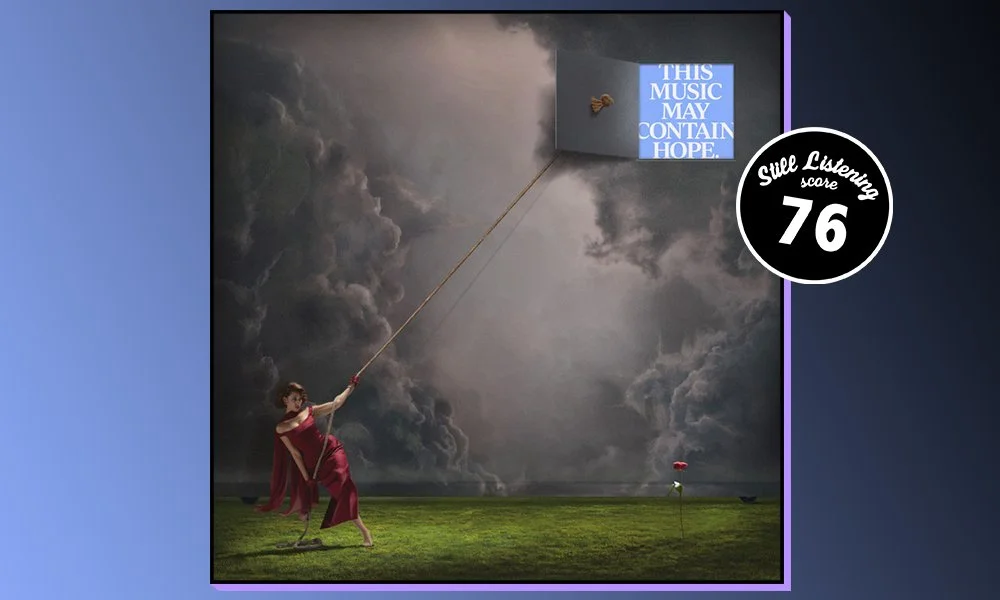
RAYE’s ambitious second act reaches for emotional grandeur, sometimes a little too eagerly.
After the success of My 21st Century Blues, RAYE could easily have leaned further into the jazz-tinged soul and confessional songwriting that made her one of the UK’s most compelling pop voices. Instead, This Music May Contain Hope takes a far more theatrical route. Structured around four emotional “seasons”, each corresponding to a side of the vinyl, the record traces heartbreak and eventual healing. RAYE has described it as a form of “medicine”, and something meant to offer listeners “a hug, a bed, or a soft place” during difficult moments.
Ambitious is one word for it.
The album opens with ‘Girl Under The Grey Cloud’, a spoken-word introduction accompanied by the London Symphony Orchestra. The scene is vivid: a woman wandering London, “seven Negronis deep”, nursing an emotional wound she can’t quite name. The track ends with a voice note from RAYE’s grandmother before sliding directly into the album proper.
From the outset, the record rejects presenting itself as a collection of songs and becomes more of a guided emotional narrative, with RAYE herself our narrator and tour guide.
That sense of scale runs throughout the project. ‘I Will Overcome’ brings back the distinctive RAYE sound of smoky jazz textures paired with powerhouse vocals, as the moment where she sings “Some people say I remind them of Amy” is strikingly self-aware. In terms of vocal performance, she more than earns the comparison: few contemporary pop singers can move between tender soul phrasing and dramatic belts as effortlessly. Yet the album’s sweeping orchestral arrangements often threaten to overwhelm that voice rather than elevate it.
‘Beware.. The South London Lover Boy’ sketches a satirical portrait of a Lime-Bike-riding charmer with “a spliff hanging off his lips”. The concept is playful, but the bombastic big-band arrangement nudges the track towards theatre kid territory. ‘The WhatsApp Shakespeare’ follows a similar path, retelling a modern Romeo-and-Juliet through voice notes and digital modern melodrama. The dramatic reveal that RAYE is merely one of seven “leading ladies” is amusing, but the delivery occasionally tips into kitsch.
But when the arrangements pull back, the album becomes far more compelling.
‘Winter Woman’ briefly captures the balance between R&B intimacy and classical flourishes that made RAYE’s earlier work so distinctive. Unfortunately, an interpolation of Vivaldi’s ‘Winter’ feels almost painfully on-the-nose, as classical music’s most recognisable cold snap feels the most predictable reference on the shelf.
The Hans Zimmer collaboration ‘Click Clack Symphony’, built around the rhythmic clatter of high heels, continues the album’s love of large-scale arrangements. It’s imaginative and incredibly ambitious, but perhaps to a fault. Moments like this reinforce the feeling that the project might function better as a stage production than a standalone record.
Still, the album contains flashes of genuine brilliance. ‘I Know You’re Hurting’ nearly becomes the emotional centrepiece, allowing RAYE’s extraordinary voice to carry the song to near perfection, until the orchestra swells back in and threatens to drown it out once again. ‘Nightingale Lane’, introduced by RAYE herself as “a song about the greatest heartbreak I have ever known”, has just enough restraint in its climax for RAYE’s voice to shine fully.
Elsewhere, the record occasionally lightens its mood. ‘Skin & Bones’ pairs candid lyrics about modern dating with a playful groove, whilst the viral sensation ‘WHERE IS MY HUSBAND!’ remains one of the album’s most immediately engaging tracks. ‘Goodbye Henry’, featuring soul legend Al Green, is for sure one of the album’s greatest highlights, a gentle farewell to a past lover that works precisely because it resists the record’s usual grand gestures.
The most vulnerable and emotive moment however arrives with ‘Fields’, a tender duet with RAYE’s own grandfather. Amid the album’s theatrical scale, the sincerity of that exchange lands with surprising force.
Not every experiment succeeds. ‘I Hate The Way I Look Today’, with its slang-heavy lyrics (“It’s giving train wreck”), feels closer to a hit tweet than a hit single, whilst ‘Life Boat’ lands somewhere between motivational anthem and football highlights soundtrack. By the time ‘Fin’ quite literally “roll[s] the credits” and thanks everyone involved in the record over whimsical orchestration, the album fully embraces its sense of spectacle. It’s a charming gesture, even if it occasionally drifts into sentimentality.
Still, it’s difficult not to admire the scale of This Music May Contain Hope. RAYE has delivered something unapologetically ambitious in a pop landscape often driven by algorithm-friendly minimalism. Not every idea lands, and the theatricality sometimes overshadows the songwriting that made her debut so compelling. But even when the album stumbles, it does so while aiming high.
And that ambition, at least, is undeniable.