
The Cramps - Gravest Gravy Review
Unearthed nearly half a century after it was recorded, Gravest Gravy captures The Cramps at their rawest, strangest and most gloriously unhinged.
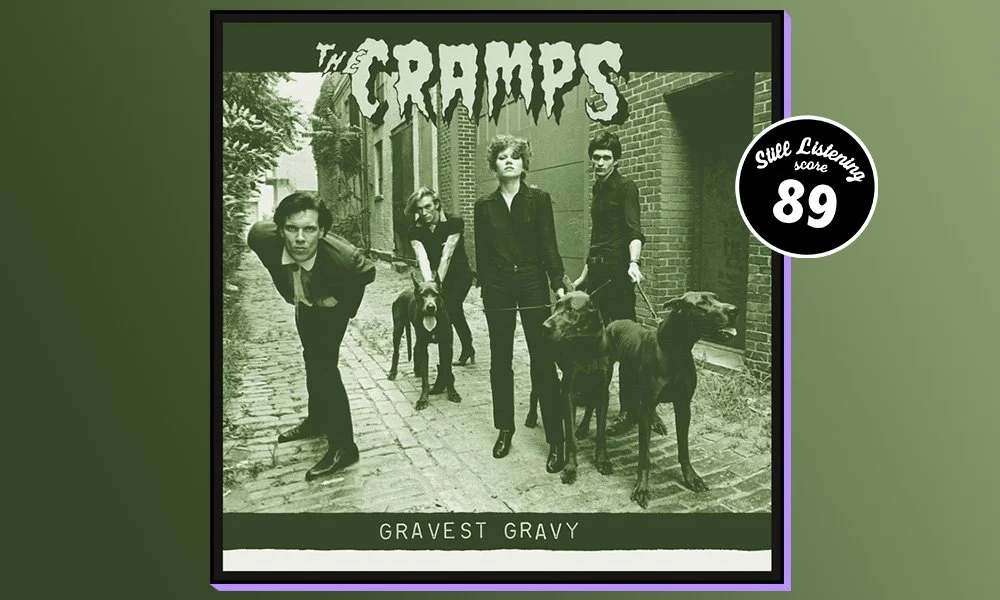
The Cramps are a peculiar animal. To me, they always felt more like a mythological creature than a band. Lux Interior and Poison Ivy seemed like the products of divine, ritualistic meddling, the gravitational pull of ancestral drums and primal incantations fused with the oleaginous sheen of ’50s rock ’n’ roll and the bratty snarl of ’70s punk.
I could never imagine The Cramps as mere mortals, rehearsing songs, choosing setlists and tuning their instruments. Instead, I always figured they were formed by some kind of sonic carbonisation process. A million years’ worth of musical transmogrifications pressed together with ungodly force until they emerged from fiery anthracite and crawled out onto the nearest stage, perfectly formed, effortlessly cool and ready to throw a stick of dynamite up rock ’n’ roll’s arse.
As it happens, The Cramps did have to start somewhere, and that’s pretty much the gist of Gravest Gravy. These never-before-released recordings date all the way back to October 1977, when The Cramps travelled to Ardent Studios in Memphis to work with Alex Chilton of Big Star. At the time, the band consisted of Lux Interior, Poison Ivy, Bryan Gregory and Nick Knox. These early sessions captured The Cramps at their most raw and primitive, before they had fully established the sound and mythology that would make them one of punk’s most enduring cult bands.
A new Cramps release in 2026 was not on my bingo card. Risen from the dead almost half a century after the recordings were made, Gravest Gravy is about as Cramps as a Cramps release could possibly be.
This has all been made possible by Henry Rollins of Black Flag fame. In recent years, Rollins has become something of an elder statesman for all things punk rock, not that he would ever agree. Here, alongside longtime friend and collaborator Ian MacKaye, he has taken it upon himself to right a few wrongs regarding The Cramps’ somewhat chaotic back catalogue.
Having recorded for numerous record companies over the years, many of The Cramps’ recordings have existed in a murky world of reissues, bootlegs and out-of-print releases, with the rights and royalties often disappearing into the moonlit ether.
With Rollins, however, this isn’t simply about business. It’s a labour of love. A lifelong Cramps fanatic, Rollins first saw the band in Washington, D.C., in 1979. “I kind of staggered out of that show and I don’t think I’ve ever recovered.” With this new venture, he seems determined to preserve and properly archive their work. Alongside Ian MacKaye and Poison Ivy, he has helped establish The Cramps Inc., reviving the band’s original Vengeance Records imprint and opening up the vaults for a new generation of releases.
For Cramps fans, this is a dream come true.
Lux and Ivy actually returned to these tapes in 1989, with the intent of releasing them. The album was fully mixed, given a title and even had artwork. It was all ready to go, but for reasons apparently lost to history, the project was shelved.
Nearly 40 years later, the tapes were rediscovered and the project was finally revived.
Gravest Gravy is less an album and more a priceless relic dug up from rock ’n’ roll’s past. Rollins himself likened the discovery to finding a secret tomb beneath Tutankhamun’s tomb, one that escaped the grave robbers because they didn’t even know it existed. Considering the plethora of Cramps bootlegs out there, this is a miracle. You almost feel guilty listening to it.
‘Almost’ being the operative word.
Gravest Gravy begins with ‘TV Set’, a song familiar to Cramps fans. The version found here is a more feral incarnation of the one that would eventually see the light of day on The Cramps’ debut album, Songs the Lord Taught Us. It’s also the song that provided the catalyst for these sessions, having originally been considered an ideal candidate for the band’s debut single. However, Alex Chilton dissuaded the band from merely focusing on a single and instead encouraged them to record ‘everything they knew’.
‘Weekend On Mars’ continues the party. ‘Well, all the boys got real fast cars, I’m gonna take you for a weekend on Mars!’ Lux sings atop Poison Ivy’s razor-sharp chords. It sounds both entirely derivative and like it’s just been beamed down from another planet, pretty much The Cramps in a nutshell.
‘Can’t Hardly Stand It’ is a sleazy gem. A hazy, drunken backbeat bobs and weaves while Lux sings like a thousand volts are being zapped through his body. Pure Cramps perfection. Credit must be given to Chilton’s production, which manages to make it sound like The Cramps are performing right there in your living room. A highly erotic and blood-curdling thought.
‘Can’t Find My Mind’ is another highlight. Guitars buzz around like the meat flies that would eventually find their way onto the iconic ‘Human Fly’. ‘Rockin’ Bones’ is a thing of unhinged beauty, as is ‘Problem Child’. Psychobilly, Halloween rock and trash culture at its absolute finest.
Gravest Gravy ends with the excellent ‘Rocket In My Pocket’. ‘Come on, let’s go someplace where we can rock a bit, I got a rocket in my pocket and the fuse is lit, woo!’ Good, clean fun, as only The Cramps can do.
After the final track ends, we get a snippet of studio tension that’s almost as hilarious as it is terrifying. ‘I don’t want nobody in here fuckin’ fucking me up,’ Lux scolds after being interrupted mid-take. ‘This costs me eighty bucks an hour, please leave!’
The only slight downside to all of this, and I feel it necessary to mention it given the band’s ethos, is the apparent use of AI-assisted imagery in the promotional video for ‘TV Set’. This has already caused something of an uproar amongst Cramps fans. Amid all the hubbub, director Jason Willis has recently denied using AI, but many fans don’t seem to be buying this, and these protestations of innocence have only added more fuel to the fire.
I’m not entirely against AI. Used in the right way, I think it can be a useful creative tool, much like Photoshop or digital editing software. But using generative AI to create visual art is something I find considerably harder to stomach, particularly when it is attached to a band whose entire aesthetic was built upon human creativity and the gloriously imperfect.
If portions of the video are indeed AI slop, then it’s a great shame. Surely there is a host of incredibly talented visual artists who would have loved to get involved with a project like this. It feels like a missed opportunity, particularly when the rest of the release has been handled with such obvious care and reverence.
And if AI hasn’t been used, then why create imagery that imitates it so closely? Hopefully, all of this is something that’ll be reconsidered for future Cramps releases.
But let’s not end on a low.
Overall, this is a joyous occasion for Cramps fans and fans of punk rock in general. Gravest Gravy is a genuine piece of lost rock ’n’ roll history, dragged kicking and screaming from the vaults and finally given the release it deserves.
Nearly half a century after these recordings were made, The Cramps still sound dangerous.
And that, frankly, is bloody brilliant.