
YHWH Nailgun broke out into a hip, arty underground that’s as noteworthy for its careful hedonism (thinkpieces about darkrooms abound) as it is for its self-consciousness.
It should be a contradiction in terms, but here we are: We want to fuck and party before the earth’s house lights finally go up and reveal that the fire exit’s caved in, but the prospect of our shit dance moves and/or gurning being posted up on Instagram stories the next morning has the Instagram-first youth all-too-often opting to stand still. It’s noteworthy when something new comes out of our own borders that makes our stiff crowds move. It’s hard to imagine something like acid house or jungle – entire new genres, cultures, and appropriately named movements – emerging to the kind of earnest mass enthusiasm that defined social movements of old; what we do get, though, are occasional acts that light rooms up, that remind us who care about how we come off too much what we’re capable of when body and music really let loose together. YHWH Nailgun’s debut 45 Pounds answered that need. Still, now, Castrato Raw (Fallback) is the closest that self-conscious art school kids have had to a home-grown dance anthem in years.
The band, committed to something altogether weirder and darker than being a good time, purposefully sabotaged their own upward path with the release of Magazine earlier this year. They’re far from the first band to correct course after finding fame, but it’s noteworthy that YHWH Nailgun went about it in such an understated way. They haven’t over-corrected: It’s not a wholesale rejection of their sound, neither a cynical shitpost nor a totally avant-garde left turn; it’s more of a throat clearance, a quick shaking off of whatever grand expectations their newly ecstatic and entranced fans have gained in order to re-focus on the band’s essence.
The runtime has been halved from their debut, its twenty-odd shaved down to only ten minutes, and the difference is immense: 45 Pounds was hardly long, but where that album was hypnotic, Magazine passes by the passive listener in a flash. Adding to the cutbacks, drummer Pickard totally ditched what were instantly taken to be his signature rototoms; it’s impossible to call his playing anything close to austere, but they lift songs up less, his kit is more solidly stuck to the ground.
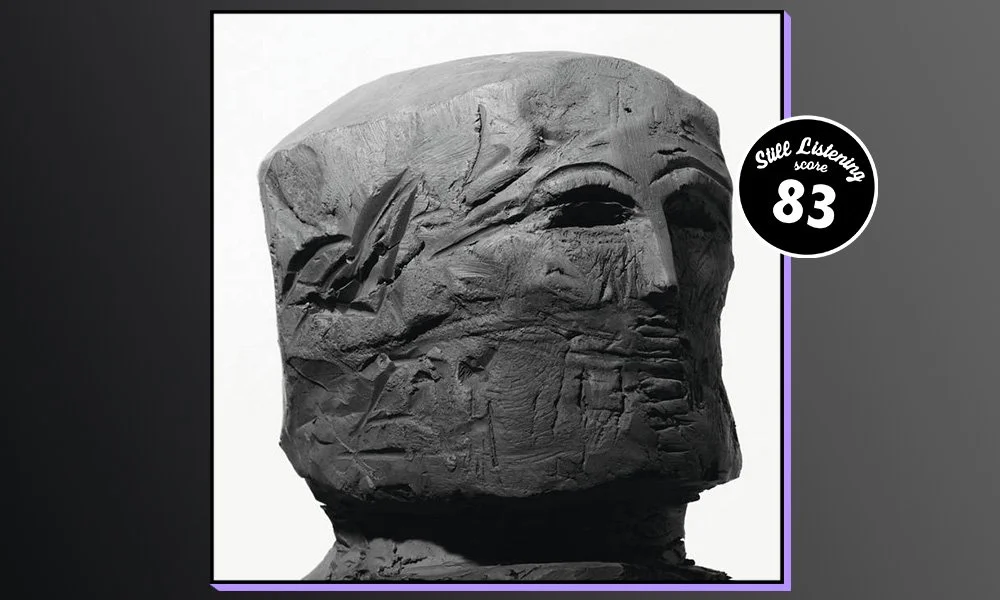
I felt the difference when I saw them at a pop-up show in London in the summer: Magazine’s songs were delivered almost apologetically. They came and went, and were outshone by their earlier offerings, which moved the crowd into a frenzied ecstasy. Listening to Magazine as an album, though, is a tighter, more focused, more grounded, and altogether lonelier experience; I keep coming back to it, egging it on to penetrate deeper into my brain with each listen. The difference is reflected in the albums’ artworks: 45 Pounds is a red haze with a black hole, what you see if you look up at the sun with your eyes closed, encouraging you to swim blindly upwards into that darkness; Magazine, in contrast, has a statue of a head, literally carved out of the ground. Its lacerations resemble speed lines out of a comic, as if showing the aftermath of an onslaught of blades. The songs are short and often end abruptly; vocalist Borzone grunts and sighs through his lyrics in the little time afforded him, and violence abounds: Whether dodged, observed, or perpetrated is unclear, but certainly survived.
Blood, blood, Bleed / Bleed; it’s all over the album. He isn’t making grand statements, but I can’t help but think that the violence that is omnipresent in all of our lives, the imagery of end-times carnage and genocide made diffuse by phone screens, is present in these lyrics. On the titular track, Borzone imitates a machine gun with his mouth. It’s childish and breezy, as is contemporary slaughter. That violence is filtered through Borzone as a person: Details on what he’s gone through, or is going through, aren’t forthcoming, and he feels no need to justify himself through earnest clarity: Enough to know that he bleeds, whether proverbially or literally, and he stands defiant, perhaps defiant even against himself; he imitates a machine-gun, peppering outwards, resisting what comes at him, and he is one with this world that is both being destroyed and destroying itself, as are we.