
The East-London based multi-instrumentalist catches up with Still Listening following the release of his newest single, ‘Last Gasps’.
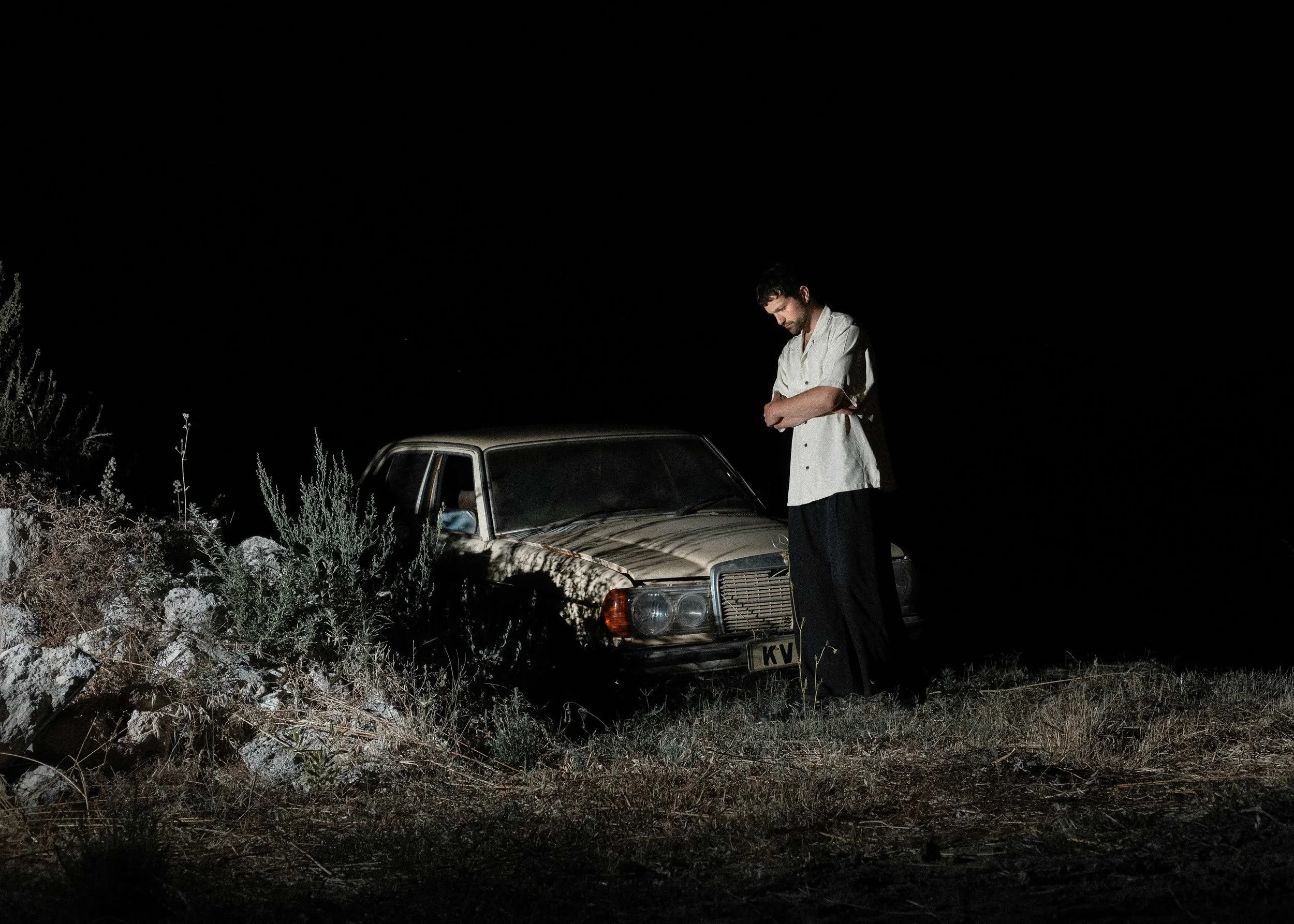
Plenty of artists - particularly those speckled about the wide and deep electronic scene - deal directly and unabashedly in the business of dopamine, in some way or another. Maybe it’s an aggravated attack on the listener’s dendrites, innocently trying to help them see God and accidentally treating them like a rat in the process; maybe they make music on drugs to take drugs to later; maybe they enjoy withholding the beat drop just to remind us of our ratlike nature, and accidentally help us see God. While not totally exempt from indulging in the harmless vice of buildup and payoff, Harvey Causon reframes a beat in the context of electronica as something designed for strictly utilitarian gatherings around a sticky speaker, and moreso an expression of chronically living inside ones’ own mind - try to put the casual pleasure of listening to a beat drop aside, and you’ll see what I mean.
In his 2024 debut album, Square Breath, the Bristol-born, East London-based multi-instrumentalist holds us in a sort of purgatorial corner of his consciousness for 46 minutes (and it made me less scared of purgatory). A cerebrally satisfying sound fused with the embodied indulgence of rhythmic electronic dance music, either mode and any mood feels mediated with a sort of existential long-sightedness that treated each moment as temporary and fickle as they, indeed, are: though as capable of brutalism as it is of shimmer and elegance, Square Breath reckons with a rare sort of this-too-shall-pass uprightness even through its more flailing moments. And such moments certainly pass; the dark, arid default space is oft hacked with tight-air-pressure snares, crumbly dark-ages-PlayStation Pac-Man-y configurations, and light particle-dense synth strobes that occasionally lighten the darkness disorientation, and at others make the confusion feel more chaotic.
Of course, such a nuanced sound was inspired by more than the usual coming-of-age dramatics (think: a guy who’s fascinated by quantum physics, why the hell it has anything to do with us, and entropy through the eyes of a struggling London, etc). That leads us back to my half-earnest thesis: with Causon’s gold-panning lyrics leading the search for the answers (none detected :( - try, try again) working with the room-reading electronics, any dramas dispensed in Square Breath don’t sound like mere mood manipulation, but rather like a natural byproduct of the highs and lows/ebbs and flows ordered by working through one’s purpose amidst immense existential doubt. The result of his suffering, then? A catchy, neon-splashed electronic record rife with steaming-hot beat drops that is, above all else, organic and humane.
Though recently switching gears to the softer-footed, piano-driven sound of his newest single, ‘Last Gasps’, Causon is still building sound around a curiosity-driven core and a tenderness for the ‘organic and humane’: below, he chatted with Still Listening about experimenting with new sounds, honoring past ones, and more.
You've previously made music that's been a little more electronic-oriented, a little more danceable, but Last Gasps was quite different. Even with slightly fewer digital or layered instrumentals, what was surprisingly difficult about pulling off that more stripped-back sound?
I think because it was definitely more stripped back, and I wanted to articulate something that felt closer to home. When I first wrote the song, I didn't want to dress it up in so many electronics because it felt like a very pure track. I think that was probably the hardest thing: not trying to embellish things too much, but using only the elements that would help articulate the song in its purest form.
So, I guess the hardest thing was trying to take things away, not overdo it, and stay true to the original feeling I had when I first wrote it at the piano. It came out very quickly. It's the first song I've written in a while, and the lyrics were there from the first pen, just from sitting at the piano. It felt like an honest song, so I wanted to make sure I wasn't just doing loads of random production, which I can quite easily do now that I spend so many hours learning all these things. That was probably the hardest part.
That makes sense. I honestly loved Square Breath. Don't be ashamed of all the electronic dressing-up. It's very fun.
I think it's fun for certain things. But it was a nice challenge for me as well, just to record the piano really well and get the most out of that sound. I've done that before, but not properly, and I'd had access to a friend's piano. I've been looking after her dinner for about eight months, and it went away last week while I was away, so I'm kind of sad.
It's a £7,000 Yamaha piano, and I properly miked it up and everything. So I need to find a new piano that I can afford.
What do you feel Last Gasps has achieved better than any of your previous songs?
I think its lyrics are very direct and less ambiguous than those in other songs. Hopefully, people can understand and hear what I'm saying more quickly, rather than having to put their own meaning onto things. I don't know if that's a good or bad thing, but I think it's quite clear, and the ideas are easy to understand.
It's quite a ubiquitous theme, I guess: family and parents, people getting older and passing away, and what it's like to suddenly become the carer in a parental relationship, when those roles flip. Hopefully, it's a feeling that translates a bit more easily than some of my other songs.
I'm curious, because I could honestly see it going either way: would you say it's more or less difficult to write ambiguous lyrics, compared with straightforward, direct lyrics that stay very much on theme?
It's harder to write songs with really clear themes, and I think ambiguity can be an easy cop-out. But there's also something really magical about what I love about writing lyrics, which is stream of consciousness: making sense of it afterwards, and having it feel like it captures a little moment. Sometimes it doesn't really make sense, but then it makes sense a couple of months later when you're reading it.
Leaving things ambiguous can be pretty fun, and it can feel abstract in the same way that a weird melody does. I think there are just different things for different times and different places in my work.
Your music is quite exciting and experimental. Are there any recurring ruts you find yourself slipping into that you have to force yourself out of, because you think including them would make the music feel more expected or repetitive?
I think I just like to keep things interesting for myself. What I love about electronic music is the endless inspiration. With pop music, and with synthetic and analogue sounds, it feels like there's an ever-ending source of inspiration. You can process something a million times and it'll come back as something completely different.
I don't feel like I struggle with writer's block, or anything like that. Obviously, some things sound shit and some things sound better than others, but there are just endless things you can do. There are layers of meaning with lyrics and production, and you can fuse those together in different spaces and at different times. I think that helps me avoid getting into a rut. It's about messing things up and using a tiny little feedback delay at the end of processing something so much that it suddenly feels like it's papier-mâchéd itself into something else. I love working with granular processing because it immediately creates randomness. You get a sample and chop up where it's playing from, and I don't know - I think going right down those rabbit holes and then trying to bring it back to songwriting is something I find endlessly interesting. It stops me getting in a rut.
For a slightly less confusing question: name an album you're still listening to from when you first started making music, and explain why it's still important to you or informs the music you make.
Artist: From when I first started making music... To be honest, A Seat at the Table by Solange. I would have stuck that on last night. I just think the space in it all is so incredible, and the songwriting is still quite experimental, but it's also so clear and poppy. I think it's the space in it, the attitude, the drums and the stuff that's quite silly almost at points. It feels like it's not a decision, but it is very much a decision, you know? I think that's probably the one that's stuck around the most. It's a real record you could stick on in lots of different places. Another one is definitely Steve McQueen by Prefab Sprout. It reminds me of my parents and my dad. It has a very nostalgic feel to it, and the songwriting is really interesting and strange, but it still has that '80s voice and the way it's recorded.
I feel like I've definitely heard of it, but I might have heard of it from stalking an interview you did with someone.
Yeah, Prefab Sprout. They're a funny band from the '80s, but they've got some good songs, and they're just weird. 'Bonny' is a song that's travelled with me because it's one of my dad's favourite songs. It reminds me of being a kid, and it's stuck with me through different eras of songwriting.
And then also Amy Winehouse. I feel like this week was a big celebration of Amy Winehouse, and Back to Black is just insane.
In Square Breath, you talked about how your interest in physics had informed the structure of the music - or at least found its way into it. Even if your approach to instrumentation has changed on this recent single, what aspects of your approach to structure have remained the same? What did you learn from that earlier approach that still informs your newer work?
I think the physics stuff was more prominent before Square Breath. Earlier tracks like 'Extended Present' and 'London Stock' were a bit more influenced by my obsession with quantum physics. I think Square Breath was more about - I don't know, maybe it did influence the structure, I'm sure, but it wasn't a conscious decision to bring physics into the making of the music.
It was more led by the meaning of the songs, which was quite social and political, and about love and relationships. They were a bit more macrocosmic, rather than focusing on the abstract and weird things I used to write about.
In terms of what's remained the same structurally, I think it's about using different, interesting ways to lift different sections through songwriting. I always find it quite a weird feeling. I've never really been taught how to do it, or anything. I have friends who really know how to use keys and think about where they're going to go with a chorus or what the options are, and I've never really wanted to know. I love the feeling of how something can resolve or lift in a particular way, through melodies or arrangements - just how things can lift.
I think the biggest thing that's always stayed the same is... there's a Joni Mitchell quote, I think, but I'd have to find it for you. It's something along the lines of: if you haven't resolved the theme by the time you've finished writing the song, then you haven't learned anything from the song. That's probably a misquote. But basically, I think what I took from it is that she goes on these huge research journeys with a song, for herself or literally, physically. By the time you've got to the middle or the end, you've gone on this journey where you've learned something and wrapped it up.
I always like each song I write to have a journey and a sort of storyline, and a... what's the word? Something that feels rounded. A cadence, I guess. But, yeah, I like things to feel wrapped up in a sense.
Has your music ever been described in a way that surprised you?
I get a lot of people, or some journalists, saying that my music is quite dark. Sometimes that takes me by surprise, because for me, sometimes it really isn't dark. But then I can listen back and sort of understand why people would say that. I'm like, ‘Oh yeah, okay, that makes loads of sense.’
I guess the music I release can be quite heavy, or have more information in it, and that's the reason I've wanted to finish those songs. But there are a lot of songs I haven't finished that are much lighter. So sometimes it takes me aback that the music is being read in that way. I feel like writing music is a big way for me to cope with everything and express everything. It feels like a bit of a lifeline at points, and maybe that comes out in the music. But it's not always dark for me, so it's sometimes weird to hear it described like that.
It's not moody for the sake of itself, which is a really good thing.
Yeah, I'm not trying to be a moody person.
What's the best compliment you've ever received about your music?
I guess I can't really pinpoint one. I get a lot of lovely messages online, in DMs or on Instagram every now and then, and they actually mean so much because they remind me to keep going. I've had messages from people who are in a difficult place, or in parts of the world that are war-ridden, or who can't afford to come to a concert, or are scared because there are things happening that are oppressive. I've had conversations with people in DMs who've said they're listening to my music while all of this is happening, and that they like it.
More than anything, that reminds me to keep making music and gives me a lot of inspiration. Those messages always make me feel good.