
Rotterdam four-piece Library Card discuss their debut album, the strange beauty of everyday observations, the city's changing music scene and the emotions that go into their songs.
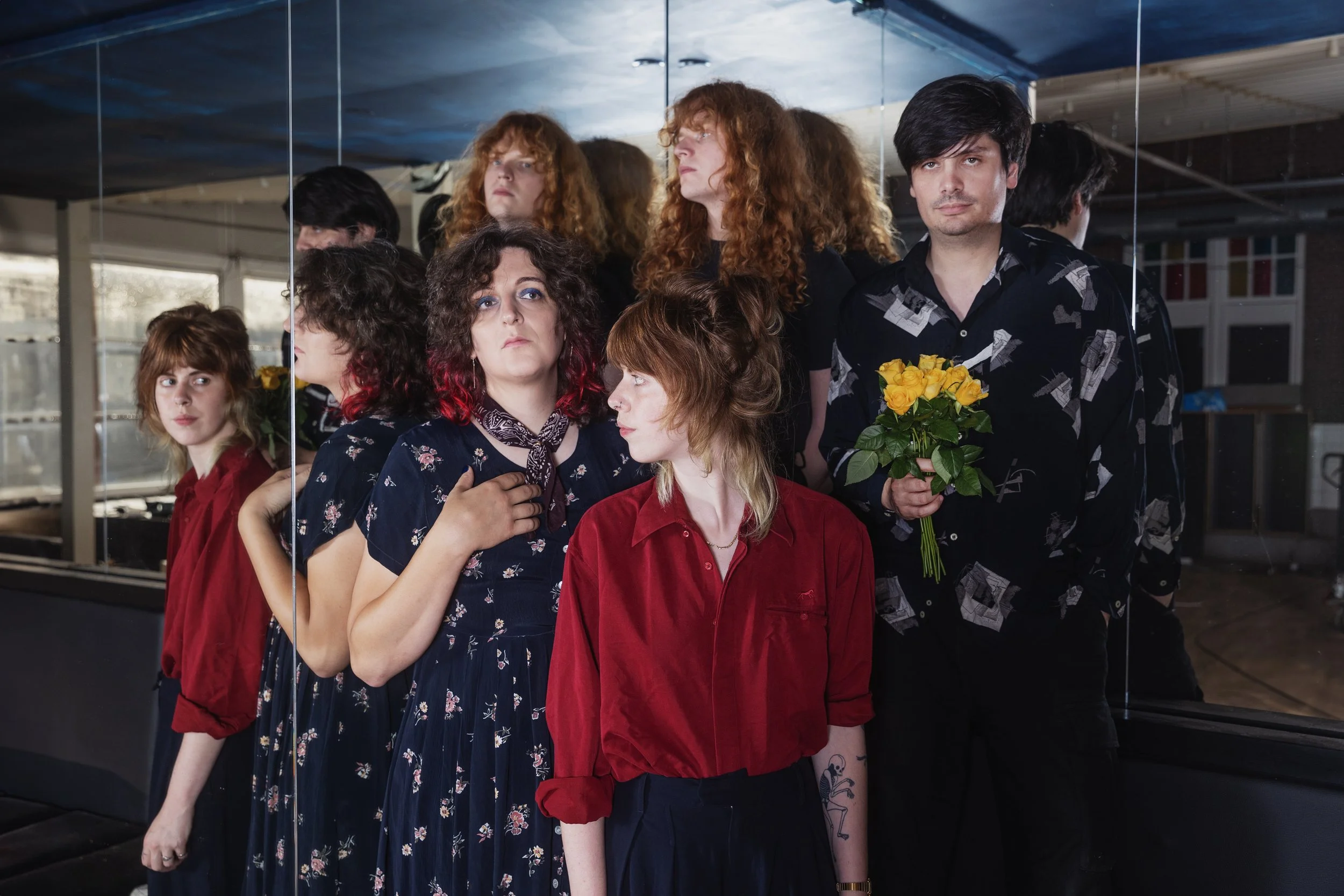
There’s something wonderfully peculiar about the way Library Card approach making music. The Rotterdam four-piece, made up of Mitchell, Lot, Emre and Kat, draw on post-punk, noise rock, spoken word and a host of other influences, with songs that can be funny, unsettling and deeply personal, sometimes all at once. Their debut album, Peeling An Orange In Just One Go, takes its name from the satisfaction of achieving something small and seemingly insignificant, an idea that runs through much of the record's fascination with everyday life. We caught up with all four members to discuss the album, recording drums through a rehearsal room intercom, their relationship with Rotterdam's music scene and why even the smallest victories deserve celebrating.
For those unfamiliar with your music, can you tell us who you are, where you’re from and about the music you make?
We’re Mitchell, Lot, Emre and Kat, also known as Library Card, a band from Rotterdam, the Netherlands. We make loud music, which has often been described as post-punk and spoken word, with math rock, noise rock and post-rock influences. (K)
Kat, you’ve said you don’t feel like a new band anymore, even though this is your debut album. What can the four of you do together now that you couldn’t when you started?
Although there was an immediate musical connection from the first time we made music together, we’re even closer together musically now. Not that we like the same stuff, because we don’t really, like, genre-wise. But we more or less know what each of us contributes to the music as we write new songs. It always takes a while for us to write new songs, because we keep on polishing until we’re all happy with the end result. But we all understand that process now and we’re much more patient with it and give each other more space to experiment. (K)
Peeling An Orange In Just One Go takes its title from a small, fairly useless victory. What made that image feel right for the whole record?
To me it reflects how I see what we've achieved by recording an album. Yes, I'm proud of it and of the result, but it doesn't really feel like it has a big impact on the world. I mean, I won't solve any armed conflicts, cure any horrible disease or stop world hunger with it. It's a small victory, but still one to be proud of. (M)
Looking at very ordinary and boring things through a bit of a warped lens really inspires me and that’s why I pay extra attention to them. When we were discussing the title of the record, I made a list of possible names. Mitchell immediately gravitated towards this one, and I really love it when he gets enthusiastic about things. He’s usually on the right track with these things. I feel like the record shaped itself to the name when we finally decided on it and I think that’s really special. (L)
Lot, you’ve described ‘Breakfast of Champions’ as involving ‘self-imposed naiveté’. What does that mean to you, and when does choosing not to know something become tempting?
I feel like the theme of ‘Breakfast of Champions’ is really an observation in romanticising the mundane. Sometimes we go through periods of time in which nothing seems to make sense, an all-encompassing confusion framed by the horrors of the world as it is right now. In those times I find myself zooming in on small things that catch my attention or spark my curiosity. I think it’s a kind of survival technique. (L)
The opening drums on ‘Breakfast of Champions’ were recorded through the studio intercom. How did that happen, and what made you keep it?
This came to be rather serendipitously. In our rehearsal space, to open the door, you have to be buzzed up through an intercom system, and we have a phone in our room to communicate with the person ringing the bell. But as we play, the vibrations cause the phone to fall off the hook. So when buzzing up, when there are people playing, more often than not you'll hear drums come through the intercom. This was the case when our engineer, Daan Duurland, came to visit to discuss something related to the album, and he suggested we record the intro through the intercom. We liked what we heard, and it made its way onto the album. (E)
‘Out of Context’ deals with feeling like an outsider in the adult world. Can you remember a moment when you caught yourself putting on that performance and wondered who you were trying to convince?
There are so many instances that it’s hard to pick one. I feel like the word ‘adult’ has kind of lost its meaning as we know it, considering the world has changed so much in the last few decades. The meaning of the word is upheld by a lot of conventions that aren’t as clear-cut as they once were. Whether it’s about being able to purchase a house, have a career, have children even, all these things have really changed due to the fact that the context they’re placed in isn’t the same. We all know this, but sometimes it’s still hard to make peace with that and not feel pressured by societal expectations in that sense. (L)
Your writing moves between humour, strange observations and more direct expressions of distress. Does a joke sometimes help you get closer to what you actually want to say?
Sometimes, yes! Finding humour in dire situations can be really helpful to navigate and understand them, and also in relieving a bit of pressure. But apart from that I feel like it’s really important to show a lot of different perspectives in my writing, since nothing is one-sided. (L)
Kat described the scream in ‘People Pleaser’ as something the whole band feels physically. How did you arrive at that moment together, and what was it like recording it?
知るんだよ (M)
Most songs we write start as instrumental jam sessions. How the ending of ‘People Pleaser’ came about I really couldn’t tell. But it’s always a really magical moment when Lot steps in and adds their vocals to it. This particular part of ‘People Pleaser’ is already very intense, one of the loudest things we play in Library Card, and hearing Lot scream in this part just ties it together. (K)
The scream is very cathartic, not only in its volume and intensity, but also in timing. Performing ‘People Pleaser’ is really fun and energetic but it’s also almost like a workout, so when the scream comes you finally have the explosion you’ve been waiting for, the resolution to the building anticipation. (L)
‘Every Ten Minutes’ confronts violence and the experience of not being believed. What did you most want to get across in the song, and how did you approach putting that into words?
Encountering femicide in whatever way, shape or form awakens a very visceral rage and despair in me. It’s almost impossible to put that into a song, but it is even more impossible not to write a song about it. With fascism on a vast and steady rise, the systemic inequalities and injustices only keep increasing and at the very least make me want to crawl out of my skin. With writing the lyrics I’m staying really close to my own experience of living this enraging fear. It’s abhorrent to be confronted time and time again with the fact that just existing as you are means you’re not safe. I’m so tired of being afraid, I’m so tired of having to explain why it’s a horrible aspect of the world to have to wake up to every day. I’m so tired that this very real and very collective experience is still being questioned. It should not be this hard and the people on the receiving end of it should not be the ones taking responsibility or doing emotional labour. (L)
How has Rotterdam shaped the band? Is there a place, a community or even an everyday encounter that you can hear in these songs?
Rotterdam is a city with a pretty specific music scene. Or actually, a couple of scenes, which are also interconnected. When we were younger we spent a lot of time going to shows, playing in different bands, or even working in the local music industry. So it’s very connected. These days we’re less active in the scene. We’re not going to the pub every weekend where we see each other. But we still like seeing each other and connecting. Rotterdam bands like Iguana Death Cult, Tramhaus, the Sweet Release of Death, ebby, Nagasaki Swim, Texoprint, to name a few, are some of those we consider friends. Besides that, there’s always this urge of journalists to ascribe a kind of grittiness to the sound of the bands that has to do with Rotterdam historically being a working-class city, with most people working in the harbour. And, actually, I don’t really buy that. A lot of the musicians from Rotterdam didn’t even grow up here, and almost all of them have nothing to do with the harbour. So yeah, I don’t think that has any effect. But Rotterdam IS a city with a lot of problems. It’s the most modern city in the Netherlands, with tall shiny buildings, constant building, but there’s also a lot of poverty and crime. It’s a very vibrant city with a lot of contrasts. Maybe that somehow translates into the music? Who knows… (K)
I don't feel it really exists anymore, or at least our generation's scene is gone. I think that is mainly because a lot of people from that scene are in their thirties now. But between 2010 and the start of COVID there was a big, lively scene in Rotterdam. If you ask me, it started somewhere around when The Afterveins and Rats on Rafts came up, grew bigger with Iguana Death Cult, The Sweet Release of Death, Cusack, The Lumes and KIEFF, and faded when COVID hit and most of those bands either stopped or went on a long hiatus. Since then, the music scene in Rotterdam has felt kind of scattered. (M)
I’m not really sure if there’s a specific thing about Rotterdam that you can really hear in these songs, but I do love the fact that there’s a very large community surrounding the band scene and that everyone knows each other. There’s a lot of mutual support, and that’s very heartwarming and inspiring. (L)
What do you love right now?
Time off. It gives me more room to get better at all the fun things I like doing. Oh, and Kaneko Ayano. Went to one of their shows in Tokyo and it completely blew me away. (M)
I had the chance to see Madra Salach play twice at Into the Great Wide Open this year, and I've been absolutely obsessed. (E)
There’s a new dimension announced for Minecraft (called ‘the Sift’) and I’m very hyped! (K)
I love looking at the sky when the sun starts going down. First there’s golden hour which makes the world look a little kinder and after it starts painting stripes of pinks, reds and purples in the clouds, washing everything in a warm gradient. Very few things beat an autumn sunset. Nothing calms me like the sky. (L)
What do you hate right now?
Chores, but who doesn't? Specifically right now: doing my taxes. Ugh. (M)
There’s a sense of hopelessness about the future that keeps on getting bigger. War, AI, climate change… It’s hard to live a good, fulfilling life when you’re constantly thinking about those things, so I try not to. But, yeah, I sure do hate it. (K)
The apathy I feel when I think about the current state of the world, and that it can be really hard to stay hopeful sometimes. (L)
Name an album you’re still listening to from when you were younger and why it’s still important to you.
I'm afraid my music taste does a complete 180 every decade, so there isn't really anything from when I was younger that I still listen to. But bands like Sunny Day Real Estate, Braid, Mineral and Rainer Maria (with their best song, ‘Breakfast of Champions’!!!) made a big impact on my angsty teen years, and Protomartyr was very important to me in my twenties. (M)
Revolver – The Beatles
A cool thing about bands with multiple songwriters who appeal to very different types of people is that over time you start to appreciate different sides of the same album. I find this particularly to be the case with any Beatles album. For instance, I was 11 when I heard ‘Yellow Submarine’, and at that age that might be the most accessible thing on there. In my teens and early twenties I couldn't stand the McCartney songs, I felt that music needed to have an edge to it, and so naturally I gravitated towards Lennon's material. Now, I have a new appreciation for McCartney and his style of writing, so it feels ever-changing. George Harrison's work is consistently the best, though. (E)
The first band I really loved was Queen. I recently listened to some of their albums and it’s still amazing (well, not everything, but a lot is). When I went to high school I went through a lot of different phases. Nu metal, emo, punk and finally prog-rock. Of those genres I only really still listen to prog. Although I used to be a Yes fan, now I’m more into Genesis. Their last good album (IMHO), Duke, is a really, really great album and I listen to it a lot. And I’ve always listened to classical music (romantic and modern mostly) and I’ll never stop listening to that. (K)
Halcyon Digest by Deerhunter. It’s one of the few records that I always listen to in its entirety. The way the songs follow each other is so balanced and beautiful. It’s been the soundtrack for a lot of very important phases of my life, and I think it will still be like that in the future. (L)
When someone hears your music for the first time, what do you hope sticks with them?
Honestly, it doesn't really matter what sticks with them. If any emotion sticks at all, that's what makes making music worthwhile to me. (M)
I hope it inspires people to create/be creative. The greatest gift I got from music is that it made me want to play music, so I'd love to pass that on. (E)
When I’m listening to some of our songs I get really hyped. There are so many emotions in them and that’s what I like most about Library Card. It just goes in all different directions. Almost like we’re running in a couple of different directions at the same time. Even though some songs are pretty heavy, I always sense a love for making music and being creative. It’s very rewarding to hear that on the album and if other people feel a bit of that, I’m a very happy person. (K)
I hope they find at least one thing that surprises them. Whether it’s a lyric, a bit of percussion, or a weird accent in the guitar noise doesn’t really matter. I love listening to things that make me go ‘wait, what was that?’, that make you do a double-take. I hope our music sparks that same kind of curiosity. (L)
Photography By: Kelly Alexandre