
Start Listening To: maya ongaku
The Japanese psych-folk trio discuss stepping away from constant touring, building their own creative sanctuary and the philosophy behind Nothing Space Music.
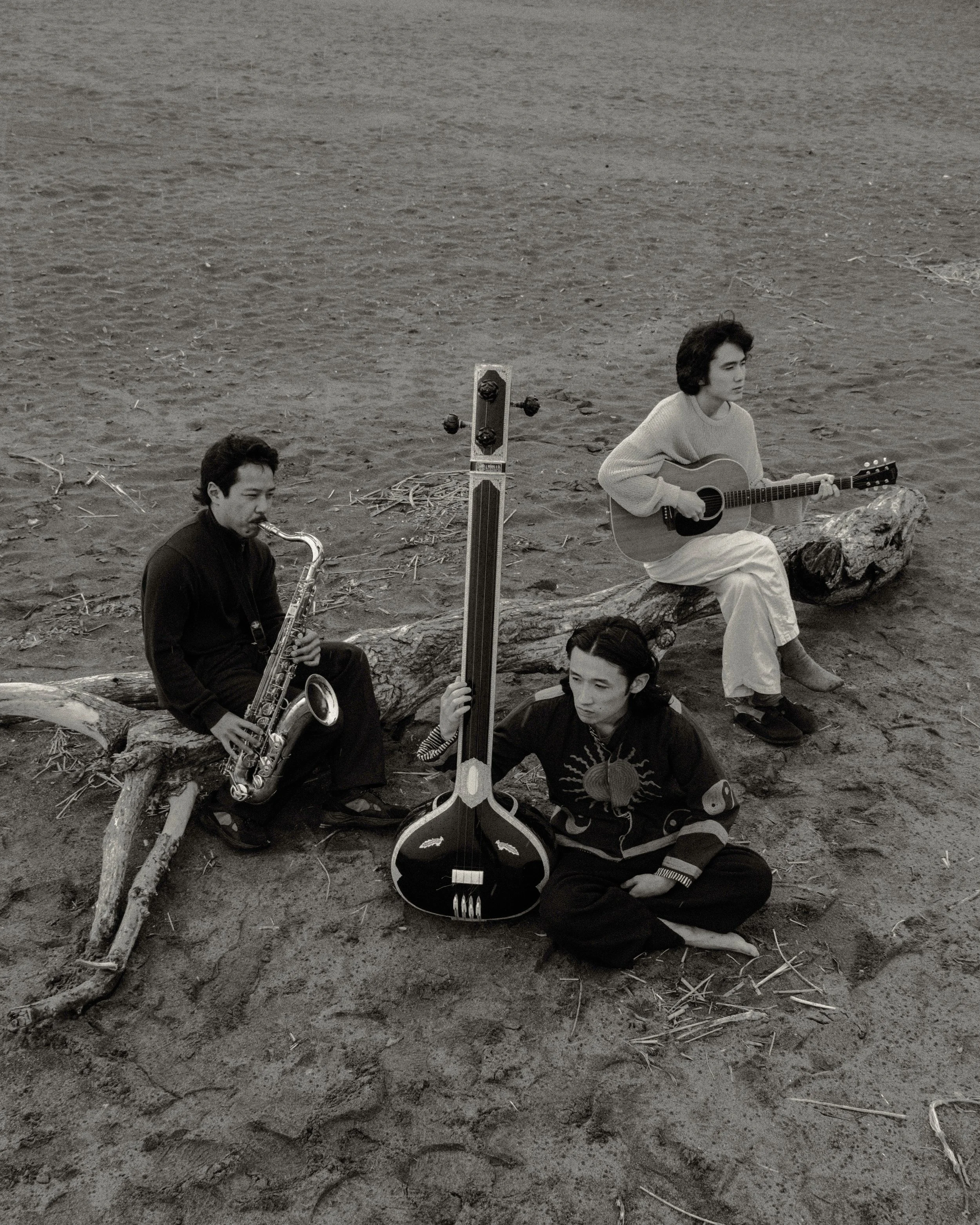
After years of international touring, maya ongaku made a conscious decision to slow down. Retreating to a self-built studio near their hometown of Enoshima, the trio spent months creating Nothing Space Music in near-total isolation, reconnecting with the people, places and ideas that first inspired them. We caught up with the band to discuss "natural emergence", silence, deep human connection and why sometimes the most radical creative act is simply to wait.
For people who don’t yet know maya ongaku’s music, could you tell us what kind of band you are, where you’re from, and what kind of music you create?
We are three childhood friends who formed the band in a coastal town near Enoshima, a mystical island located south of Tokyo. It’s difficult to define our music in words, but we aim to create sounds that blend with nature while also introducing something new.
After spending a long time touring internationally, why did you choose to step away from that “noise” and create Nothing Space Music?
While touring larger venues, playing louder shows, and reaching bigger audiences, we gradually began to feel a sense of discomfort. In order to continue as a band, we needed to confront that feeling.
What emerged was not a desire for fleeting, superficial connections, but for deeper ones—with music, culture, people, nature, and everything we love.
How would you explain the concept of “Nothing Space,” which runs through the entire album, to someone hearing it for the first time?
It is a single space that contains past, present, and future. Within it, boundaries dissolve, and time and matter lose their individuality. Silence and sound, time and space, sky and sea—all exist and do not exist at once. That is the space.
And we believe it is the world we are living in.
You built your own studio near your hometown and created the album in an environment with almost no outside interaction. How did building that space yourselves affect the work?
The process was a continuous musical dialogue between the three of us, gradually dissolving the unconscious boundaries between us. To do that, we needed a sanctuary for creation where no outside presence could enter.
Before making the album, we searched for a place, renovated it from a bare structure, equipped it with gear, and after several months, we were finally able to begin making music.
You’ve described maya ongaku as a band born from “shizen hassei” (natural emergence). Does that still remain at the core of the band, or has your creative process become more intentional and structured over time?
In the flow of continuous band activity, creation inevitably becomes more structured. Schedules begin to prioritize efficiency, and music becomes something made to please others. Within that process, we constantly think about how to preserve “natural emergence.”
For that reason, we have decided to dedicate the first half of 2026 entirely to creation, spending time only in our creative sanctuary.
It is impossible to perfectly preserve “natural emergence” while remaining connected to society. But we can choose not to give up on it. We will continue searching for that way.
“Astral Echoes” is a song about waiting quietly rather than chasing inspiration. In a world that constantly demands new output, has “stopping” or “waiting” become an important part of your creative process?
We believe that a large part of creation is “waiting.”
Not passive waiting, but waiting while preparing to receive. That means living carefully, meditating, aligning mind and body, and deeply loving the world as we perceive it.
Your music carries influences from Japanese folk, psychedelia, and experimental music, yet it doesn’t feel nostalgic. How do you balance respect for the past with your own creative identity?
The musicians we admire from the past were always searching for new sounds. Nostalgia, taken to its end, becomes mere imitation.
We believe true respect lies in approaching music with the same attitude, continuously seeking renewal.
You handled everything yourselves, from recording and mixing to artwork, and didn’t let anyone hear the album until it was finished. Was that complete freedom exciting, or did it ever feel uncertain without outside feedback?
If there is any uncertainty, we see it as space still left for the work to grow.
Doing everything ourselves also means taking full responsibility for the work until the very end. It is the most difficult path, but we believe it is essential for continuing as a band.
You’ve said this album is not just a collection of songs, but a continuous immersive experience. Did that idea influence track order, structure, and even the use of silence between songs?
We see an album not as a collection of songs, but as a 40-minute journey. The history of concept albums left by our predecessors still runs through us, and we believe this is the most beautiful form of the album.
When thinking of it as the creation of a world rather than music production, we treated silence and transitions with the same level of tension as the songs themselves.
The nature and landscapes around Enoshima seem deeply connected to maya ongaku’s identity. Even when you’re not consciously thinking about it, how much do you think that environment influences your music?
We believe it has a very strong influence. We grew up seeing the ocean every day since childhood. Seasons, weather, wind, tides, and the movement of the stars - all of it constantly changes the landscape. No two moments are ever the same.
We want our music to exist within the same kind of living time as that world.
You will soon be performing this album in the UK and across Europe. How do you plan to translate such intimate and meditative music into a live setting?
People sometimes ask, “Will your shows be quiet?” but that is not the intention (laughs).
We are musicians, and we believe musicians are people who explore the relationship between sound and environment. In places that require loud sound, we play accordingly. In spaces where quiet sound can deeply resonate, we place those sounds instead. Responding to each space with the appropriate sound, that is the sensibility we believe musicians need.
What do you love right now?
Deep human connection.
What do you dislike right now?
Domination.
Please name one album you’ve been listening to since you were young and still listen to today. Why is it still important to you?
The Beatles – The White Album.
We believe it represents a moment where experimentation and freedom reached their peak within the form of a band.
What kind of feeling or impression do you hope first-time listeners of maya ongaku’s music will take away?
We simply hope they listen freely, in their own way.
Thank you very much!