
Start Listening To: Sarah Meth
Sarah Meth reflects on the New York encounters, close friendships and confessional songwriting behind her debut album, Something Shameful.
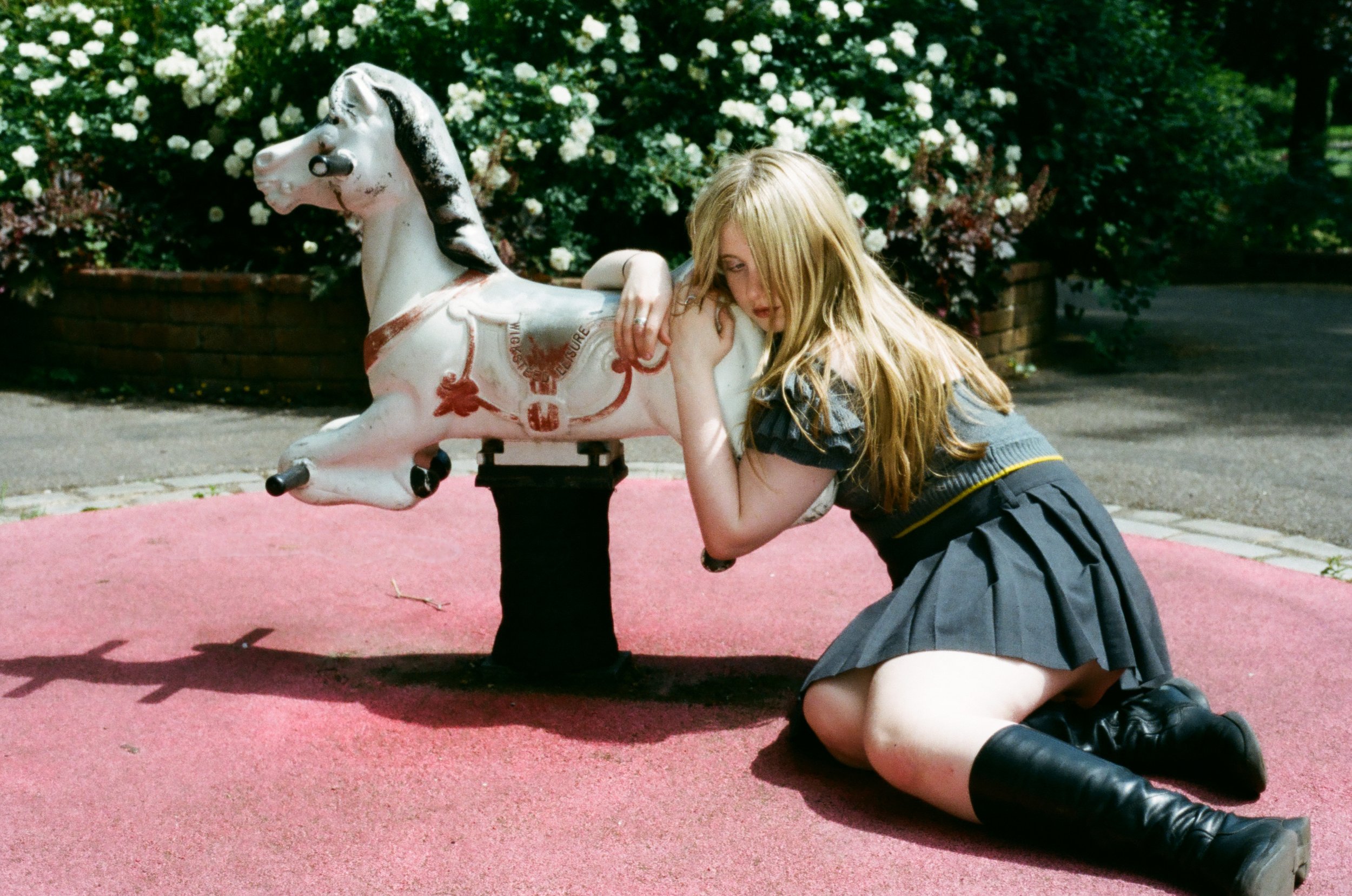
Sarah Meth describes her debut album, Something Shameful, as a leap from ‘lonerist to collaborative’. Bringing together songs she has held onto for years with newer material recorded alongside her band, the record draws on experiences of desire, shame and finding connection, with trips to New York opening up another side of her life and writing. Here, the London musician reflects on the friends who have helped shape her sound, the humour in her most candid songs and what she has learnt about trusting and protecting herself.
For those unfamiliar with your music, can you tell us who you are, where you’re from and about the music you make?
Sarah Meth is the name I was born with contrary to popular belief. I’m originally from North London but I have been living and cemented in South East London for many years now. I make sensitive, tongue-in-cheek musical confessions that are inspired by a variety of sounds and genres. My production tends to be quite lo-fi, but for this album, I recorded with my band at the 4AD studio for some of the songs too. I think this album has been a musical blend of everything live and recorded so far. It’s been my leap from lonerist to collaborative.
With Something Shameful, what did you want your debut album to say about you, and how did you know you were ready to make it?
I wanted the album to say that I am here and I am ready. I’ve released many EPs and demo projects; they’re all special in their own ways and each a little world that got me to where I am now, but there had always felt like a slight gap between my released music and the live show. I also had to live my life for a bit to figure out my setup, sound and reflect on what experiences seemed to impact me enough to write about them. There are some songs on this project that I’ve been saving for my first album for years like ‘Lonely World Girl’, because I always knew that was the pool in which it belonged. Whereas other songs like ‘Horses’ and ‘Don’t touch me’ were pretty late additions, having written them not too long ago.
You went to New York on your own after someone bailed on you, and that trip ended up shaping much of the record. What surprised you about the version of yourself you met there?
I met a bunch of people that first trip who all ended up being main characters in my life at different times…it was a strange period for me. I’d just done my first big support tour and was struggling slightly to adjust to what my real life looked like after that. I was told to hold off playing any more shows in London and went back to my nannying job whilst starting to make the album. The idea of going to NY had been planted in my head by someone offering to take me so when I realised that wasn’t going to happen anytime soon I took a leap of faith and booked it. I find the version of myself when I’m there to be a lot less constrained than the version of me that has lived in London my whole life. There is a certain openness there culturally that I find infectious. I had my first queer experience there. That definitely surprised me. I also like the version of me there, that takes the time to talk to people on the street, or the subway. I’ve had to learn my boundaries with that though. One time I was there I complimented an 80-year-old man’s red nails on the subway who had just been to the opera. I was kind of impressed when he asked me ‘for my insta’ at his fine age and said it was nice to meet him as he got off. Only to receive a DM from him inviting me to a sex party that night! New York is crazy and you just have to laugh. I’ve definitely learnt it can be harsh too. Things there can be fleeting and transactional in a way that’s different to London. But for me, the beauty and curiosity of the city pushes through and always reflects it back to you. London can sometimes make me feel like I’m chasing aspects of my life, but in New York, I’m following where it leads me. Perhaps the version of me there is more present and confident in myself, from discovering the people and places the city has to offer.
What made Something Shameful the right title for this collection of songs? Did your understanding of shame change while you were writing them?
It took a while for me to decide and realise it was a good fit. It felt right because of how overly confessional the album is. I am of course not actually ashamed of these songs or I would not be sharing them. It’s perhaps taking agency over feelings that feel beautiful and ugly and hard to understand sometimes, and delivering them in a way that’s like, this is what living life feels like to me. I’m still not really sure that I have a fixed understanding of what shame is and I guess that’s what the album explores. Shame thrust upon you, shame internalised, shame when it’s all-consuming, shame when it’s lacking and shame when it’s necessary. These songs are a collection of writings in the last 5 years of my life and I think it’s helped process my own relationship to shame for sure.
You’ve said the King Krule tour was where you, Kit and Charlie really secured your sound as a band. What clicked between you on those shows, and how did it affect the songs you wrote afterwards?
The tour definitely threw us into the deep end of figuring out our sound as a live band. Me, Kit and Charlie all went to BRIT School together and they are like family to me. I call them my furniture, because when the Artful Dodger sings ‘consider yourself part of the furniture’ it sums up how I feel about them. They’re fundamental to my life and musical arc. As for our sound as a band. The more tours and shows I’ve done since I’ve realised how musically influenced by all the bands and artists I play with I become, because they all mean a lot to me as people and makers in the world. I think that tour definitely gave me more confidence to play with some noisier sounds with the band whilst still keeping other songs more soft and sensitive. They’re masters at playing with that spectrum and watching it every night felt inspiring and very rewarding. Artists such as him, Jacob (Jerkcurb) and Sorry completely soundtracked my teenage years in London and were all artists that made me want to pick up a pen and write, or a guitar, or my laptop. So having been able to play and collaborate with all of them since has meant a great deal, and have them all be welcoming. I’ll always take that learning and sentiment from them with me!
You spent twelve years singing in a choir, learning by ear and listening to harmony. Do you recognise anything from that experience in the way you write or arrange music now?
Yes, I write completely intuitively with no training in anything aside from standing in this wall of sound every Sunday as a child pretending to sight-read, trusting my musical instincts and feeling a part of something. Harmony is very prevalent in my arrangements and production which I have no doubt is from being in that choir. There isn’t a fixed formula of how I tend to write music, I just know that when something triggers some inspiration and the cogs start to turn in my brain to solve the next musical puzzle, it’s usually when I’m walking somewhere or on the train. So I have to write it down or record myself humming the idea before I forget. Then when I get home and can give it some proper attention, the ideas of how to expand this random voicenote or sentence written in my notes app return like muscle memory.
‘Don’t touch me (you’re my hero)’ draws on your experiences in sessions with powerful male musicians. What did you want to say in that song, and how did you arrive at its humour?
I’ve honestly not done many sessions beyond the ones with my mates I like to collaborate with. I had some less fortunate experiences in that department pretty early on as a teenage girl, which was ultimately what led me to start teaching myself to self-produce. The song is more a commentary on the industry in general and the ambiguity of it all. The song isn’t just about music, it’s about anyone in an industry that has had to question the intentions of the men in power around them. When I wrote it I’d had a week of different things happen that made me feel pissed off and invalidated, so I wrote it on guitar and arrived at Louis [O’Bryen]’s studio after about 2 hours of sleep and feeling quite manic. I played it to him on guitar and said I wanted it to sound more electronic, upbeat and that I heard all these harmonies coming in at the end in my head. He wrote the synth part really quickly, and I just remember going really hyper in the studio because it felt so fundamental to the song and his production was encapsulating exactly how I felt better than I could. That feeling shared is always better than a solo mission. As for the humour: it’s just me being honest!
‘Fun’ takes on casual dating. What were you trying to get off your chest when you wrote it?
Is there really such a thing as casual dating? I wouldn’t be the person to talk to you about that: I’m way too chalant. I wrote it more from a perspective of realising certain patterns in hedonistic choices or behaviours of mine in regard to longing for connection I think ... I don’t know. The need to feel wanted and held for a night by someone who could mean something. The heartbreak and disappointment of realising it can be difficult to find real connection with longevity to a person in that way. But sometimes you can. There is no rule book for intrigue and connection. There probably should be. To answer your question, if anything this song is more about me being a drama queen than anything else.

‘I gave you a shell (because I felt like one)’ is such a particular way of describing a feeling. Do your lyrics tend to begin with a phrase like that, or do those lines emerge as you work out what a song is about?
I think often the phrases will come to me, and I’ll figure out what the song is about based on those. My songs often sound cryptic when they’re really not. I wrote it on the morning-after pill and had physically given someone a shell as a present the night before.
Your Wishbone nights bring friends and collaborators together to perform. What have those evenings given you creatively, and is there a moment from one that has stayed with you?
Wishbone gives me a new way of approaching performance and collaboration from reworking our collective material each time we do one. It grows my confidence and sense of community too. A moment that has stayed with me is probably the Wishbone at Theatreship with Mary in the Junkyard. I didn’t know them before but had spotted Clari come to a few of my shows and knew we were fans of each other’s music. We exchanged lyrics and phone recordings but it wasn’t until the day of the show we met and threw something together. David and Saya were improvising when we sang ‘Brooklyn Bridge’ together. It was the start of a blooming and meaningful friendship to me with all of them. I find their live shows extremely moving and emotional. Wishbone was the first time I’d seen them play and I don’t think I’ve had a dry eye at any of their shows since. Fast forward a year later and I’ve just come back from touring with them!
What do you love right now?
My Captain Hat
What do you hate right now?
Distance
Name an album you’re still listening to from when you were younger and why it’s still important to you?
Moon Safari by Air. It was one of my dad’s classic car CDs and it reminds me of my brother.
You’ve said your identity as an artist feels solidified now. What do you understand about yourself that you wish you’d known when you first started releasing music?
I know now how to trust and protect myself better, and some of that means giving less of myself away. But some of that means remaining open in ways I’ve struggled to be before. Most importantly I think I understand how to follow where my creations lead. I don’t wish I’d known that back then though, because I had to find it out somehow!