
Start Listening To: Supermaus
On ‘San Francisco’, Supermaus explore absence, projection and the emotional weight of places that only exist in the mind.
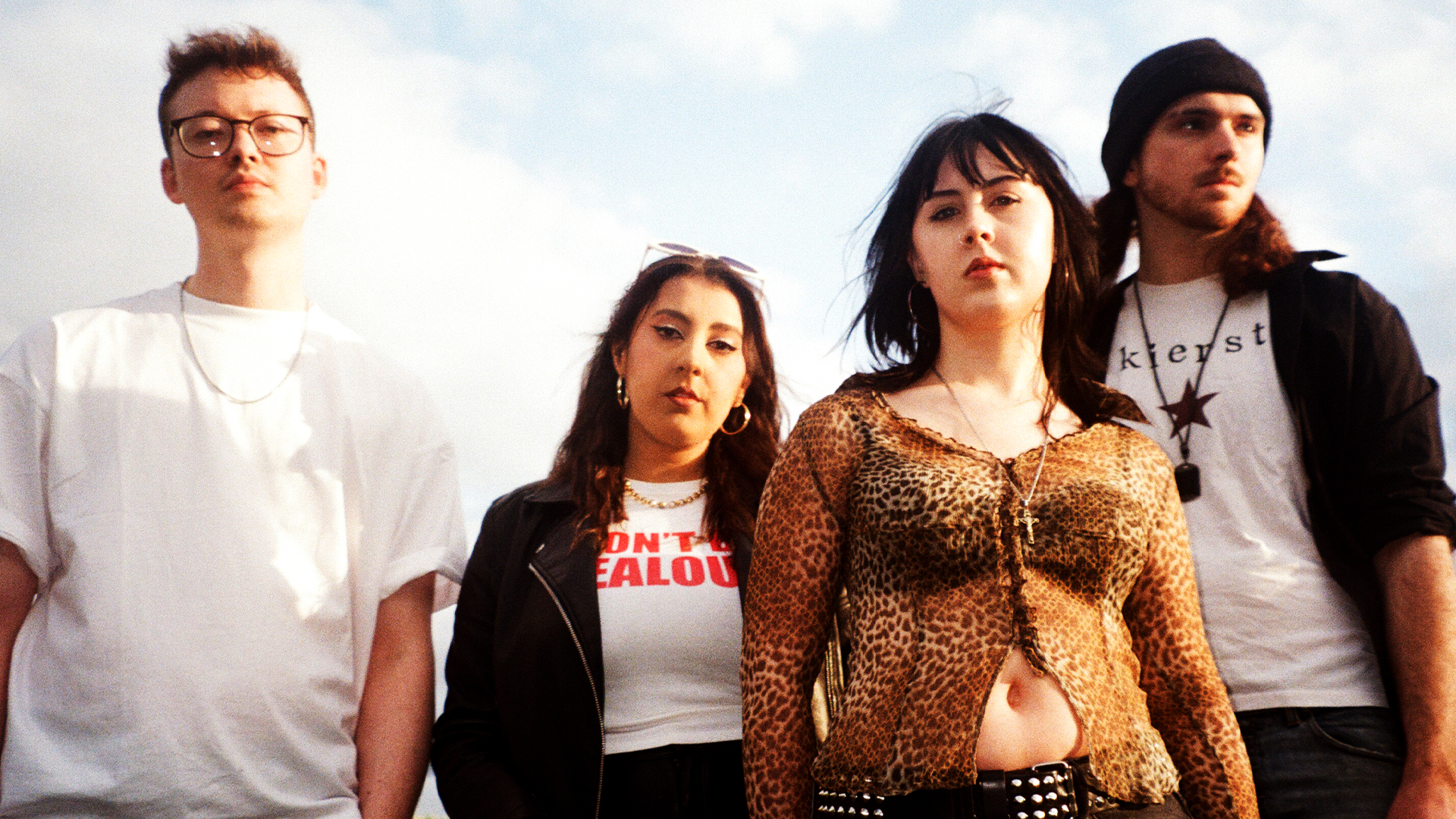
Leeds four-piece Supermaus build their world out of tension, texture and feeling, pulling from grunge and shoegaze to create something that sits just out of reach. Their new single ‘San Francisco’ leans into that instinct, unfolding less like a story and more like a sequence of images, shaped by absence, memory and projection. Taken from their upcoming EP Out of Body, the track captures a band increasingly confident in letting songs breathe, stretch and blur the line between intimacy and intensity.
For those unfamiliar with your music, can you tell us who you are, where you’re from and about the music you make?
Helen (Vocals): We’re Supermaus and alt-rock/grunge-gaze band from Leeds.
We all knew each other from around college and were playing in separate projects at the time. It started with just me and Tom (bass), working on something pretty loosely, and then it gradually grew from there. I ran into Rağna at a New Year’s Eve party and somehow convinced her to join on drums, and then we brought Michael in on guitar to complete the line-up.
‘San Francisco’ feels very cinematic, almost like a series of scenes rather than a straight narrative, how did the song come together?
Helen (Vocals): I think the cinematic side of it comes quite naturally to me when I’m writing. I studied film at Uni and I work as a video editor, so that language is kind of built into how I think. And even though I hate Vincent Gallo (sidenote check out his website it’s such a weird trip in a bad way), I was watching Buffalo ’66 a lot while writing this song which probably seeped into it in some way.
With ‘San Francisco’ I was more interested in writing more as a sequence of images than a neat, linear story. I wasn’t trying to explain a breakup or pin down a single event; I was more interested in residue. The shape someone leaves behind and the way memory isolates certain details and makes them feel bigger than the person themselves.
The city in the track feels more symbolic than real, what drew you to using a place in that way?
Helen (Vocals): I think for me ‘San Francisco’ had a certain mythic quality around it. It’s a place I’ve never been to, but I’ve read a lot of Joan Didion and felt a certain draw to it. In the song it isn’t really functioning as geography so much as projection. I liked the idea of taking a real place and letting it become a container for grief and longing, all those things that become much bigger once they’re attached to somewhere you can point at on a map.
Tom (Bass): We chose San Francisco because "I want to bury my bones in Scunthorpe" didn't have as good a ring to it.
There’s a strong sense of absence running through the song, do you find that distance often shapes how you write?
Helen (Vocals): Yes. I think a lot of my writing starts at the point where something has already become unreachable. Presence is often quite difficult for me to write about plainly, but absence generates images. You start reading into objects, rooms, gestures, all the things that are left behind and that uncertainty, that not quite knowing, is what really shapes how I write.
The line “I want to bury my bones in San Francisco” is pretty striking, what does that idea represent to you?
Helen (Vocals): I should probably come clean that the first version of the lyric was “I want to bury my toes in San Francisco,” which sounded awful. I wanted something darker, something with more weight, and that’s when “bones” came in. The original idea was always about wanting to remain somewhere to stay in the same life without change but taking it to that extreme, where you’re willing to root yourself into a place completely.
There’s a slow-burn quality to the track that really builds tension, how do you know when to hold back and when to let things open up?
Rağna (Drums): It’s all about feeling and knowing when to hold back and when to let loose, understanding the emotional arc of the song. You want to create anticipation, letting the tension build gradually before releasing it in a way that feels earned.
You’ve built a reputation for intense live shows, how does a song like ‘San Francisco’ translate in that setting?
Rağna (Drums): Translating a song like San Francisco to a live setting is all about capturing its emotional core and amplifying it. While the recorded version might have a more introspective vibe, live, it becomes this communal experience where everyone in the room is sharing that sense of longing and connection. We build on the dynamics, creating moments of intensity and release that really resonate with the audience.
Tom (Bass): We’ve moved ‘San Francisco’ around quite a bit in our setlist because of how much contrast there is between its sections. The intro and outro sit at completely opposite ends of the dynamic spectrum, so it’s a great song to place after something quiet, but also right before something heavy. It kind of works as a bridge between them.
The EP is called Out of Body, how does this track fit into the wider themes of the EP?
Helen (Vocals): It fits quite naturally because the whole EP circles disconnection in different forms, from other people, from your own body, from any stable sense of where you are. ‘San Francisco’ is probably the song where that becomes most mythic. It takes emotional dislocation and gives it a landscape. The movement in the song sounds outward, but really, it’s about someone becoming more and more trapped inside their own projection.
Your music often deals with longing and emotional dislocation, do those themes come naturally or are they something you consciously return to?
Helen (Vocals): I don’t think it’s something I consciously return to, it just seems to be where my writing naturally sits. Longing and dislocation feel quite tied to perception for me. It’s that sense of things not quite lining up with how you remember or imagined them and trying to make sense of that gap.
Tom (Bass): The idea of emotional dislocation is almost a precursor to being born into the generation that we were born into, the world is on fire, and people mention it were told we are wrong for doing so. Art in any capacity is political, no matter how hard you attempt to detach it. because those creating the art are innately affected by the political environment in which they live. So, regardless of whether the longing and emotional dislocation is conscious, it will inevitably make its way into our music.
You’ve been steadily building momentum through support slots and live shows, how has that shaped your identity as a band so far?
Rağna (Drums): All those support slots and live shows have really shaped who we are as a band. Watching other bands perform at that level pushes you to step up and really work on your craft. It’s made us tighter, more confident, and more connected to the people watching.
Tom (Bass): We've gotten really good at playing support slots.
With ‘San Francisco’ as the final single, what do you want people to take away before hearing the full EP?
Helen (Vocals): If anything, I’d want people to sit with that feeling of ‘San Francisco’ rather than try to resolve it. The EP doesn’t really offer clean answers, it’s more about staying inside those moments of dislocation and seeing what comes out of them.
What do you love right now?
Tom (Bass): The independent music scene in the north of England (especially Leeds) is incredible right now. What’s even better is that people of all different ages and backgrounds are showing up and just enjoying it together.
There’s this older guy who comes to our shows, always in a battle jacket. Every time we finish, he takes one of our setlists. One day I’ll find out what he’s doing with them.
Helen (Vocals): Mini eggs.
What do you hate right now?
Helen (Vocals): Not to get too heavy with it, but I think it just comes back to the way things feel right now. There’s a lot of hostility in the world, and it’s hard not to absorb that.
So, I guess, in a very simple way, we just hate hate.
Name an album you’re still listening to from when you were younger and why it’s still important to you?
Helen (Vocals): I feel like I cycle through albums quite quickly, so this was a hard one. I’d probably come back to Pet Sounds by The Beach Boys. I was actually in the top 0.005% of their listeners one year. I love how it manages to feel so deeply melancholic and existential, but also strangely uplifting at the same time, also Brian Wilson was just a genius, and I find him very inspirational, even if he did once say in an interview ‘Norbit’ was his favourite film.
Tom (Bass): Bad Magic by Motörhead has been a constant since I was about five. My mum used to play it on vinyl, and me and my sisters would jump around the sofa while Lemmy growled through “Victory or Die.” I don’t write like Motörhead in Supermaus, but Lemmy’s always been my biggest influence as a bassist. If you listen closely, some of that probably comes through. In the band, we all kind of shape the sound in different ways: Helen brings the melancholy, Michael brings the complexity, Rağna brings the dynamics, and I make it heavier.
Rağna (Drums): In Rainbows by Radiohead. It perfectly balances experimental sounds with emotional songwriting. Thom Yorke’s voice and lyrics blend paranoia and romanticism in such a powerful way. The way it mixes complex rhythms and textures with themes of love, loss, and uncertainty has always stuck with me. And the pay-what-you-want release felt completely revolutionary at the time.
When someone hears your music for the first time, what do you hope sticks with them?
Tom (Bass): I just hope they feel something. If they feel anything at all, then we’ve done our job. Music is meant to evoke emotion, but we don’t get to choose what that is.
If it makes someone feel excited, I hope that sticks. If it makes them feel sad, I hope that sticks. If it makes them feel a deep, murderous hatred for me specifically… they can probably let that one go and maybe pursue therapy…
Rağna (Drums): I want them to feel like they're not just listening to a song but experiencing a genuine connection with something real. And if it sparks something within them, makes them think or feel something deeply, then I know we've done our job.
Helen (Vocals): I hope it leaves some kind of afterimage. Not even necessarily a specific lyric or riff, just a feeling that lingers once the song’s finished.