
A Beginners Guide to Joni Mitchell: Where to Start
Have you been meaning to check out Joni Mitchell but just don’t know where to start? Look no further, here’s your guide to the wonderful world of Joni Mitchell.
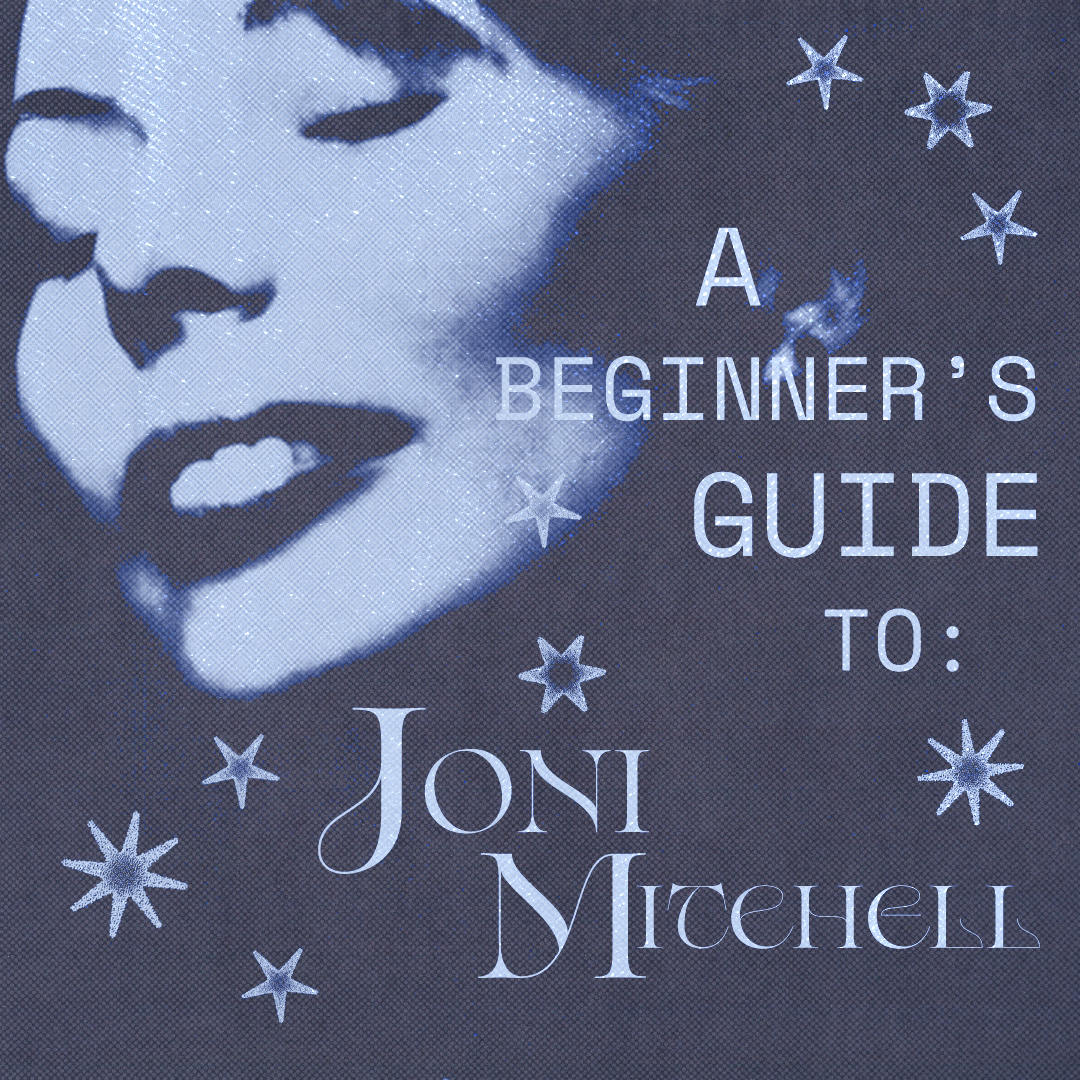
Joni Mitchell is one of the most significant artists in shaping how music sounds today. Her influence stretches across genres and she has more awards than most artists could dream of but, with nearly twenty albums in her discography, it can be quite intimidating trying to get into her work.
When thinking of Mitchell’s career, I find it quite interesting to compare her to her Canadian musical counterpart, Leonard Cohen. Both artists started their careers in the singer-songwriter scene of the late ’60s before developing their sound and experimenting with jazz, ’80s pop and more, creating new cycles of their own artistry. I’ll be going through all of Mitchell’s eras and letting you know which albums are essential and what makes her one of the greatest artists of all time.
Where to Start: Blue
With Mitchell, there’s only one place you can start. It’s an album that most immediately think of when the name Joni Mitchell is mentioned, an album that many see as her best and an absolute ’70s staple. Of course, it’s Blue.
Blue is Mitchell’s fourth album, released in 1971, and it’s a record that you always see crop up on best albums of all time lists. It is the culmination of the singer-songwriter folk sound that Mitchell had been exploring on her previous three albums. This album came after her break-up with singer Graham Nash and during her relationship with James Taylor, who was suffering from depression and addiction.
This is an absolute classic album with some of her most notable songs like ‘Carey’, ‘California’ and ‘River’. There’s Mitchell’s iconic slapping guitar style across the album and beautiful piano passages that are hard not to get lost in. The lyrics look at the complexities of love, the backdrop of the Vietnam War and references to Mitchell’s past.
One of the most interesting things about Blue’s instrumentation is the use of the Appalachian dulcimer on tracks like ‘California’, ‘All I Want’ and ‘A Case of You’. This zither instrument has such a unique, almost droning sound that works so well on Mitchell’s tracks and it’s an ode to traditional folk music in the US.
Personal highlights for me are tracks like ‘River’, which interpolates the classic Christmas tune ‘Jingle Bells’ and has the wonderful refrain throughout of, ‘I wish I had a river’. I often find it funny that this is retrospectively seen as a Christmas song even though Mitchell released it in June, which couldn’t be further away from the Christmas season. I will say though, if we’re counting this as a Christmas song, it’s easily one of my favourites.
The Early Singer-Songwriter Years
Once you’ve been sitting with Blue and feel ready to explore more of Mitchell’s work, it’s time to really dive into the singer-songwriter arc of Joni Mitchell. For this, it’s important to head back in time to her first three albums that preceded Blue: Song to a Seagull, Clouds and Ladies of the Canyon.
All three of these are well worth listening to as you hear Mitchell develop as a songwriter but, if you only want to listen to one, the essential Mitchell album from this time has to be Clouds. It has songs like ‘Chelsea Morning’, ‘I Don’t Know Where I Stand’ and what, in my opinion, is Mitchell’s greatest song, ‘Both Sides, Now’.
Her songwriting on this album is so impressive and it will help you realise why she has become one of the most covered artists of all time. ‘Both Sides, Now’, in particular, is her most covered song, having been recorded by hundreds of different artists. With the release of Clouds, Mitchell started to gain a following within this scene that only expanded with Ladies of the Canyon and Blue.
Ladies of the Canyon is a beautiful album with some of Mitchell’s most notable tracks like ‘Woodstock’ and perhaps her biggest song, ‘Big Yellow Taxi’. It feels more fleshed out and richer than her two previous albums but doesn’t quite have the charm Clouds has.
Her debut Song to a Seagull is a remarkable debut but still remains quite raw and underdeveloped in places. The opening and closing tracks, ‘I Had a King’ and ‘Cactus Tree’, are standouts on this.
Moving Beyond Blue
After familiarising yourself with Mitchell’s singer-songwriter era, it’s time to dive into her music post-Blue. With an album as big and impactful as Blue, it’s tough to follow it up, but Mitchell makes a fantastic effort with the two albums For the Roses and Court and Spark.
For the Roses is one of the first times that we see Mitchell explore a jazzier approach to her music while still firmly remaining in the singer-songwriter bracket. The album contains the humorous ‘You Turn Me On I’m a Radio’ and ‘Electricity’, which is another standout.
Court and Spark takes the jazz influences seen in For the Roses and expands on them further. This album is up there with Blue as one of her most commercially successful, helped by the popular single ‘Help Me’, which showcases Mitchell’s fantastic vocals.
Between this and For the Roses, I would say that Court and Spark is the essential listen, but both albums are worth checking out.
The Jazz Years
After Court and Spark, Mitchell steps further away from the singer-songwriter sound that began her career and truly embraces the jazz influences that she had been incorporating into her previous two albums. This sound would come to define much of her late-’70s period and the next album, The Hissing of Summer Lawns, is a great example of this as she experiments with her sound further than ever before.
The 1975 album The Hissing of Summer Lawns is a genre-breaking, unconventional album that explores elements of the avant-garde around pop and jazz music. There’s the introduction of synthesisers on here, while ‘The Jungle Line’ makes striking use of a recording of the Drummers of Burundi. ‘In France They Kiss on Main Street’ is a standout and the album often deals with themes of patriarchy alongside quite loose, stream-of-consciousness lyrics.
The album also sees the influence of Black music and culture becoming increasingly apparent in Mitchell’s work, something that would become much more controversial on later albums.
Before this though, we have Hejira, the 1976 folk-jazz record which is a personal favourite of mine from Mitchell. It’s a perfection of the jazz sound that Mitchell had been experimenting with over previous albums and was written while travelling through America. Due to this, there’s a real sense of movement to the album and no song ever feels settled. There’s almost an unease to the listening experience, but it makes you feel like you’re right there with Mitchell on this journey.
Songs like ‘Coyote’, ‘Blue Motel Room’ and ‘Amelia’ are some of her best. The backing musicians on here, like Larry Carlton, Bobbye Hall and Jaco Pastorius, help make this album into the classic it is. It’s the type of album that needs multiple listens to fully understand and, over time, it’s one that I feel grows on the listener. I see this as the pinnacle of her jazz era and one of the best albums of the ’70s.
After the success of Hejira, Mitchell released her next album Don Juan’s Reckless Daughter the following year. This album is a lot looser than its predecessor but continues the same experimental jazz sound. As a double album, it was the longest album that she had released by this point, with tracks like ‘Paprika Plains’ reaching over ten minutes long.
Unfortunately, this album and this period in general are overshadowed by Mitchell’s problematic relationship with Black music and culture. The cover artwork featured Mitchell in blackface as a character she called Art Nouveau. The racist portrayal has understandably received considerable criticism in the years since and is difficult to separate from this period of her work, particularly as Mitchell was increasingly drawing from Black American musical traditions.
Mitchell followed Don Juan’s Reckless Daughter with Mingus, a collaborative album between her and jazz legend Charles Mingus. This album pushes Mitchell’s jazz sound further and it’s one of her most experimental and, at times, challenging albums to listen to. There are spoken-word passages throughout the album too and Herbie Hancock is among the musicians involved.
Joni Mitchell in the ’80s
As we move into the ’80s, Mitchell develops her sound further, similar to how Cohen developed his sound during the decade, exploring the pop music of the time.
During this period, Mitchell released three albums: Wild Things Run Fast, Dog Eat Dog and Chalk Mark in a Rain Storm. The latter is a more laid-back album but features duets with the likes of Billy Idol, Tom Petty, Willie Nelson and Peter Gabriel.
The Later Years
The ’90s saw Mitchell return towards her singer-songwriter and folk roots with the albums Night Ride Home, Turbulent Indigo and Taming the Tiger. Out of these three, Turbulent Indigo is a must-listen, with Mitchell winning the Grammy for Best Pop Album. Taming the Tiger would then be followed by a near decade-long break from releasing new original material.
During this period, Mitchell released Both Sides Now, which sees her cover some of her own tracks as well as other jazz pieces with her now raspier voice. The new version of ‘Both Sides, Now’ is beautiful and seems to hold all of the experience and wisdom she had gained since its first release.
In 2002, Mitchell released Travelogue, an orchestral album featuring new interpretations of her own songs in a similar way to Both Sides Now. Her final studio album of original material is Shine, released in 2007, which saw her return to writing with a brand new set of songs.
Overall, I hope this has helped to give people who are interested in listening to Joni Mitchell the motivation to do so. While she has a big discography, her music is always evolving and well worth sitting with.