
Death Grips (were) online
Death Grips and you on the new internet.
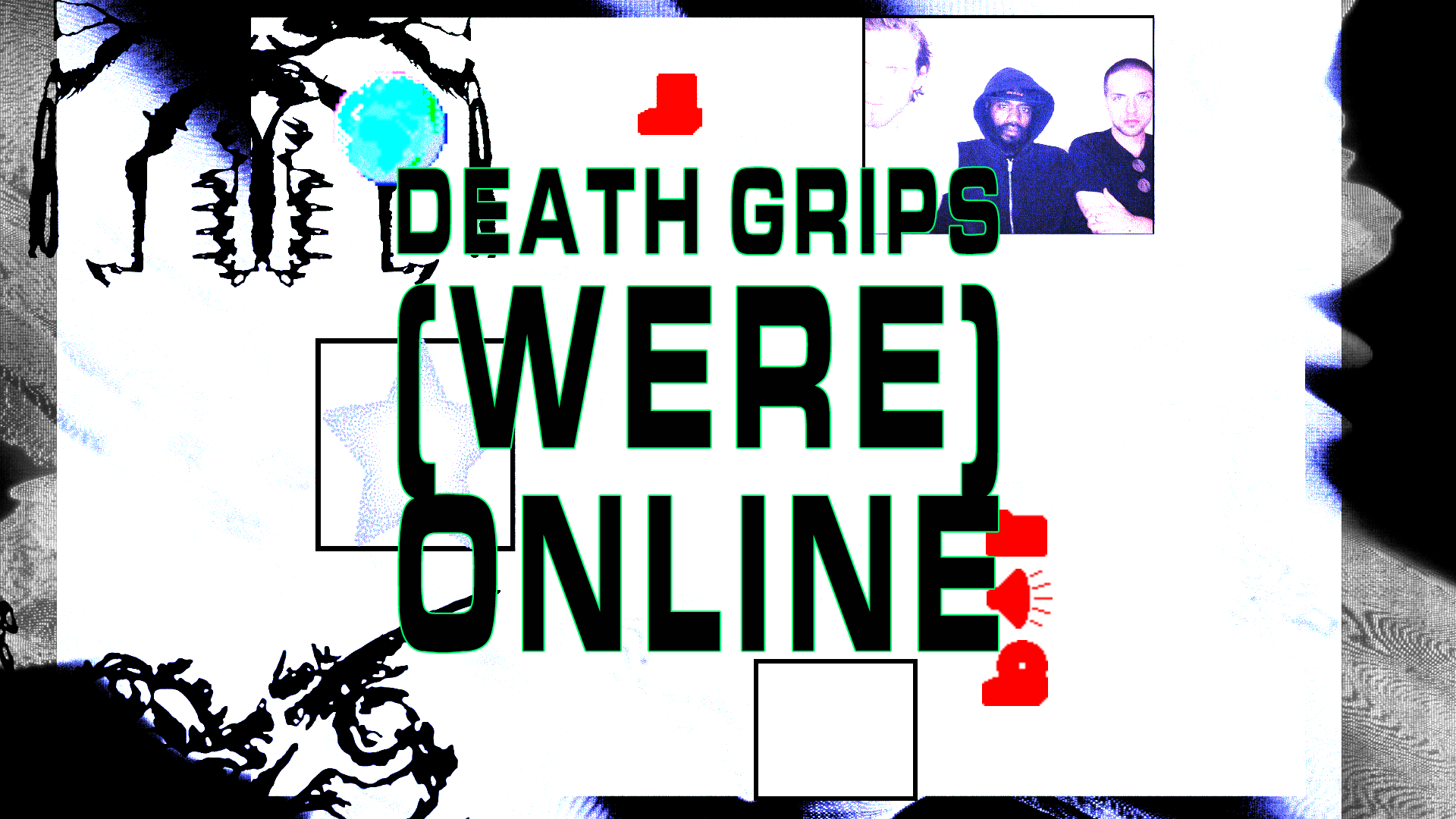
Before it became common knowledge that the internet is dangerous, the internet felt dangerous, and that distinction matters when you’re 16. I’m going to go out on a limb and assume that it’s common knowledge even among teens that vaping messes your lungs up–plus I can’t believe that sucking on those pacifiers can be attractive to anyone, so you don’t get the French chain-smoking philosopher appeal either. Being a teen ripping a vape that you got from the corner shop that’ll sell you one without ID must feel a bit shameful, not just to your parents but to your peers. There goes Mitch who needs his hit, would probably be a popular call-out for a kid trying to hide his sucking on plastic if eighty percent of the teens around him weren’t on the same juice. (I’m 31 and basing this off observations of youths at all-ages shows at the New Cross Inn, which I pass by on the way to my flat sometimes. Please write in and correct me if vaping is actually cool.)
It’s not the same vibe as puffing a joint in-between suppressed coughs and giggles, knowing that what you’re doing is both the coolest thing ever and grounds for suspension from the adults that are chained to archaic rules, ones sent down to them by a society you haven’t fully entered yet. That’s how the internet used to feel–going online meant to visit a place, or a collection of places, which you escaped into away from society’s oppressive gaze, where you experienced back-alley thrills that were truer to life than whatever was outside. We didn’t know how much it was all fucking us up, then–we heard a lot of chat about it wrecking us; our attention spans, our language, our dress sense; but we didn’t believe the scaremongering, not really, not when we were having experiences that previous generations could only dream of.
It’s different now. It’s cool, now, to be offline, because online’s the default. To find freaks whose minds had been melted by exposure and addiction, you had to go search for them. Now you don’t have to look much farther than your parents; they’re probably viewing some AI-generated conspiracy theory slop right now. Brain damage used to come from the low, from sick bastards who posted a veteran blowing his head off on the 4chan imageboard; you had to take a risk, where now we’re all slowly frying away to fund techbro superyacht lifestyles. The brain damage isn’t as violent, maybe, but it’s more total.
When on 4chan back in the day, it felt like you were part of something important. It felt like a radical project of free expression (if you were a straight, heterosexual white dude) and cultural movement. The site’s music board (/mu/) had traction that reverberated worldwide (that can be felt to this day); that the site also hosted a neo-Nazi cesspit (/pol/) felt like a trade-off, necessary for having an online underground. Not to labour the point, but today normies post alongside neo-Nazis on Substack, Instagram, and twitter because we all don’t have a choice.
Death Grips came out of that bountiful, edgy atmosphere on the internet, out of what felt like the cultural forefront. Their music was rooted (more or less) in hip hop, but also pulling from a thousand other sonic influences. To a regular listener the sound was incomprehensible, but if you were online–abnormably online–it resonated. If you were a regular on 4chan’s /mu/ it meant you were listening to electronica, folk, backpacker hip hop, hardcore, post-rock, harsh noise–all in one big cultural soup. You kept up with the pretentious userbase by virtue of open-mindedness and dedicated nerdiness. It also meant you’d probably seen someone blowing his own head off with a shotgun and/or someone vomiting onto a dildo, probably within about thirty seconds of each other on a misjudged excursion to the wrong board, or because some shitposter posted gore before (eventually) getting sniped by a moderator.
Here came Death Grips, blasting out of the gate in 2011 on their breakout mixtape Exmilitary, an album that quickly became synonymous with that forum. It laid out their mission statement, which they didn’t steer away from for the rest of their career: Making mature music for immature music nerds who’ve seen some traumatizing shit. Knuckle-dragging bonehead shit that was simultaneously thought-provoking high-art. I Want It I Need It sampled and corrupted Pink Floyd for an ode to delirious chemsex. Klink, sampling Black Flag’s Rise Above for a track telling the police to “fuck off” and not much else (complimentary) with a breakbeat that sounded like a street performer banging pots & pans (complimentary), came right before Culture Shock, which sounds like hip hop’s answer to Detroit techno with lyrics out of a futurist poetry book. Tape opener Beware transgressed by romanticising Charles Manson, sampling one of his prison interviews for its stunning intro. It then blew apart any potential criticism with an instrumental and lyricism that made overdosing in a shit-covered cubicle feel like a spiritual exercise. They then knocked the chair out from underneath that beauty for Guillotine, one of their (many) tracks referencing hanging, which had one of the most iconic and unsettling basslines of the 2010s. The kids who were frying their brains were being rewarded for their sacrifice.
From the jump, themes of drugs and death covered their lyric sheets like rorschach tests made of blood and puke. Listeners deciphering their more cryptic lyricism or imagery will mostly find heinous and/or violent shit. I’ve always thought that the opening to the video for Takyon (Death Yon) subtly and purposefully evokes the Columbine massacre. Punk Weight is about steroids and NO LOVE is probably about wanting to kill yourself because of them, taking out a whole dive bar’s worth of men on your way down.
Cultural obsession with violence is nothing new, but how Death Grips reflected it was. For Death Grips, violence came up at you in snapshots: Stolen glances at crack addicts in your neighbourhood or, more often, images and videos you’d see online. It’s no wonder that Philly death metal outfit Pissgrave caught like a match in the same online hipster circles that championed Death Grips when Suicide Euphoria came out in 2013. Death metal is typically associated with fantasies of violence, it’s a bit tongue-in-cheek–but with Pissgrave, that album cover is definitely a real body, likely nicked from some backwater site.
Just like that corner of the internet, Death Grips were also funny as fuck. A Pitchfork review I read, written towards the end of their career, said that they “made every effort to fuck up their own career”, but we’re both aware that that’s exactly why they succeeded; anyone trying too hard to succeed on the internet back then was discarded as uncool. ‘Influencers’ weren’t really a thing yet; there were, for the most part, industry celebrities and accidental celebrities. Death Grips were actively hostile to their fanbase when active hostility was cool (and so, aspirational): Notorious no-shows like the time that their fans trashed their equipment at Lollapalooza; having a massive high-def photo of a (pretty unappetizing) penis with NO LOVE DEEP WEB written on it in sharpie as the album cover; breaking up by posting a note on a piece of toilet paper on Facebook.
In today’s internet where shock value translates to real value, where any graduate from Hustlers University would post their own dick with a shitcoin’s name written on it if it would make them a bag, I’m not sure if their approach would have the same impact. When I saw that aforementioned dick take up my whole laptop screen as a teenager when I entered thirdworlds.net to download the album for free (because they’d purposefully leaked it during a dispute with their label), it felt revolutionary.
Their clearest offering to any bemused would-be fans they ever made was their 2012 track I’ve Seen Footage, which should be on any respectable “best songs of the 2010s” list. Runs through flashes of images (Little tiger, boy soldier), flashes of violence (Armored cop open fired glock / On some kid who stepped so), and stresses that it makes you paranoid (Creeps up behind me / Over my shoulder / Turn to look but it’s / Nowhere); but it’s worth it, because it’s like nothing we’ve ever felt before. Just listen to those synths screaming like a guitar: The track brings us to the highest, most euphoric peaks of rave without inviting us to leave our bedrooms. Staying inside on your computer was the new radical party. Ravers in the 90s had ecstasy in squats, and we had shitposting at home. Different highs, but all potent, all important.
The promises of anonymity in a digital playground and of surfing vast seas of art and information for enlightenment have been replaced: We are now, all of us, constantly, online, on display, our personal information lit up in neon lights, our minds controlled by corporations and by each other, what was once liberating now keeping us in line. We’ve become overstimulated, addicted to cynically created algorithms that are frying our ability to experience culture with any navigational skills; fewer of us are nerds, we’re more passive than ever. We’re listening to automatically generated Spotify playlists and mainlining ideologies in bed to soothe our brains. Anger is as widespread as it is limp. Moreover, most of us have still seen once unthinkable violence without searching for it–it’ll just pop up on your for you page, right next to the Amazon ad. Being online today doesn’t give us the same power felt on Death Grips’ celebratory Hacker; it takes it away from us.
Death Grips, even if they do come back like they’re rumoured to, won’t be a cultural atom bomb ever again. The online world that they represented and exaggerated is no longer a place, it’s everything; no longer navigated so much as survived. We’ve experienced so much cacophony, so much music from across time and place, that it’s all blending into the background. We’ve seen so many horrors that we struggle to react to them anymore. We can’t value privacy when addicted to chatbots that keep profiles on us.
But Death Grips do still have power for an individual–for you. Listen to their music and you’ll find a reminder that what’s normal to us now is, actually, fucked up–that beneath the veneer, a rotted brain that’s addicted to Instagram influencers and r/comics smells fucking disgusting. Let it remind you that there’s an ideal in becoming anonymous again. Maybe their ideal of shock value has lost power–the President of the United States himself is a sociopathic shitposter–but we can still seek freedom in our own anonymity and paranoia. We may have seen all the same shit as everyone else, these days, but we can still choose to be affected by it; we may have profiles made on us, but we can hide.
Death Grips made music beyond their 2015 album Jenny Death but, for me, the band as I knew it ended with that project. The track On GP is the only one they’ve made that feels personal, the only one where MC Ride uses his real name, Stefan. He’s in a conversation with Death; he stands up to him. He tells us about suicide; de-romanticises the act, romanticises the bonds with friends and family that keep him here on general principle. Death Grips represented the macabre, grotesque, funny, horrifying reality that throbs and bleeds and vomits and grunts beneath society’s fold, that which we can see through our screens and which should scare us; with On GP, they reminded us that all which can keep us sane is who we can love. Stay paranoid and hug your friends.