
The Mechanics of a Musical Revolution: Which Succeeded Where Most Fail?
A journey through three examples of musical revolutions - and whether we can still learn from them in a modern setting.
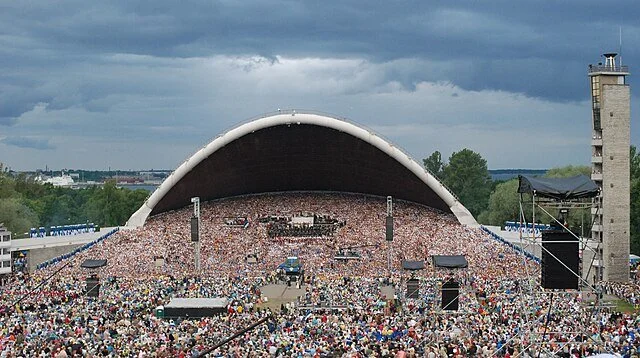
Photo by Aleksander Kaasik. Property of Wikimedia Commons: https://creativecommons.org/licenses/by-sa/4.0/deed.en
Amongst Western audiences, the idea of a “musical revolution” is most often tied to the progressive messaging emblematic of the 60s psychedelic rock scene: John Lennon’s brazenly secular Imagine, the culture’s enrapture with “reaching enlightenment”, and the devil-may-care attitudes of bands such as The Doors and The Rolling Stones caused the iconography to become inseparable from the culture itself. Mythology-driven traditions tend to thrive on narrative consensus, and the zeitgeist proved to be no exception; despite most prolific artists’ entanglement with inadvisable behavior and few durable cultural tokens left from the time besides timeless music, the movement was cemented into common understanding as unanimously progressive and politically seismic decades ago.
Contrary to archived Western memory, the days of Woodstock and progressive rhetoric were structurally inexpedient. While many on the ground level were at least partially seduced by the radicality of the counterculture, a fatal assumption by its fundamentalists was made: that enough people ‘seeing the light’ would not only ensconce the youth culture, but also uproot preexisting litigation that stood against the counterculture’s values in time. Yet, as Jimi Hendrix bent ‘The Star-Spangled Banner’ into distortion through the early hours at Woodstock, Congress had already instituted the draft lottery system; and within a year, the Controlled Substances Act would codify federal drug scheduling. Abbie Hoffman - amongst the most indispensable ringleaders of the movement - even went so far as to publicly declare that the success of Woodstock proved ‘the death of capitalism.’
Needless to say, capitalism survived the weekend. While few would prosecute a music festival for failing to topple an economic system, a pattern of perceived impact falling short of reality repeated for most issues that the movement brushed shoulders with. The chief causes for protest - particularly the dissemination of the draft for a steadily encroaching war in Vietnam - maintained themselves via bureaucracy, legal strategy, and committees that were kingpinned together by a carefully-appointed hierarchy. Rather than consolidate the galvanized generation of freshly-evangelized hippies into a group of young protestors ready to grind their backs against the grain, many within the progressive movement openly eschewed and distrusted the exact capriciousness that stabilized their political opponents throughout the discourse. This inflection point is where many socially prolific movements quietly stagnate within a few years. Or, perhaps they hardly even begin to get their footing due to a lack of defined values that exceed good vibes and well-meant platitudes. Consider a run of titles from Marvin Gaye: What’s Going On? What’s Happening Brother? Where Are We Going?…
As trite as my tone may land, I do not mean to imply that suspending a moment in time with a set of epochal songs is inherently meaningless - music can serve as a cultural equalizer and sustain morale during struggle - but alone, it does not spell lasting consequences in the barracks of a legislative office or permeate the collective consciousness of cultural thought. In reality, music tends to tangle with political action in one of three ways: it either soundtracks a preexisting movement, leverages a movement, or hits incisively enough on a bloated pressure valve to provoke a movement of its own. ‘Soundtracking’ tends to be conflated with the far more effective latter categorizations - and rather than putting them under the microscope and dissecting their biology for replication, nostalgia is overused as an ultimate referendum of success. The question, then: what has historically caused each type of movement to transcend rebellious aesthetics where most failed, and how might their success be recreated in a modern context?
The Baltic Way: Where Soundtracking Becomes Effective
“A nation that makes its revolution by singing and smiling should be a sublime example to all.” - Heinz Valk, Estonian musician and public figure
Operating within the assumption that ‘soundtracking’ means protest music manages visibility yet is otherwise low-leverage, most supposed ‘musical revolutions’ spend their lifespans within its confines. Typically, movements defined by ‘soundtracking’ achieve a paradoxical form of success: they are emotionally resonant and culturally memorable, but fall relatively quickly into impotency. In this relatively benign form, music becomes less a catalyst for change and more a mythology machine, preserving the sensation of resistance long after its practical momentum has dissipated. Regardless of whether the “revolution” itself is legitimate enough to be considered disruptive, the role music plays in the present-tense is to galvanize and cohere consciousness; and after the movement has played out, its role mainly lies in commemorating either the tragedy or victory that has already dissipated into the past tense. The Baltic Independence movement of the late 1980s stands as one of the only complications to this assumption - by operationalizing music, song was transformed from a passive reflection of identity into an active instrument of political consolidation.
The 80s weren’t kind to the Soviet Union, and the countries lumped into the post-World War II treaty between Nazi Germany and the Soviet Union - Estonia, Latvia, and Lithuania - were inextricably linked to the USSR’s brittling economy and political overextension. Following an increasingly disparaging treatment of Estonia’s land and post-Chornobyl geopolitical shame, a broiling desire for severance from Russia transformed into a cautious slew of peaceful protests and broadcasts from journalists urging Russia to abort their plan of extracting phosphorite from Lääne-Viru County. This so-called “Phosphorite War” became a flashpoint of Russia’s historical negligence over its neighbors’ land; as one Estonian journalist warned at the time, large-scale extraction would leave the country “a lunar landscape.” What began as an environmental protest quickly metastasized into something more monolithic - a shared recognition that the state’s priorities were fundamentally incompatible with national survival.
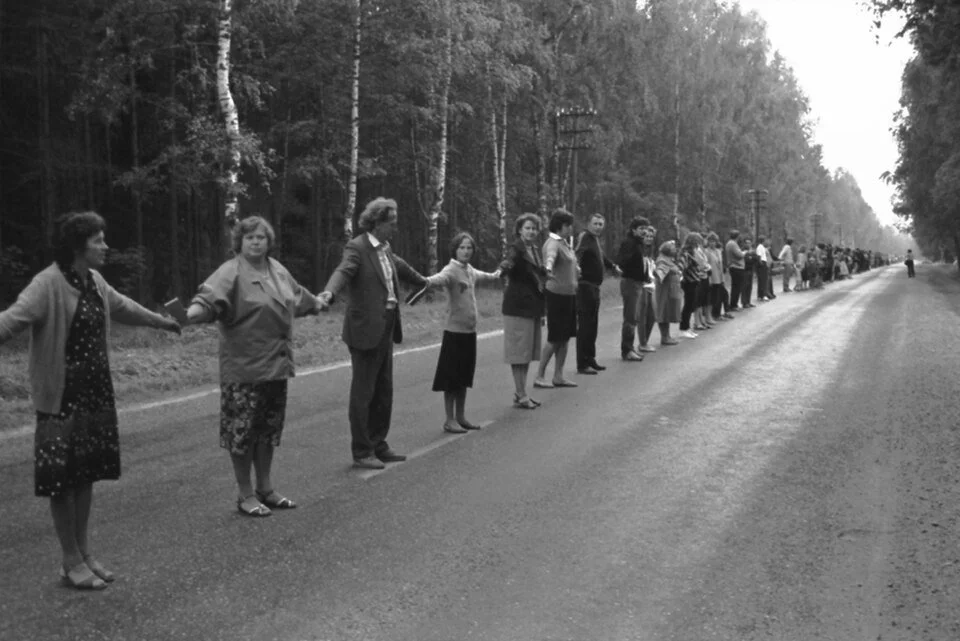
Photo by Laimonis Stīpnieks. Image size altered. Property of Wikimedia Commons: https://creativecommons.org/licenses/by-sa/4.0/deed.en
By September 1988, that recognition had found its voice. An estimated 300,000 Estonians - nearly one third of the nation’s 1.5 million-strong population - gathered at the Tallinn Song Festival Grounds, an amphitheater originally built in 1928 as a monument to national culture to sing banned patriotic songs beneath also-banned blue-black-and-white flags. The movement had just commenced, but a stalemate was instantly made clear: Russia would have to crack down on singers by violent force (egregious optics internationally), or allow the movement to unfold and watch national consciousness consolidate.
The gathering marked a preliminary yet pivotal moment in what became classified as the “Estonian Singing Revolution”. That spring, composer Alo Mattiisen’s legally banned “five patriotic songs,” performed by Ivo Linna at the Tartu Pop Festival, kept the coals running hot under the movement; whereas Jarocin - also referred to as “ThePolish Woodstock” - rode on the very cusp of legality and protection against violent punitive action for its clearly countercultural overtones, also marking the first time that Estonian secession from the rule of the USSR was publicly proposed.
As Moscow contemplated whether to concede or double down, the three countries glued to Russia since its post-World War II haplessness coordinated a showcase of multinational solidarity. In 1989, roughly two million people across Estonia, Latvia, and Lithuania formed a 600-kilometer human chain stretching from Tallinn through Riga to Vilnius in what became known as The Baltic Way. Participants stood shoulder to shoulder for fifteen minutes, coordinated by radio broadcasts, on the fiftieth anniversary of the Molotov-Ribbentrop Pact. The demonstration, held on the 50th anniversary of the Pact, was meticulously positioned to point international attention toward the illegitimacy of the secret agreement that had enabled Soviet occupation of the Baltic states.
In tandem with the protest, prominent musicians from all three nations collaborated on a trilingual anthem, Bunda Jau Baltija (“The Baltics Are Awakening”). Performed in Estonian, Latvian, and Lithuanian, the song framed the three republics as sisters rising together to reclaim their rights. By not collapsing into the implied Woodstock assumption that “visibility automatically cashes in as change,” the Estonian people, in conjunction with their neighboring allies, pulled off the most difficult feat in the realm of protesting mechanics: peaceful gathering that is united and prosecutorial enough to not merely function as a group of ankle-biters, but not quite aggressive enough to warrant reasonable arrest or be easily resold by the state as extremist propaganda.
Estonia’s Singing Revolution didn’t indulge itself in violence or vandalism, nor did it rely on connections outside of the Eastern Bloc: the movement, technically, was largely due to its evocative ‘soundtrack’. Yet, rather than merely peddling symbolism and vaguely hopeful proverbs, the revolution turned music into an infectious emblem of nationalist sentiment. The movement ultimately secured the support of Estonia’s Communist leadership by cornering the USSR into a stalemate: the USSR declared the Ribbentrop Pact legally void in 1991, leading to the restoration of Estonian independence and recognition from the United Nations as an autonomous nation soon thereafter.
The Anti-Apartheid Movement: Political and Economic Leveraging
“I do not sing politics. I merely sing the truth” - Miriam Makeba
Examples in history where music didn’t merely reflect or spark unrest but actively converted it into material pressure - or, ‘leveraged revolutions’ are relatively scarce, because they require a near-perfect convergence of timing, infrastructure, and discipline. Martyrdom without existing pressure is a casualty; shared purpose without strategy is sentimental; and protest without political leverage is rendered relatively benign. Thus, artists must be culturally legible enough to mobilize attention, yet strategically embedded enough to redirect that attention toward institutions that actually hold power. Most movements falter on one of these axes: they either generate mass visibility without clear channels for escalation, or they possess political clarity without the cultural force needed to scale. On March 21st, 1960, the apartheid-dominant South African government allowed for open fire upon a crowd of peaceful protesters in Sharpeville, killing sixty-nine citizens and injuring one-hundred-eighty more.
A more ardent struggle from the native African people for reprieve from their affliction and institutionalized subordination ensued - a festering unrest that grew even more feverish following the imprisonment of Nelson Mandela in 1962. Russia had been forced into semi-diplomatic behavior in its dealings with Estonia, as its encroachment upon the Eastern Bloc was but one issue on their laundry list of reasons for international animosity; largely explaining their reluctance to rely on violent punitive countermoves. The apartheid-era South African government proved itself an altogether different opponent. With protest very definitively no longer enjoying protection under the law after the 1960 assault, peaceful gathering was not a feasible option. Even music that was deep-fried in political sentiment and commiserated experience was either heavily discouraged or banned within national borders, largely shutting down attempts at protest art - vibrations in the air, as sweet as they may come and go, are no match for military tanks.
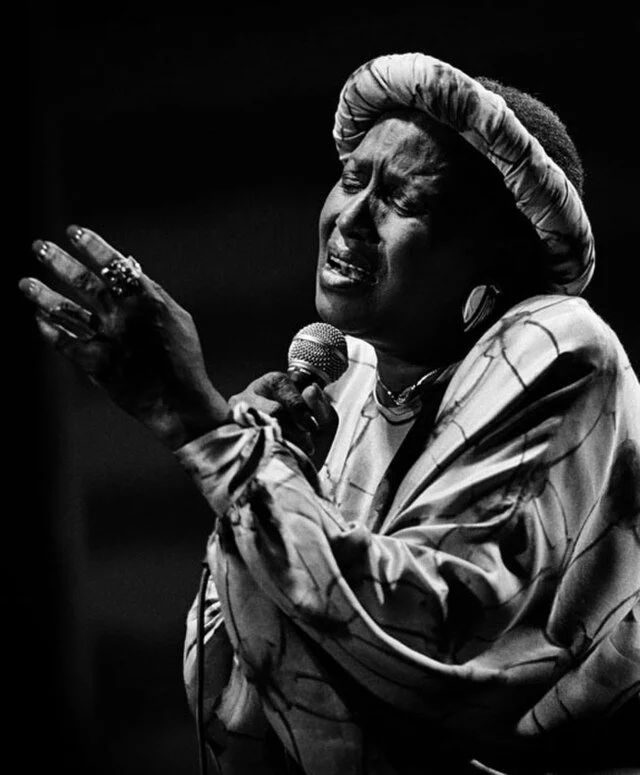
Photo by Paul Weinberg. Property of Wikimedia Commons:
https://creativecommons.org/licenses/by-sa/3.0/
Rather than rotting the system’s narratives internally, musicians were forced to cast their net internationally. Artistic heavyweights like Hugh Masekela leveraged the general emotional legibility of jazz to turn his music into a global call for action, with songs like “Bring Him Back Home (Nelson Mandela)” directly advocating for the release of political prisoner Mandela. The mobility of the movement, alongside growing media exposure, pushed the moor of consciousness from local to multi-continental. Miriam Makeba - later crowned with the name “Mama Africa” - faced exile from South Africa in 1960 as punishment for the growing political insistence baked into her songs.
Leveraging her enforced geographical freedom and growing platform, Mariam performed at the United Nations in 1963 to testify against apartheid. Her visibility amongst international audiences first helped prod the movement into focus from distant geopolitics to an immediate, humanized injustice. External attention directed at the ostracizedinternal struggle raised awareness for South Africans, with songs like “Nkosi Sikelel’ iAfrika” (later integrating into the national anthem) facing a domestic ban but heavily spun - and chanted at protests -globally.
From the 1960s onward, the African National Congress and international allies orchestrated a cultural boycott, urging artists to avoid performing in South Africa. The boycott reframed the apartheid regime as a pariah state, with Sun City - a luxury resort and casino that openly welcomed foreign entertainers despite sanctions - becoming a flashpoint for the cost of supporting Africa’s apartheid-driven affliction.
The boycott was not merely symbolic. Artists who performed at venues such as Sun City faced blacklisting, sometimes appearing on informal or institutionally circulated lists tied to organizations like the United Nations. In 1985, the protest song Sun City (organized by Artists United Against Apartheid) featured Bruce Springsteen, Miles Davis, Run-D.M.C., Bono, and others with the hook, “I ain’t gonna play Sun City”. Artists who performed there were blacklisted internationally, and public campaigns against “Sun City gigs” elevated the stakes for musicians and corporations alike. Benefit concerts such as Nelson Mandela’s 70th Birthday Tribute at Wembley Stadium, broadcast to over 600 million people worldwide, reinforced the political consequences of artistic engagement (instrumentally, it was broadcast in the UK during Thatcher’s resistance to sanctions against South Africa). By the late 1980s, Western corporations were divesting, universities were under pressure to pull investments, and governments were consistently tightening sanctions.
Without drifting into overwrought “music freed Nelson” truisms, its reach and inflating social currency tightened the margins through which the South African government could send propaganda internationally. At its peak, the movement reached a point where performing a concert could carry geopolitical consequences - which, notably, is an inversion of the typical relationship between culture and power. Exiled musicians functioned as diplomatic actors; boycotts weaponized reputation; benefit concerts altered global perception; and protest songs became economic signals. In addition to adding emotional pigmentation to the movement, music made persecution costly by targeting international perception and skewing the cost-benefit calculus of its oppressors against their agenda.
The Acid House Movement: Intercultural Porousness
“Punk is a rebellion born from the ashes of dissatisfaction and social norms.” – Holly Adams
Examples of protest music successfully supplementing preexisting cultural rupture tend to reveal a pattern of coherence; however, certain collectives that err toward “punk culture” represent a different model of reaching their directives entirely, and perhaps require a recalibration of what the word ‘success’ specifically denotes. When examined across a range of context and time, a pattern tends to emerge: movements may be highly structured and coordinated, reliant on careful planning and incremental leverage - or they function best when anarchic, reactive, and radically low-barrier-to-entry.
Admittedly, movements that are clearly lubricated by aesthetics and sensationalism have a tendency to overestimate the sharpness of their own trappings. For instance, I once saw cult-classic Irish post-punk band Flogging Molly, whose opener took the stage in leather wristcuffs and regrettable tattoos from nights past - men with long locks, women with short - chanting about “storming the gates” over a moral infraction upon Ireland from the 1980s. For many, this image will land as almost too on-the-nose in how threatening punk music and its resulting spillover into culture is perceived to be. At their most definitive, this brackishness is not a weakness; historically, successful punk movements respond to political conditions while simultaneously treating the state as a distant irritation rather than a central opponent. The result is a skipping over of calculated strategy and a direct acceleration toward revolt, one that privileges immediacy over coherence.
Where traditional protest relies on a knifepoint strategy, punk movements harness energy to generate pressure in unpredictable ways: rather than emerging from unrest with a meticulously drafted blueprint, reflexive social reactions to an unfavorable atmosphere can accidentally grow threatening enough to be thrust onto the political stage. This apparent chaos should not be mistaken for intellectual laziness, and assuming punk collectives are intellectually bankrupt would be quite glib. Rather, their impetus is rarely to create change through litigation, but to override it and to saturate culture so thoroughly that formal policy is eventually forced to reconcile.
Northern Britain needs no more reason to be depressing than it already has. Imagine your life trajectory is to toil in a coal mine; now, imagine the local economy is so dilapidated due to London’s policymaking gravity that all fantasies of landing a job in one of the least glamorous careers possible have begun to curdle. Margaret Thatcher’s workforce policies, in all their abandonment of Northern England, inadvertently assembled the perfect conditions for a supreme music scene: an influx of revolt from the LGBTQ+ community in response to conservative hostility, abysmal weather, and economic depression.
A few years prior to Thatcher’s first election in 1979, British youth had already reoriented their energies from pop to punk, with the Sex Pistols, the Clash, and the Buzzcocks as mascots of a move toward dingier, more abrasive styles. The genre’s low barrier to entry for aspiring musicians (learn three chords) and spirit of anti-virtuosity turned aesthetic preferences toward punk whilst softening attitudes toward class divisions; while the music itself stirred rebellion and hedonism across class lines, its universal accessibility made the culture surrounding it far more porous. As Greil Marcus wrote of early-stage British punk; the scene felt less like a platform, and more like “a demand to live differently, now.” The “every man for himself” driving spirit of Thatcherism directly channeled into the rise of DIY venues, illegal warehouse shows, and taste-making punk labels like Factory.
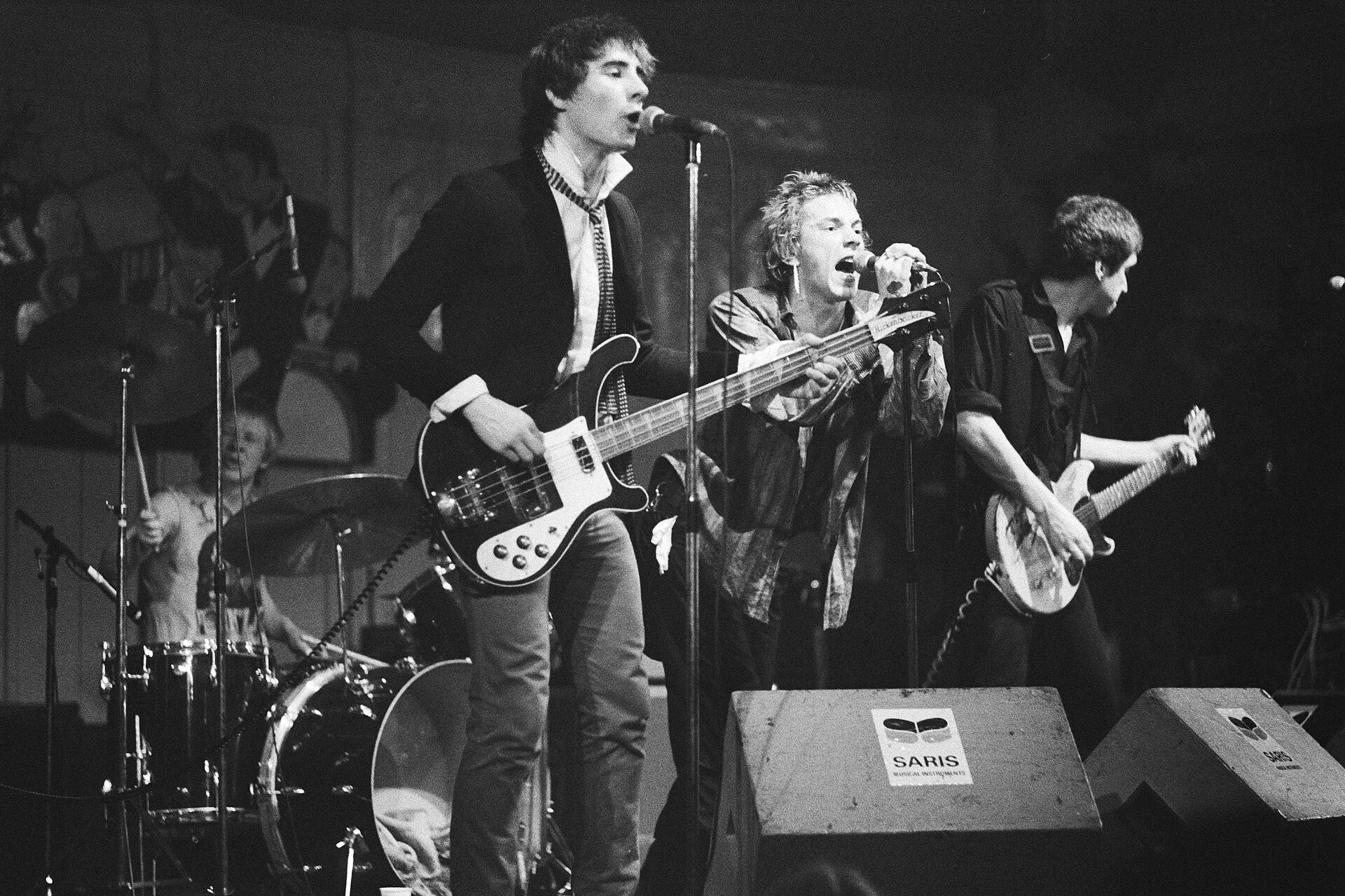
Photo by Paul Weinberg. Property of Wikimedia Commons:
https://creativecommons.org/licenses/by-sa/3.0/
The first wave of acid house - initially swelling in Chicago warehouses through the use of the Roland TB-303 synthesizer, known for its gurgling, “squelching” sound, four-on-the-floor rhythms, and trance cycles - soon spread to London clubs after pollinating in the metropolitan powerhouses of Mumbai, Chicago, and Detroit. Unlike many spouts of genre - which spawn, and ultimately fritter - in London’s arteries of subculture, acid house gatherings included southerners reliving their trips to Ibiza and northerners who couldn’t afford such escapism at all. This class-spanning youth culture, already disillusioned by Thatcherism and primed by punk’s permissiveness, proved voracious for hedonism untethered from forced moral posturing. As prolific rave photographer Gavin Watson recalled: “Rave is more punk than punk ever was, because kids didn’t even think about breaking the law; they just wanted to get to a rave. The spirit was amazing.”
Predictably, illicit gatherings defined by freeform attitudes toward dress, drugs, and sex were met with fear-mongering from the country’s more sensible factions; despite most ravers being largely harmless, outlets like The Sun and the BBC warned of acid house culture spreading among the youth. Media, police, and antiseptic public attitudes toward the emerging movement found their tipping point with the largest illegal gathering in UK history: Castlemorton Common. What began as a spontaneous convergence swelled into a week-long gathering of roughly 30,000 people across the countryside, prompting public outcry and demands for stricter regulation. “NEVER AGAIN!” declared the Malvern Gazette headline, juxtaposed against bootleg images of colorful, dislocated vans spilling over the hills of the pastures. “The events at Castlemorton Common in the last week have offended and shocked all decent-minded people.” Disgraced police officers and officials postulated a similar disdain for the movement, and a combination of lobbying and restless tabloids gave way to a new wave of litigation.
The 1994 Criminal Justice and Public Order Act granted police the authority to stop vehicles within eight kilometers of a rave, and even defined illegal gatherings with music as the focal point - banning “sounds wholly or predominantly characterized by the emission of a succession of repetitive beats.” While legislation against a movement may seem antithetical to the idea of music driving progressive change, little fuels punk spirit more effectively than external opposition. The rupture of commercialized music distribution was permanent, and the counter-narrative proved resistant to erasure. Crackdowns like the 1994 Act did not extinguish the movement; they formalized it, pushing rave culture from fields into clubs and cementing dance music as one of Britain’s most enduring cultural exports.
However, these movements are not without risk. Cultural cohorts that largely orbit around music often intersect with normalized drug use and psychedelics, creating powerful collective experiences - community, synchronized energy, and progressive messaging - but with an immediate pleasure payoff that can diffuse long-term political traction. The human proclivity to find ourselves consistently dissatisfied with our current circumstances can largely be attributed to our calculation of utility. The joy derived from new pleasures rises alongside an ever-updating margin, not alongside the gap between how bad conditions could be or used to be. Psychedelics typically undo this entanglement: amongst the first ‘revelations’ that most users experience is that meeting a goal or striving for success past oneself seldom increases quality of life. In accordance, their time-dissolving nature often flattens urgency, making promises of future improvement feel abstract in comparison to present euphoria. Yet, the inverse function applies as well: one must glimpse ideal conditions, even temporarily, to recognize what still demands change. This tension - between temporary transcendence and sustained action - sits at the core of such impassioned and enlightened groups.
Accordingly, movements that foster progressive attitudes toward drug usage tend to run on competing dual cylinders: groups largely inspired by psychedelic experience either entirely stagnate themselves in ‘nothing really matters, so why even try’, or spread into the larger culture effortlessly enough that changing legislation hardly matters - because as long as the way that people interact together changes within the context of a broader social pact, most democracies will struggle to fundamentally change this behavior. Its original apologists did not retreat permanently into altered states, nor did they overintellectualize the movement into vapidity; rather, they operated within a culture already flammable enough that shared experience could meaningfully reshape how different classes interacted with one another.
While parallel to the acid house movement in several respects, the 1960s countercultural movement was driven by ideology - artists like John Lennon and Bob Dylan used music to articulate political visions and persuade audiences, often within traditional performer–spectator dynamics. By contrast, acid house was experiential rather than hypothetical or ego-inflated, dissolving the boundary between artist and audience and prioritizing collective participation over virtue signaling. The 60s movement sought to convince the world to change, acid house temporarily set up alternate, accessible realities - ultimately forcing confrontation with authority through action rather than argument. Furthermore, the Woodstock era proved seismic, but was somewhat prone to permanent lamination as a romantic yet final moment in the past. Rather than get drunk on its own perfume in real-time, acid house functioned as a “proof-of-concept” template with no single face as a mascot of the movement; gatherings such as Castlemorton Common became an infinitely replicable example of how to set up DIY networks via pirate radio, word-of-mouth, and underground networks.
The brawn of acid house, then, laid in its ability to be absorbed into the mainstream while remaining resistant to cultural usurpation. Underground collectives tend to be overprotective of their identity as an underdog; but, objectively speaking, absorption into the mainstream should be considered an ideal outcome rather than a ritualized defanging. Rather than remain siloed within a single radical enclave, anarchic punk idealism embedded itself into Britain’s cultural and economic infrastructure; it synthesized in warehouses, expanded into larger ones, and eventually saturated culture itself. The goal of a countercultural movement, then, may be to gradually dissolve into the mainstream until ‘radical’ thought becomes assumed. As the Sex Pistols’ manager Malcolm McLaren admitted of punk’s early sabotage of pop culture, “The trick is to infect the system from within.”
By collapsing once-definitive class divisions, normalizing autonomous gathering, and provoking the state into defining music as a legal threat, the movement reshaped youth identity an d the policing of public space. The aftermath born from the culture’s optimism did not manage to topple neoliberalism, nor did it attempt to. However, it did largely flay through the dead-end cells that had hence weighed down the post-Thatcher cultural consensus: thus proving that even movements that decenter cerebralism in favor of embodiment, when scaled, can become threatening enough to fundamentally alter the way that people reclaim their autonomy in the midst of state-sanctioned degradation.
Modern Protest Culture: Could a ‘Revolution’ Ever Happen Again?
While specific mythology may consistently fall victim to the game of Chinese Telephone, several fundamental realities always expose themselves under examination: the key to success tends to either lie in bullseye strategy or in decentralized revolt that is scaled enough to free original goals from the demands of an inherently political agenda; bodies are required to repetitively meet in a physical space; and the threats that a movement faces can be as internal as they are external. Furthermore, the measurable payoff of each type of movement largely lies in the public, scaled reclamation of autonomy. So, as activism is forced onto a technology-mediated platform, how might each form of movement navigate through social settings that simultaneously ostracize and oversaturate with meaningless connections?
Admittedly, movements mobilized predominantly by protest tend to begin with definitive directives and end with art as either a byproduct or incentive to gather around a preexisting issue; and historically, musical movements that aren’t stabilized by structured protest ultimately find impetus in creating their own set of countercultural values. The striking degradation of protest infrastructure throughout the past decade aligns clearly with the fragmented nature of general society. Whereas protests used to take months - and sometimes years - of meticulous planning, fundraising, and even strategic leveraging, their current nature tends to be viewed as benign by policymakers. If the social reach and aesthetic cogency of movements that tend to lean toward ‘scaled embodiment’ rather than ‘structured persuasion’ are innate to social media’s structure, then why hasn’t a music-driven cultural shift occurred since the technology became the default medium of connection?
Feel free to call me an estranged theorist, but ‘embodied’ movements tend to work best within mediums that allot for physicality. Historically, the cohorts start as communities and then either materialize into a slew of protests or directly impact a young community’s behavioral preferences. However, the internal threat innate to such groupings - mistaking the means for the ends, and thus staying within their self-imposed confines - is far more easily exploited within a digital sandbox. As algorithms are driven almost entirely by aesthetics and user tolerance for nuance incrementally decreases, individual consumers are funneled into their own microcosms of feed-driven content rather than included in broader experience: this ultimately removes the solidarity demanded by democratic movements while satiating the scratch to feel socially engaged and effortlessly placed in a like-minded community. Even if one did position themselves optimistically and suggest that tidepools of online content-driven dissent could spill over into a larger unrest - which ultimately could have an effect with protest at its core - how such dissent plays out amongst communities cannot be paralleled by its historical predecessors. Music has occasionally proven to be an effective emotional amplifier within protest culture, but amplification without insulation or continuous friction leaves movements entirely vulnerable to attrition.
The role of the ‘state’, or powerful opponent, tends to be relatively fixed in activist narratives: protests are always considered detestable if oppositional, and only protected under right-to-protest laws. While this assumption is intuitive and narratively clean, it undercuts the strategic prowess of the state. Certain governments may strike down protests, but ‘democracies’ are often far more skilled at silently managing a crowd’s emotional resources.
Consider the anthropological principle that everything conscious creatures do is either in pursuit of pleasure, avoidance of discomfort, or the conservation of energy. The incentive structure of digital communication stacks these variables until they collapse under their own weight: the illusion of participation triggers pleasure, and the convenience of not lending your physicality or true participation both conserves energy and facilitates the avoidance of ‘pain’ or discomfort. Under a modern protest framework, we are just connected enough to mine the blissful emotions associated with participating in the conversation and just disconnected enough to rationalize our inertia. Thus, online discourse is often allowed free rein from algorithmic control because it so rarely calcifies into contempt; rather, it circulates safely, exhausts itself quickly, faces desensitization as trends, and resolves without threatening infrastructure or authority. By turning to a medium that stacks each variable in a way that both satiates and stagnates a crowd, dissent is easily diffused without shouldering the social blame of denying the crowd a right to peaceful protest.
With that reality acknowledged, it is prudent to emphasize that the claim, ‘nothing interesting happens anymore because the population has been zombified by screens’ is a falsely-totalizing interpretation of our culture’s technology-amplified malaise. Gen Z and millennial generations tend to be relatively vociferous around issues that matter to them - especially as finding meaning in one’s culture has had to fill the expansive space left by a general decline in religious subscription. Instead, perceived complacency stems from the sense that online protest is largely ineffective; and when incentives appear low and the perceived cost of involvement appears high, people default to the second-easiest option that still feels participatory.
Many within the field acknowledge that social media is irrevocably embedded into current protest culture, but suggest causes that ride on the internet’s back for visibility somehow need higher ‘barriers to entry’ for allowed participation. Even though friction and consequence do indeed tend to connect movements across time and specificities, attempting to reintroduce it the social media protest landscape is likely ineffective. With technology functioning as a tool encouraging social anonymity, the low-level social guilt that causes exhausted participants to stick within a movement is derooted: meaning “making participation harder yet apply no reasonable incentive to do so”, on the immediate scale, arguably only worsens an already-difficult paradox. The solution, then, must reconcile three realities at once: people want to engage; they have a lower tolerance for discomfort; and the internet is now fully integral to communicative procedures.
The true history of smaller-scale ‘music revolution’ is, in part, the history of benefit concerts: moments where festering energy was successfully converted into material support and, at times, political pressure. One potential evolution point could lie in the resurgence - and strategic reconfiguration - of benefit-driven music festivals as hybridized scaffolding. Benefit concerts can still function as protests once did in their ‘golden age’. Operating as more than symbolic gestures, they functioned as convergence points where cultural attention, financial capital, and physical bodies were consolidated into a single, high-density moment of pressure while remaining broadly accessible due to their aesthetic appeal. In a modern context, festivals are uniquely positioned to bridge the gap between algorithmic reach and tangible impact: digital ecosystems can efficiently aggregate and prime audiences, while physical gatherings convert that diffuse attention into concentrated economic and social leverage.
Moreover, festivals inherently operate as networked environments, bringing together artists, industry figures, media, and audiences within a shared space, thereby increasing the likelihood that cultural momentum translates into institutional consequence - whether through fundraising, coordinated messaging, or direct engagement with political and economic actors. If contemporary movements struggle because participation dissipates, then benefit festivals may represent one of the few remaining formats capable of reintroducing scale and escalation into an otherwise fragmented landscape. Furthermore, activists are most effective when simultaneously humbled by scale and raised in solidarity with fellow protesters. Benefit festivals, when done right, inherently fulfill each need equally.
Each type of movement requires participants to set aside personal egotism in order to ultimately reclaim their autonomy and thereby humanity; social media drives users toward egotistic behavior while subtly dilapidating self-esteem. Therefore, the reclaiming of music as a powerful indicator of culture inherently lies in the reclamation of physical autonomy. While technology disguises itself as enabling historically unprecedented scales of individual autonomy, it fundamentally resets the equilibria that give rise to effective behavior. Therefore, the solution is not to somehow ‘make social activism media more meaningful’, nor is it to blame current protest songs for their obvious modernity - while new movements will likely always be born and raised on social media, their crest must be a unanimous experience united by physicality.
Regardless of what the most effective antidote to an atrophy-prone protest culture may be, the intractability of the issue is impossible to refute: the absence of a consistent gathering point turns potential activists - who are otherwise passionate and visible - into vagrants, both frustrated by their inability to participate meaningfully and validated in their complacency by it. As a result, users may cluster toward modes of involvement aligned with ‘low barrier to entry’ movements, but the low-risk, low-return social payoff inherent to technology-mediated platforms eliminates the intractable friction that has historically acted as the lowest common denominator connecting counterculture across time and specificities. The modern loss of a physical rendezvous point does not simply contextualize how behavior is either reinforced or debilitated via music: it engineers even the most evocative of protest songs to function as anesthesia, thereby exploiting the human desire to reap the aesthetic satisfaction of participating in a fight without risk or sacrifice.