
Did most of the film critics dislike Digger because it was too similar to reality or because it was too detached from it?
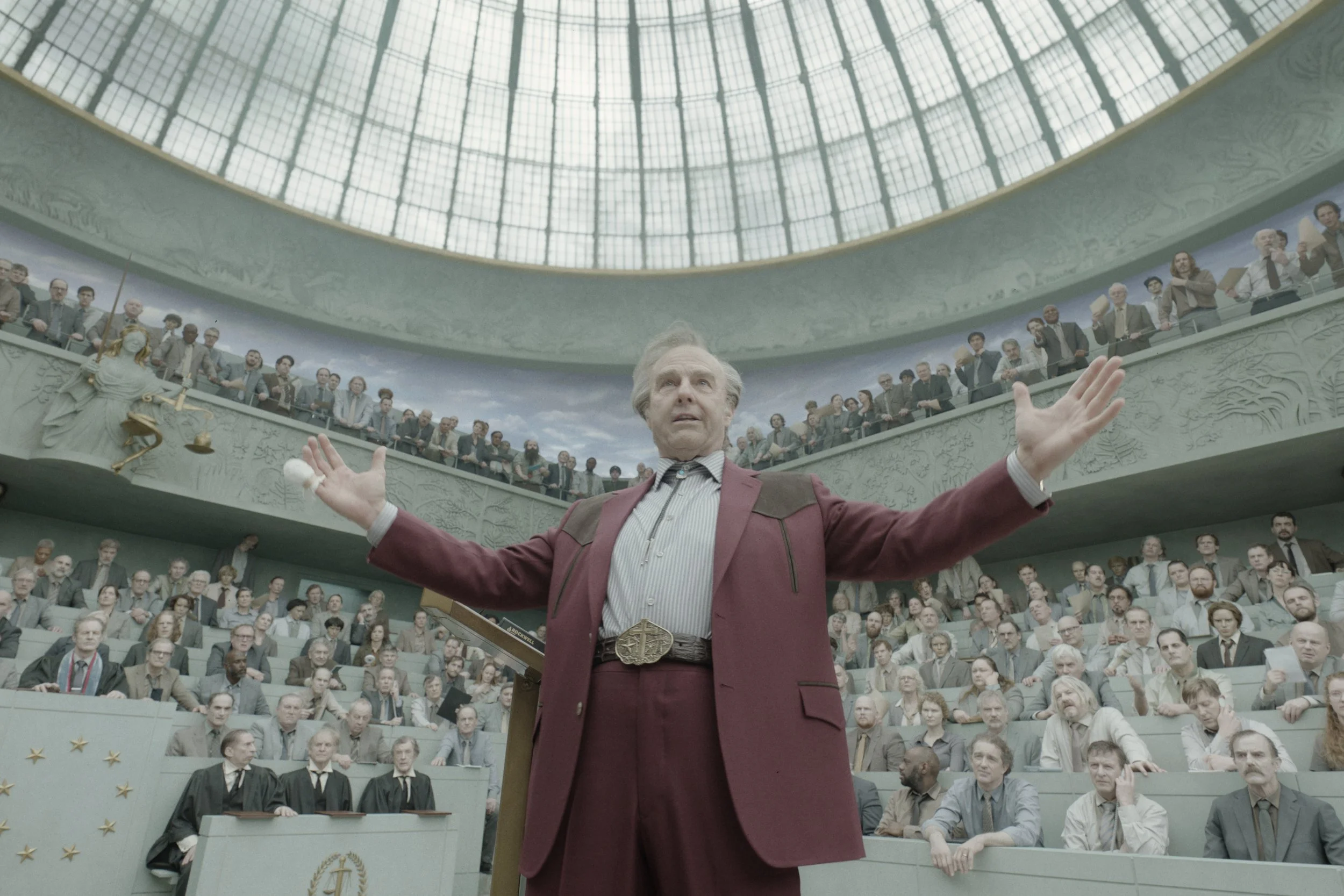
A few days after I watched the movie, I attended my graduation ceremony at film university and one of the topics that came up in conversations with my peers was Digger. Discussing politics and AI, we would come back to Digger a couple of times in the ironic sense that its doomed future was where we were all heading. Obviously, our reality is not as exaggerated as it is in the ‘Fossil Fools’ play, but the fact that it’s so easy to imagine the dystopian society with polluted, unbreathable air and AI robots is brutally disarming.
A lot of critics mentioned that Digger was not funny, highlighting it as a disadvantage. I find it remarkable that Iñárritu focuses our attention on the destructive capitalist structures that are driving ecological collapse, yet most of the time the audience does not laugh.
This film is about storytelling and the music seems to be a narrative voice that sits above everything. The first level, being told in the first 30–40 minutes of Digger, is the environmental critique, which is meant to unite the viewers against the capitalist bastards. The second is about the role of the author in a society dealing with a collective trauma: how do we talk about a shared trauma? Do we have the right to laugh at the evil characters, ultimately legitimising their worldview? What’s the point of the theatrical play in the setting of the movie? The third level, which I think is the most important one, emerges through Jesse Plemons’s character, Kenny, and his relationship between art and politics. Kenny Rockwell, who inherited his uncle’s corporate empire and still remains one of the most powerful people in the world, is financing the play. Can art meaningfully criticise the system that finances it?
Cosmo Sheldrake, Digger’s composer, created the score that essentially stays above all of the story layers. His music is the antithesis to AI, to the conventional form of film scoring, and to Digger Rockwell himself. The score rarely demands the viewer’s attention, except for the very first sequences of the movie, but even the short cues scattered across the film create a whole fourth layer of storytelling, which probably helps us dig deeper into the core idea of the picture.
Mark Fisher, in his book Capitalist Realism, argues that the animated film WALL-E (2008) only seems to be an anti-capitalist movie that advocates for environmental protection. Lazy and obese people on the giant spaceship do not acknowledge their agency; instead, they are being saved by a robot who was produced by the exact same corporation responsible for the garbage pollution. Mark Fisher wrote: ‘It seems that the cinema audience is itself the object of this satire, which prompted some right wing observers to recoil in disgust, condemning Disney/Pixar for attacking its own audience. But this kind of irony feeds rather than challenges capitalist realism. A film like Wall-E exemplifies what Robert Pfaller has called “interpassivity”: the film performs our anti-capitalism for us, allowing us to continue to consume with impunity.’
Fisher’s argument raises a question for Digger itself: can a film about environmental destruction do more than just allow us to use the image of our own concern? Sheldrake’s score does not provide a definitive answer and cannot replace political action, but it complicates the human-centric narrative of the film, giving the non-human world an opportunity to speak out.
Avian Elegy
This opening track was developed from Cosmo Sheldrake’s ‘Nightingale, Pt. 1’, released in 2020. Digger’s director, Alejandro González Iñárritu, stumbled across this track while searching for the right musical direction and immediately fell in love with it. ‘Avian Elegy’ is composed of recordings of a nightingale, bittern, ring ouzel, and a long-eared owl. The birds that are about to be extinct. The process of creating music for the rest of the film was based on this piece. The composer and the editors exchanged demos back and forth, simultaneously influencing the final cut and the music. This is a rare case in contemporary filmmaking, where no traditional temp score (a placeholder musical track often taken from existing film soundtracks or classical pieces that is edited into an early cut of a film) was used during the picture editing, replacing it with the composer’s original musical sketches. A variation of this track concludes the soundtrack album, emphasising the core part of the entire Digger score.
This Sacred Promise
Have you played My Singing Monsters? If someone compared my music to this game, it would have been the biggest compliment, honestly. A couple of years ago, a track from the Ice Age score, ‘Mini-Sloths Sing-A-Long’ by John Powell, was my most-played track, so you can probably tell that ‘This Sacred Promise’ matches my interests and I can’t be fully unbiased, but let's go back to Digger. All of these different percussive elements sound raw, unprocessed and naive. The instrument that starts at 0:34 is a musical saw, rarely used by film composers. It has a thin, continuous, slightly trembling tone coming out of a bowed saw. Most of the tracks on the soundtrack album have a clear song-like 4/4 structure which makes it super easy to follow intuitively and move along the waves of… oil spilled in the ocean?
Drowning
Cosmo Sheldrake: ‘This track features a humpback whale, a long-horned sculpin, the sound of haddock courting, and a sperm whale echolocating.’ On one hand, we have the dirty multifaceted storyline, money-hungry businessmen who are destroying the planet before our eyes, and on the other hand, everything is happening to the music that was made out of field recordings, birds singing, marine creatures’ calls and human humming.
Blah Blah Blah
Entering the UN Assembly, Digger is the evil in the eyes of everyone in the room. He tries to seem honest and vulnerable but people (and even motionless mannequins in the stands of the hall) still hate him. After a 10-minute monologue in which he pointed out that all the processes in the world are heavily dependent on him, Digger leaves the audience divided in half. While people are literally fighting with each other, Digger Rockwell stays in power. Working on the track ‘Blah Blah Blah’, Cosmo Sheldrake spent a couple of days on the film set orchestrating and rehearsing extras to sing in time.
The movie does not tease us with a promising future. We leave the theatre with the unsettling feeling of entering a dystopian world where robotic guards coexist with the remaining society. ‘Fossil Fools’ might be a comedy for its viewers but Digger is an intensified reflection of our world; that’s why it's not funny.
Despite being funded by a major studio and heavily dependent on sales and capitalist structures, Digger draws our attention to the immense power that is in the hands of politicians and billionaires. I’m pretty sure this film will become more and more relevant over the years. It shows how desperate we as a society are in the face of people in power and the music puts everything in frames made of endangered species and unsettling melodies, and puts it on the wall, so that the next generations choose their politicians more wisely.