
When songs are tested on TikTok before they’re finished, audience reaction can start to shape the creative process.
The 2020s could be considered a fruitful era for pop music, introducing new artists like Olivia Rodrigo, with her earnest confessional songwriting, and Chappell Roan, with her ostentatious synth-pop sound that took the world by storm and turned it into her very own Pink Pony Club. Rodrigo’s ‘drivers license’ went viral overnight, pulling on the heartstrings of teens and adults alike. ‘Good Luck, Babe!’ became the breakout hit that launched Chappell Roan into superstardom. Their artistry, respectively, paved the way for a new era in pop music, inspiring more artists than ever to become songwriters. Many aspiring artists wanted to emulate Rodrigo’s emotional ballads, while others leaned into Roan’s elaborate stage presence. Their success proves virality and artistic sincerity aren’t mutually exclusive; both of those songs have memorable hooks and infectious melodies that soundtracked thousands of social media posts, but their appeal extends beyond a thirty-second clip. Their virality feels like a result of human connection rather than a solid formula. Lately, however, I’ve noticed the industry may have mistaken the ingredients of a viral hit for the ingredients of a good song.
Record labels, along with such a highly competitive industry, create intense economic pressures that shape the decision to make the most marketable song. Both artists and labels watch what kind of lyrics, production, and branding circulate online, then make music based on those findings, rather than allowing artists to develop their own musical identities and instincts. In doing so, the industry risks rewarding those who can most efficiently replicate what has already proven successful instead of those who create experimental and interesting music. The Guardian reaffirms this in a quote from Charlie Harding, co-host of the Vulture podcast Switched on Pop: ‘I’m very hesitant to say that things have become simpler or we’ve become dumber; it’s just that different things are taking precedence.’ The argument then is more nuanced than claiming pop music today is bad; it’s more about what happens to pop music when commercial viability begins to take precedence over creative expression.
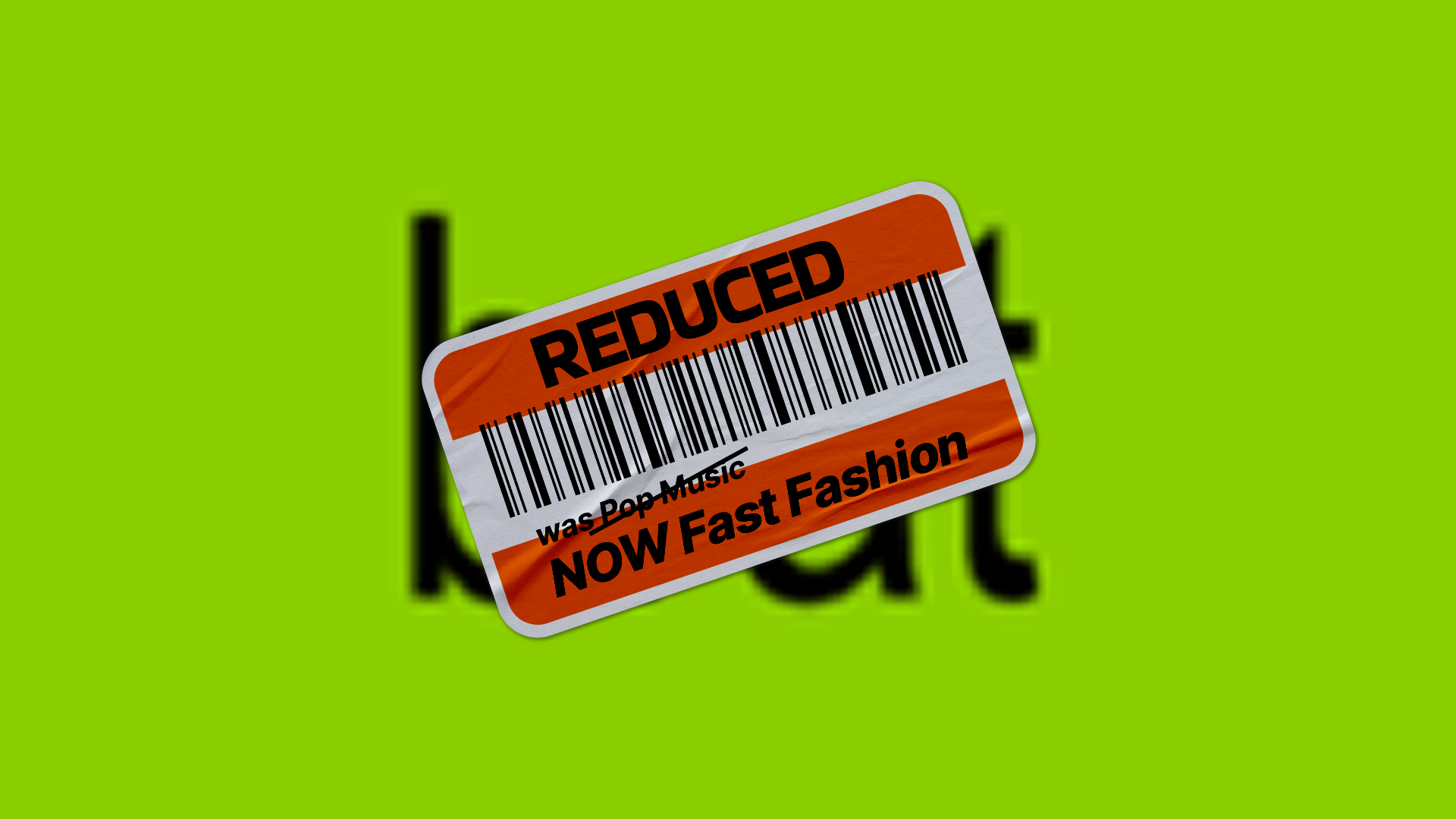
Pop songs today seem like they are designed to get stuck in our heads but not necessarily leave an impact. I can’t help but notice the stark resemblance to fast fashion in terms of its longevity, or lack thereof. Fast fashion depends on a continual cycle of novelty. Something becomes desirable, is consumed, and is replaced by something new. Social media can encourage a similar relationship with music, specifically TikTok, which is engineered to keep you scrolling for the next best thing. It’s a strangely disposable relationship to have with music. A song can be inescapable for weeks, accompanying thousands of outfit transitions, dance trends and TikTok edits, before fading away and being replaced by the next trending sound. The problem isn’t that these songs are popular, but that their popularity can become detached from any meaningful engagement with the music itself.
When a particular style becomes fashionable, retailers rush to reproduce it before the trend loses momentum, and pop music has started to operate under a similar commercial logic: trend-driven, reproducible and designed for immediate mass consumption. Rolling Stone even called TikTok ‘the future of the music industry. It’s where careers are launched, communities are built, and songs find meaning far beyond the studio.’ I agree to an extent. TikTok allows listeners and fans to engage directly with content, but it has also created a culture where we often hear a song’s fragment before the song itself. I know too many songs only by their viral, earworm chorus, but can’t tell you any other lyric or even the title.
Benson Boone’s ‘Beautiful Things’ comes to mind, along with Sabrina Carpenter’s ‘Manchild’ and, most notably, sombr’s ‘back to friends’.
sombr, the 21-year-old indie/rock singer, even admitted that he writes a chorus, posts it on TikTok, and then, based on fan reception, decides whether to finish it or scrap it. He says, ‘I don’t finish songs usually,’ until he tests them with the audience and finishes writing them if they get a good reception. To me, this method raises concerns about the development of artistic instincts, particularly if it becomes a blueprint for other up-and-coming artists. It’s not uncommon for musicians to abandon songs they find mediocre or uninspiring, but there is a difference between abandoning an idea because it no longer excites you and abandoning it because it hasn’t excited an audience. Songwriting, like any creative discipline, requires experimentation, patience and a willingness to pursue ideas without knowing whether they’ll amount to anything. Learning to recognise a song’s potential is part of the process of making music. When the decision to finish a song depends on its immediate reception, artists risk depriving themselves of that process, allowing external validation to eclipse their own creative judgement. This process begins to resemble market research rather than artistic exploration, with audience engagement functioning as an early measure of commercial viability. My concern with artists consistently relying on public feedback to determine which ideas deserve development is that it could eventually weaken their confidence in their own creative instincts, inevitably stunting their artistic growth.
Pop music has always been commercial, and there’s nothing wrong with wanting to write a viral hit. But when the pursuit of virality begins to dictate the creative process itself, I worry that artists can become too focused on what the public has to say more than discovering what they themselves want to say with their music. And what does this mean for the music we’re left with? A song can accumulate millions of streams and dominate the cultural conversation without necessarily becoming something listeners return to once the trend has passed. The pop songs that have meant the most to me were never simply the ones I couldn’t get out of my head, but the ones that stayed with me long after I’d stopped listening. Katy Perry’s ‘Teenage Dream’, for example, or Britney Spears’s ‘…Baby One More Time’ and Taylor Swift’s ‘Style’ were all massive commercial hits, but their appeal extends far beyond their infectious hooks. Whether it’s the euphoric production of ‘Teenage Dream’, the unmistakable opening riff of ‘…Baby One More Time’, or the evocative lyricism and shimmering production of ‘Style’, each song offers something worth returning to beyond its immediate listenability. All three have left a lasting cultural impact on the pop landscape, yet each possesses a distinct sound and artistic signature that cannot, and should not, be replicated.
As listeners of pop music, we don’t want endless reproductions of what we’ve already heard. We want the creativity and individuality that made those songs so compelling in the first place. I believe the greatest danger of treating pop music like fast fashion isn’t that we’ll run out of good songs, but that we’ll become increasingly accustomed to treating music as something disposable rather than something sacred and personal.