
From early digital collages to the choreographed release of STORM, Yung Lean’s music videos trace a shifting relationship between isolation, identity and collective belonging.
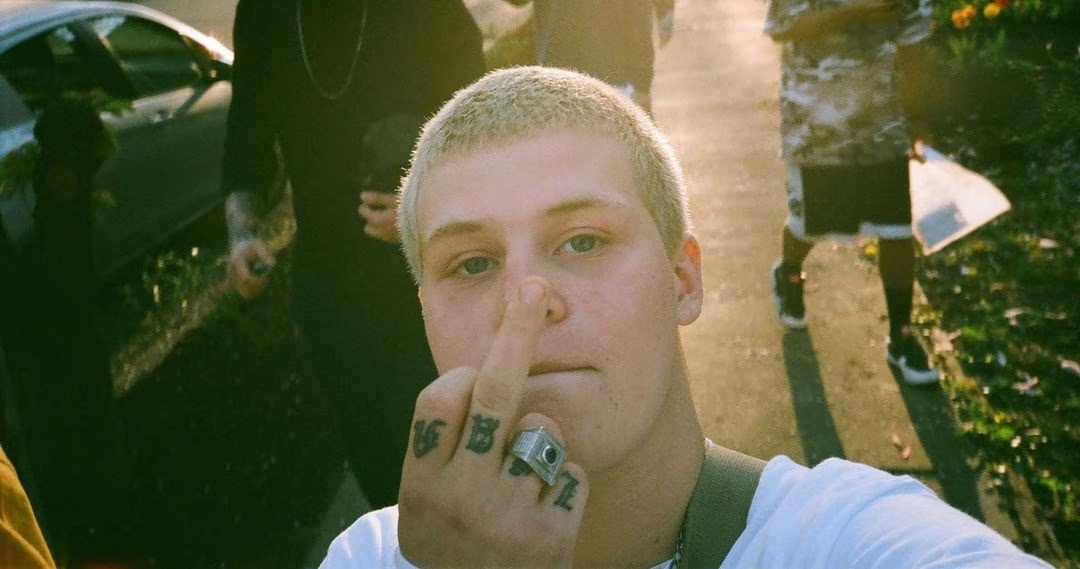
Swedish rapper Yung Lean (Jonatan Leandoer Håstad) has had a killer year: a viral short film collaboration with French multimedia project GENER8ION, a phenomenal VMAs performance, and a first major art exhibition in Stockholm, Sweden. Since the video for ‘Ginseng Strip 2002’ went viral in 2013 and cannonballed the artist into stardom, Håstad’s music and its corresponding images have developed side by side. This article takes a brief dive into Yung Lean’s discography through the sound and visuals of three music videos, from 2014 to 2026.
Lightsaber // Saviour (2014)
Released in July 2013 on the mixtape Unknown Death 2002, ‘Lightsaber // Saviour’ accompanies its sound with a video, created by Ossian Melin and uploaded in January 2014. The title ‘Lightsaber // Saviour’ is already a mini-collage of opposing forces: two words, one of a weapon and one of a rescuer, joined side by side with two forward slashes, no syntax to explain the nouns’ relationship. The video extends this logic to both image and sound.
Rather than opening on Yung Lean, it opens on aerial stock footage of Stockholm, over which planes are visibly edited in, giving the video a collective, anonymous and overtly digital identity. Against this sit purple-hazed scenes of a shadowed Lean at a night-time gig and blurred shots of a highway at night, and clips from Harmony Korine’s Gummo (1997), shown as screen recordings of what appears to be Lean’s desktop. File names such as ‘Gummo.1997.DVDRip.XviD-DiSSOLVE.avi’ are left visible, so that the borrowing is displayed within the work. The result is a series of contradictions: digital footage against lived night, a shadowed performer, a collective anonymity that reads as isolation.
The music operates by this same logic. A looped hook from Future Islands’ ‘The Great Fire’ anchors the instrumental, and the track closes on the ‘Tears in Rain’ monologue from Blade Runner (1982). Both are, again, found materials, lifted from other works and collaged into a single mood. The song’s sources pull against Håstad’s voice: the borrowed material is impersonal and elegiac, a synth-pop hook and a dying replicant’s soliloquy, while Yung Lean’s own lyrics are brash and first-person, falling from ‘shining, shining’ to ‘on the floor crying, crying.’
Trip (2022)
‘Trip’ hides the yin beneath the yang: a carefree, sunlit song whose lyrics and video both carry something darker. Released nine years after the song ‘Lightsaber // Saviour’, ‘Trip’ falls at a different emotional frequency. In the break came albums Warlord (2016), Stranger (2017), Starz (2020), and the mixtape Poison Ivy (2018). By 2022, Håstad was returning about two years after Starz, with ‘Trip’ the lone single from Stardust (2022), his first solo Yung Lean project since Starz. Produced by Fredrik Okazaki, Woesum and Art Dealer, the song has a bouncy, innocent beat (reminding one of my friends of summer car trips). This is a sharp turn from the isolated, nocturnal haze of 2013 Yung Lean.
The music video makes the shift visible. Instead of a collage of borrowed footage, ‘Trip’ is made entirely of home-made footage of Håstad and his friends. Warped and blurred filters add visual texture and complexity, and zooming gives the clips a movement that matches the upbeat tempo. The palette is bright and open: sunlight, sky, clouds, and the woods. Yung Lean’s identity, which receded into the shadows (literally) in the earlier video, is restored here in full Yung Lean swagger.
The brightness, however, is not unbroken. Cutting through the yellow-tinted clips are shots of rain and cloud, and the raindrops are left, unwiped, on the lens, putting a barrier up between rapper and viewer. These visuals mirror the lyrics. Beneath the buoyant sound, Håstad sings of a rocky, intense romantic relationship in which both sides cheat and trade blame. The sound sweetens all of this. The verses are scented with ‘peppermint’, ‘cinnamon’ and ‘licorice’, imagery as sugary as the track’s chiming synths.
STORM (2026)
And finally, we arrive at Yung Lean’s collaboration with GENER8ION, the French multimedia project of electronic music producer Surkin (Benoît Heitz) and director Romain Gavras: ‘STORM II’ (2026). The song draws its duality from both earlier-mentioned tracks simultaneously. From ‘Lightsaber // Saviour’ it takes the collective, anonymous body; from ‘Trip’ a brighter, upbeat sound. Where ‘Trip’ infused chaos beneath that tone lyrically, ‘STORM II’ releases the turbulence in one satisfying punch.
The song arrives four minutes and 17 seconds into the seven-and-a-half-minute film STORM, where Yung Lean is now one of approximately sixty dancers in a beautiful dance routine choreographed by Damien Jalet. The costume is the school uniform, which threatens to erase individuality, just like the planes and stock footage did in ‘Lightsaber // Saviour’, but here, fluid, strong, physical movement turns that uniformity into a collective celebration of freedom.
The sound matches it: a euphoric anthem, perhaps the most cathartic release in Yung Lean’s catalogue. Where earlier records tended to dissolve Håstad’s natural voice into haze, here he is, loud and clear. A call-and-response track, ‘STORM II’ is an embrace of individuality and found community. That recognition has been public: the film was nominated at the VMAs for Video of the Year, Best Direction, and Best Choreography.
Across three videos and twelve years, Yung Lean has morphed and developed as a music artist. The borrowed footage of 2014 gave way to the home movie of 2022, and then to a choreographed collective in 2026. It has been a killer year for Yung Lean, and the journey is still going.