
From Pink Slip’s teenage frustration to the peculiar brilliance of the Soronprfbs, these screen inventions deserve a place in your record collection.
It’s mildly annoying when a band invented for a film turns out to be better than plenty of the ones doing it for a living. You watch a comedy, get attached to a group of people who don’t exist, then discover their entire discography amounts to about twelve minutes. There will be no second album, no tour announcement and no chance to catch them in a small venue before they start charging £80 a ticket. Still, those twelve minutes can do a lot. The best fictional bands make you understand why their characters put up with the terrible rehearsals, bruised egos and deeply questionable career decisions. Sometimes the music is the joke; sometimes it’s good enough to make you forget there was supposed to be one. From garage rehearsals to a rock career with an alarming body count, these are some of our favourites.
The Soronprfbs: Frank (2014)
The Soronprfbs are the sort of band you would struggle to recommend out loud, partly because of the music and partly because nobody has provided a satisfactory arrangement of vowels. Fronted by Michael Fassbender beneath an enormous artificial head, they spend much of Frank making experimental music under conditions that would have most musicians quietly checking the next train home. What makes them compelling is the film’s refusal to treat their strangeness as proof that they need fixing. Jon, the aspiring songwriter who joins them, assumes that wider recognition is the obvious goal, even when his attempts to secure it threaten the things that make the group worth hearing. Stephen Rennicks’ music gives that argument substance: there is awkwardness, repetition and abrasive noise here, but also enough melody to suggest that Jon’s idea of accessibility is embarrassingly limited. By the time Fassbender sings ‘I Love You All’, the band’s peculiar language feels intimate and familiar. You don’t need to understand every decision they make to want them to keep making music together.
Sex Bob-omb: Scott Pilgrim vs. the World (2010)
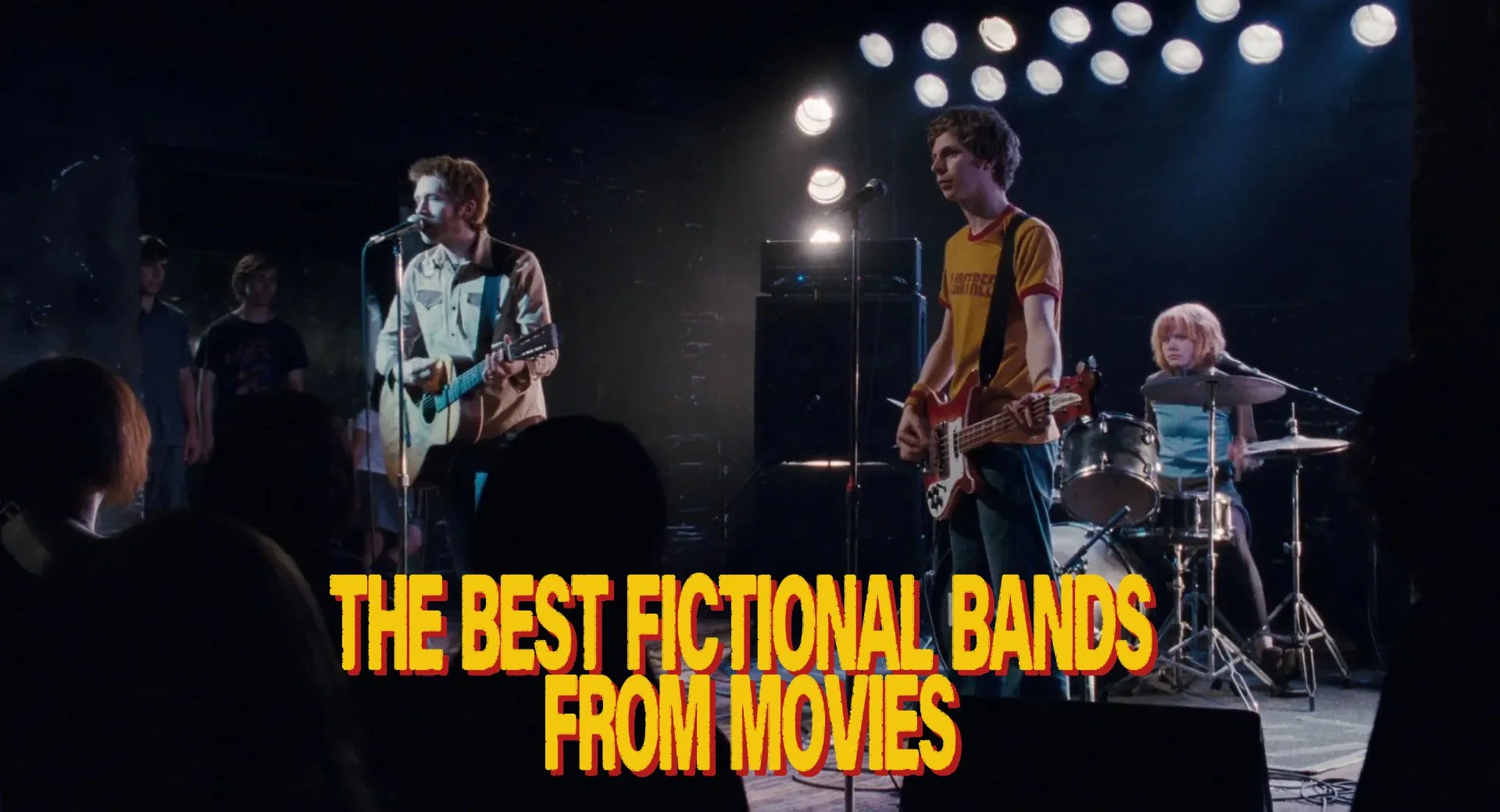
Sex Bob-omb make a convincing case for starting a band before you’ve worked out whether you’re particularly good at being in one. Their songs are short, distorted and impatient, with bass that seems to be chewing through its own amplifier. Beck supplied the material, including ‘Garbage Truck’ and ‘Threshold’, and understood the assignment well enough to avoid making this struggling Toronto garage band sound suspiciously accomplished. There are hooks underneath the fuzz, but you can still picture the rehearsal room and the argument about whose turn it is to pay for it. Just as useful is the division of labour: Stephen Stills supplies the anxiety, Scott Pilgrim supplies the romantic complications, and drummer Kim Pine looks understandably exhausted by both. In a film where musical competition becomes literal combat, their scrappiness gives you something to root for. The Clash at Demonhead might have the entrance, the wardrobe and ‘Black Sheep’, but Sex Bob-omb have the appeal of the local band you insist your friends need to see.
Stillwater: Almost Famous (2000)
Stillwater have barely become famous and are already finding it an enormous inconvenience. Cameron Crowe’s touring rock band arrive with the riffs, the hair and the interpersonal grievances of a group whose members will eventually communicate through solicitors. Billy Crudup’s guitarist Russell Hammond has the easy magnetism that frontman Jeff Bebe, played by Jason Lee, knows is becoming a problem, and their dispute over a band T-shirt tells you plenty about the distribution of attention. Crucially, the music makes their ambitions plausible. ‘Fever Dog’ has the heavy blues-rock swagger to sit comfortably within the film’s early-1970s world, without requiring us to believe Stillwater secretly invented everything good about the decade. They sound like a band who could get bigger, which makes the possibility that they might ruin it entirely convincing. Almost Famous understands how easily affection for music becomes tangled up with affection for musicians who behave appallingly. Stillwater give it plenty to work with on both fronts.
Dewey Cox: Walk Hard: The Dewey Cox Story (2007)
Dewey Cox is a solo artist, technically, but a man who has survived this many musical reinventions can survive being filed under bands. John C. Reilly’s catastrophically eventful career takes in rockabilly, country, protest folk and increasingly extravagant studio experimentation, with the film cheerfully dismantling the idea that every great record requires a solemn explanation of the artist’s childhood. The songs do an impressive amount of the work. ‘Walk Hard’ gives Cox a signature anthem sturdy enough to sustain the ridiculous mythology built around him, while ‘Let’s Duet’ pursues its innuendo with the determination of two people who have never encountered a broadcasting restriction. ‘Royal Jelly’ is especially good, sending up Dylan’s verbal abundance with lyrics that sound loaded with significance until you attempt to locate any. Reilly commits to the singing throughout, which gives the silliness something substantial to sit on. You can laugh at Cox’s entire existence and still find yourself wanting to hear the record again.
Josie and the Pussycats: Josie and the Pussycats (2001)
A satire about the music industry manipulating young listeners becomes considerably more interesting when its fictional band make songs you would happily let manipulate you. Josie and the Pussycats have ‘3 Small Words’ and ‘Pretend to Be Nice’, which is already a better opening argument than most bands can offer. With Letters to Cleo’s Kay Hanley providing Josie’s singing voice, the soundtrack gets its combination of sweetness and irritation exactly right: bright choruses, crunchy guitars and enough impatience to keep the sugar from sticking. Rachael Leigh Cook, Rosario Dawson and Tara Reid give the group a friendship worth caring about, too, so the industry’s attempts to package them come with something to lose. The film surrounds them with conspicuous branding and people who regard an audience as a purchasing decision waiting to happen. Their music has to persuade us there was something worth exploiting in the first place, and it does. You can enjoy the joke about manufactured pop while developing a fairly sincere attachment to the product.
Pink Slip: Freaky Friday (2003)
Pink Slip understand that teenage frustration deserves a proper chorus. ‘Take Me Away’ gives the band in Freaky Friday a song substantial enough to justify Anna Coleman’s conviction that the adults around her aren’t taking her music seriously. It has the churning guitars and emphatic release of early-2000s pop-rock, with Christina Vidal’s vocal giving all that pent-up irritation somewhere to go. The film’s body-swap premise also produces an unusually practical test of parental understanding: appreciating your daughter’s interests is one thing; getting through her band’s audition while occupying her body is another. Lindsay Lohan and Jamie Lee Curtis make the resulting guitar predicament very funny, but the performance works because the band were worth supporting before either of them switched places. Pink Slip make rehearsing in a garage with your friends look like a very reasonable response to being a teenager. For a band with so little recorded material, they leave you unusually aggrieved about the missing album.
School of Rock: School of Rock (2003)
Dewey Finn’s teaching methods would make for a difficult safeguarding meeting, but his ear for a band is harder to dispute. Having talked his way into a substitute teaching job, Jack Black’s failed rocker discovers that his pupils can play and immediately sees a route back to the stage. The pleasure of School of Rock is watching his vanity gradually accommodate their talents, until the children have a stake in the music beyond helping a grown man settle a grievance. By the Battle of the Bands, they look and sound like a group who have earned their confidence through playing together. Zack’s song gives them a suitably direct account of classroom frustration, while the performance makes room for the backing singers, keyboards and rhythm section that Dewey has spent the film assembling. Black is a gloriously excessive frontman, but the kids make the band worth watching. It’s hard to begrudge the film its sentimentality when the reward is seeing an anxious child discover they can command a stage.
Wyld Stallyns: the Bill & Ted films
Most bands would be pleased with a decent debut album. Wyld Stallyns have the future of civilisation hanging over theirs, which seems an unreasonable amount of pressure to put on two people still learning their instruments. Bill S. Preston, Esq. and Ted ‘Theodore’ Logan begin with an excellent name, considerable enthusiasm and very little evidence that the world should be waiting for their music. That gap is a large part of their appeal. Alex Winter and Keanu Reeves make them such generous, excitable company that you want the prophecy to work out, however implausible their prospects might look during rehearsal. Bill & Ted’s Bogus Journey eventually gives them a suitably outsized musical payoff, with Steve Vai’s guitar work leading into Kiss’ ‘God Gave Rock ’n’ Roll to You II’. The sound is as gloriously excessive as the circumstances demand. Wyld Stallyns make the prospect of getting very good at guitar inseparable from the much simpler ambition of having an excellent time with your best friend.
The Messengers: La La Land (2016)
The Messengers have the awkward distinction of making music that sounds like a perfectly enjoyable evening out while their keyboardist experiences an artistic crisis. Fronted by John Legend’s Keith, the band give Ryan Gosling’s Sebastian regular work, a substantial audience and an opportunity to play something recorded after his preferred version of jazz history ended. His discomfort is understandable, given his ambitions, but ‘Start a Fire’ makes it difficult to regard the whole enterprise as a tragedy. Its clipped funk guitar, busy percussion and glossy chorus have an appeal that survives Mia’s troubled expression in the crowd. Legend is an effortlessly persuasive frontman, and Keith’s argument that jazz needs to keep changing deserves a fairer hearing than Sebastian seems prepared to give it. You can want Sebastian to open his club and still think his bandmates deserve a keyboard player who enjoys being there. The Messengers sound like they would manage a very good set once everyone stopped worrying about what it meant.