
From church halls to basement clubs, Left of the Dial offers plenty to believe in across a Rotterdam weekend of noise, discovery and occasionally unhinged stagecraft.
There’s a part of me that I must kill sometimes. It’s the part of me that hates standing in a field. It’s the part of me that grows tired of festivals. The wider mythos around festivals, what they represent, what they can be when reduced to just a lovely weekend in the country with a few bands playing, it sickens me. It sickens some bizarre purist part of my brain because deep down I don’t give a shit about good vibes or a sense of community or staying up late round the campfire. I’m here for the bands, I’m here for the music, I like it when a festival is in a parking lot, I like it when I can’t feel the grass because it’s smothered in concrete. I want raw brutalism; music delivered with the violence and velocity of a car crash directly to me.
But there’s also a part of me that I will never kill nor harm. It’s the part of me that views ‘Left of the Dial’ by The Replacements as maybe the greatest song ever written. The part of me that treats indie as a concept beyond Radio 6 playlist fodder. That treats it like a religion. That will kneel at the altar of Sarah Records and Flying Nun, that chews on a vinyl like it’s a communion wafer. The part of me that sings Pastels lyrics like they’re benedictions. It’s the part of me that kills the cynicism that allows me to somewhat engage in the hippieish good vibes fest that most UK festivals offer. With a festival like Left of the Dial, that part of me takes over.
The five days I spent in Rotterdam seemed to land somewhere between a basement show and a mass. Across the city, venues became stuffed with all manner of uni students, DIY Dutch uncs, and industry heads as they moshed, chin-scratched, and drank their way through the expertly curated lineup of over a hundred bands. No repeats either, with each addition being rarer than the last. And what a city it is to watch them in, even under the blistering wind and rain that scorched down across the city’s maze of brutalist skyscrapers, odd statues and speeding trams, not to mention the endless armada of cyclists tearing through the streets. It’s a wonder that at no point do you really feel lost in Left of the Dial. Its venues extend from punk bars to basement clubs, to churches and theatre foyers, and are all within twenty minutes’ reach, with most being adorned by a flailing tube bearing Left of the Dial’s name across its wind-battered body.
Across each venue I found crowds heaving with joy. A sense from attendees young and old of devotion not just to the music they were hearing but to the festival itself. A remarkably well-organised and democratised event. There were no real headliners at Left of the Dial; every band is given a forty-minute set, with some playing up to four sets across the weekend. It leaves you with the feeling that every band is as important as one another. That every set has an equal heft. And while all of the twenty acts I saw were good, many of them were brilliant. When discussing with friends as we wandered through the rain to catch a closing show at Salsability, we all found it impossible to name a bottom three. Every band had played like pros, with excellent sound accompanying every one of them. But inevitably, there are favs, whether it’s a matter of stagecraft, timing, or venue, all these small things coming together to edge them over the competition. Those are the bands that made Left of the Dial, the ones that turned a club into a communion. The ones who left me and the rest of the audience bowing low in revelry.
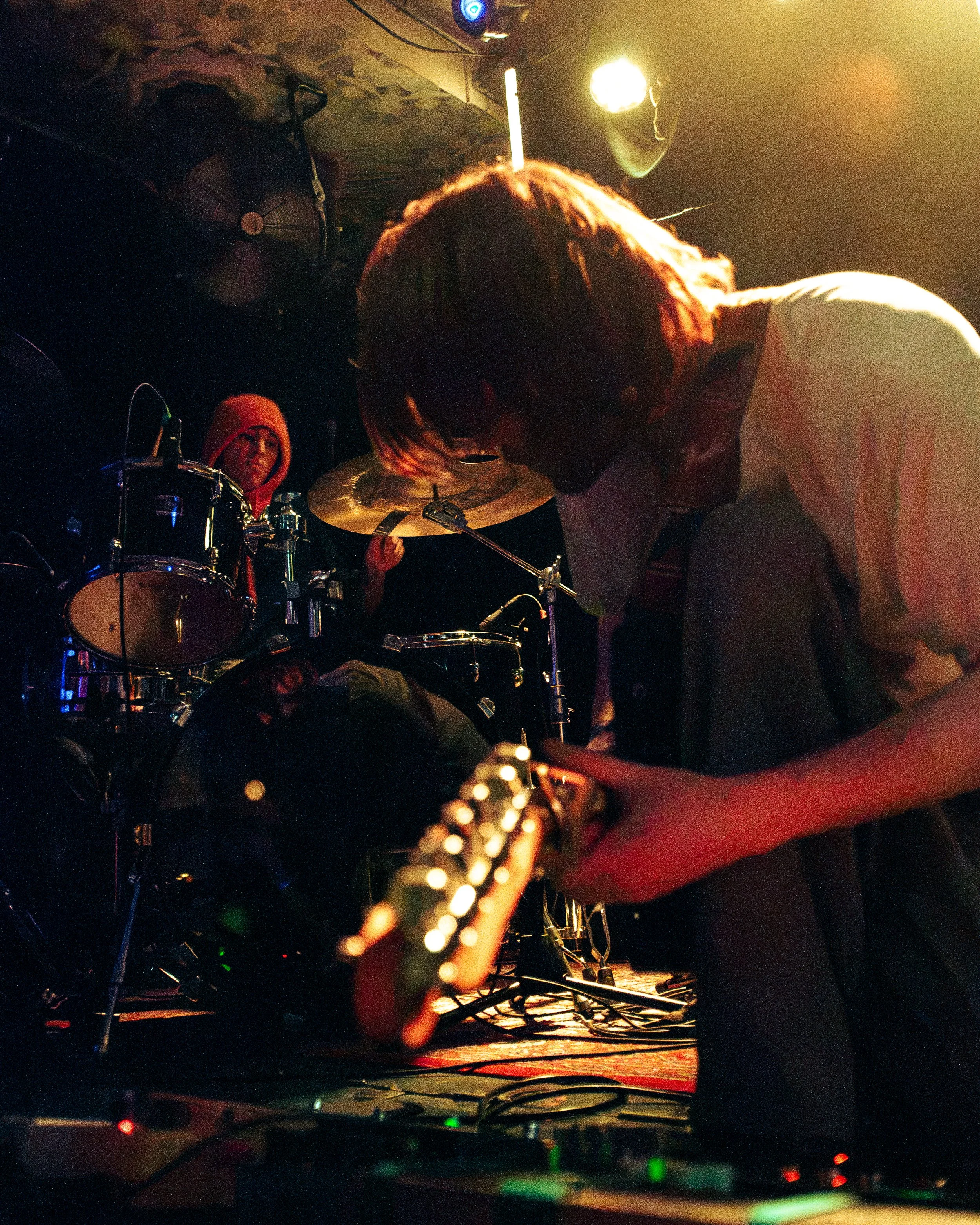
Holly Head
There’s a strong argument to be made that Holly Head are the best band in Manchester. The four-piece set the cramped underbelly of V11 alight on Thursday with a roaring set of agit-funk. Despite seeing them five times now, each time they just get better. Their dynamic grooves of dubby melodic basslines and complex polyrhythms are utterly vicious, tearing through the body and leaving you wobbling in an ecstatic pulse. Yet Holly Head aren’t really a dance outfit. In fact, what they are feels hard to categorise. There are smatterings of post-punk, afrobeat, space rock, and shoegaze strung about their sound, but categorisation only seems to distance the music from its effects. Holly Head are a sensational guitar band. One who is just as capable of threading complex guitar interplay through the eye of their maximalist rhythms as they are of shredding so hard that it feels like the notes are falling on your head like glass shattering at the detonation of a dirty bomb. But it never feels like Holly Head are showing off. Their technical brilliance is steeped deep into their songwriting, the suite of songs they display feeling dynamic and expertly road-tested, as are the band themselves, who ricochet off each other both musically and physically. Jumping and colliding into one another throughout the songs in a manner that feels less aggressive and more organic. The four-piece moving with the synchronicity of a singular organism spread out amongst four individuals.
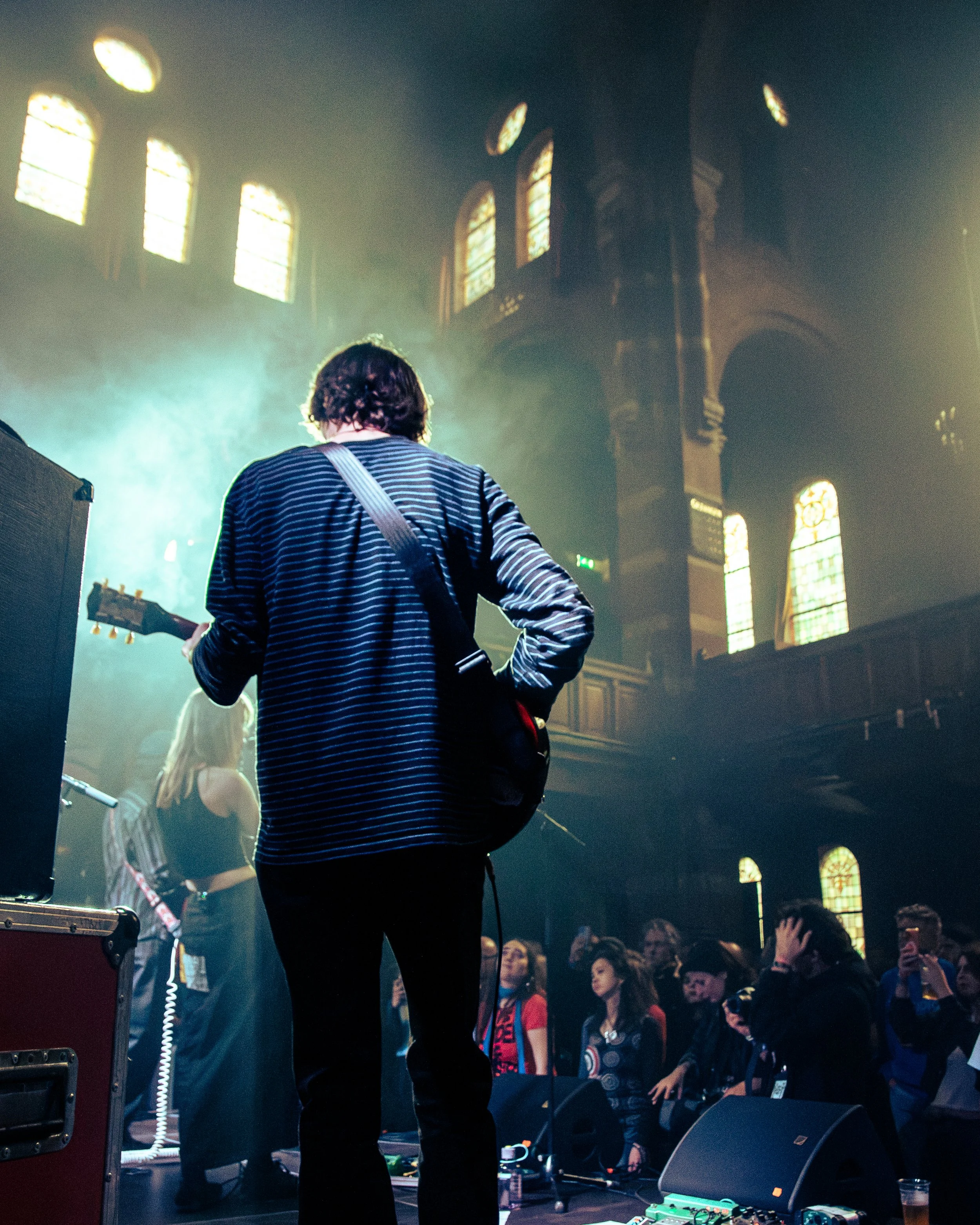
Healing Power of Horses
Opening the hallowed halls of Church Arminius on Friday, cloud rock up-and-comers The Healing Power of Horses defied pretty much all my early expectations of them. Atmospherics were shed in favour of heavy grooves and clear production, blown-out guitars, yes, but piercing rather than fuzzy. While their singles suggested a dreamy trip-hop-adjacent outfit, Horses ended up surprisingly gritty. With a clear focus on tone in both instrument and voice, their songs felt focused and clearly constructed. Every element seemed to ricochet off each other with calculated precision, yet always maintaining an off-kilter groove and an oddly danceable rhythm. Rather than the nonchalant atmospherics I expected, The Healing Power of Horses emerged instead as a near-grungy group. One grounded by a crystal-clear vision and precision shared across its members, but with no interest in easy clichés. The guitar work was tight and dynamic, weaving itself in and out of the rhythm section’s tight grooves through clever playing and complex moves. It’s the sort of playing that’s impressive to witness only as a byproduct of skill rather than being an intention. It led to songs that felt like precise bullets of idea and texture. The precision of the power-trio instrumentation rendered them closer to Shellac than contemporary nugaze. Their singer commanded the stage with understated grace and control. Her percussive spoken word amplified the poppier songs’ minimalist alt-dance, while her huskier tones echoed through the hall high above the instrumentation. The result was a remarkably textured and tactile set. More reminiscent of Pinback than Deer Park, Chanel Beads, or any of their fellow cloud rockers.
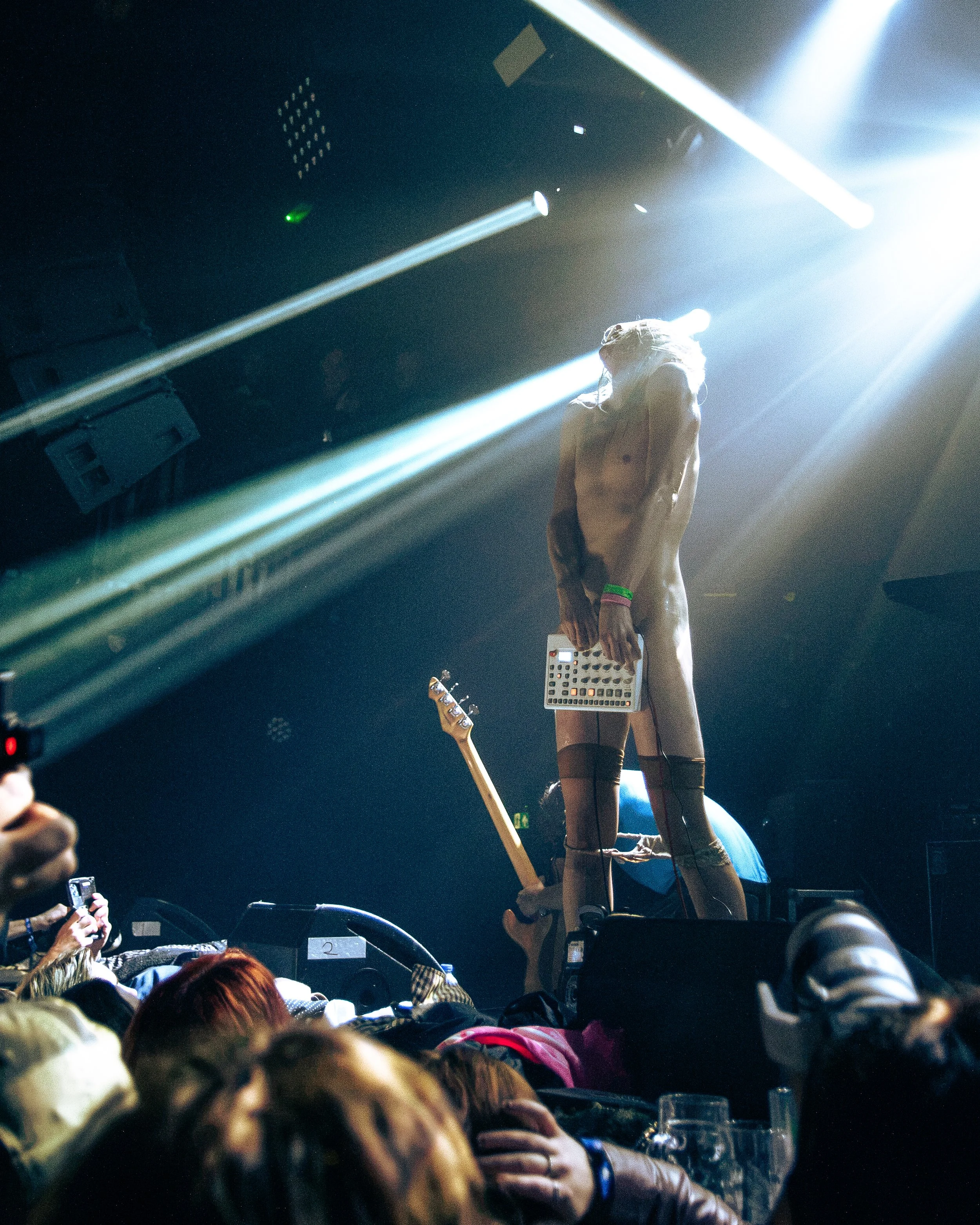
Bathing Suits
If one band felt particularly ascendant in their journey across the many shows of Left of the Dial, it had to be Bathing Suits. It was a stark contrast to see them up on Annabel Downs’ towering wide stage when just a year ago, I’d witnessed them tear through a set in a damp pub basement. But any contrast dissipates as soon as the band starts; the massive crowd that’s gathered before them is in the palm of their hand as soon as the first guitar note screeches out the speaker. Their set is titanic, dance-pop deconstructed and reconstructed through the language of noise rock, a style that’s become a genre of its own in the past few years with bands like Chalk and Model/Actriz, but despite being only one EP into their career, Bathing Suits might be the style’s masters. Their throbbing basslines carry a martial funk as they descend over glitchy dance beats to create a thrashing rhythm. Their two guitarists, one bassist, and drum machine setup are reminiscent of Big Black through and through, but Bathing Suits’ industrial crunch is all their own. The twin guitarists contort their fractured distortion with scientific precision; each riff echoes out like a broken transmission. Scattered remnants of pop melodies become redefined and fractured through their amplifiers. The band’s frontwoman, Freyja Blevins, commands the stage with a mix of ecstasy and authority. Her silver hair flails against the band’s combined sonic terror like an archangel leading an apocalypse choir. Over the course of their set, the distortion doesn’t let up. The highlight might be ‘I Can Be A Freak’, a high-speed nightmare take on Estelle’s dance-pop classic which builds and builds only to end up chopped and screwed to oblivion. But picking out a singular highlight feels reductive. With Bathing Suits it’s about the whole experience. The set builds and builds as the guitarists find new ways to torment the ears and Freyja finds new ways to control the crowd, whether that’s through surfing over their heads or stripping down till only her pants are left on and pouring water over her head. By the climax, each instrument is bludgeoned into a wall of noise, with Freyja left humping and contorting the drum machine into pure. There’s a hint of JG Ballard or Cronenberg in how the band mixes sex, futurism, and pop into a new frightening language. Though while Cronenberg and Ballard were grim visions of the future, Bathing Suits’ vision is jaw-dropping in its appeal and eroticism.
Hammok
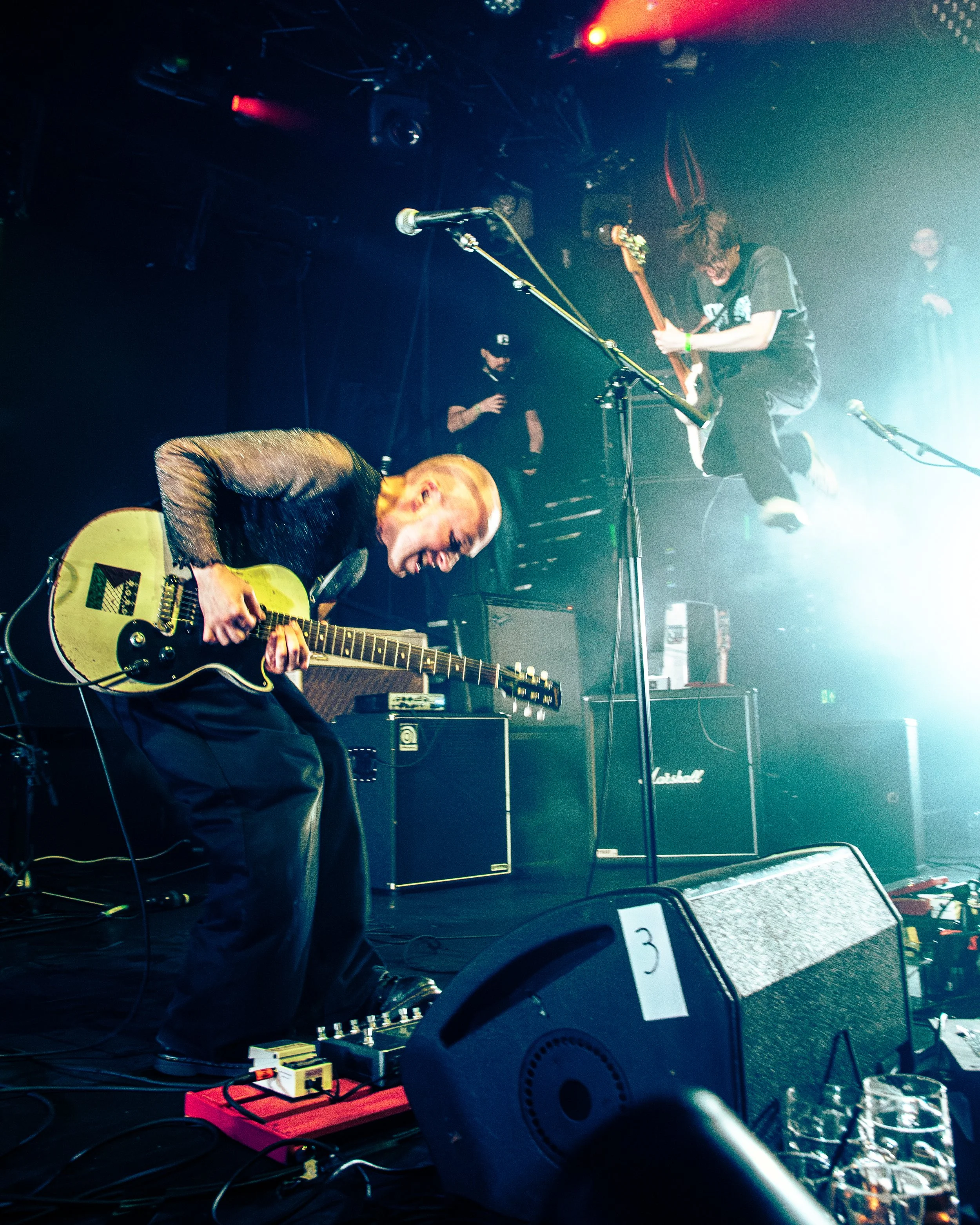
Stopping off at Left of the Dial as part of their ‘This Place, Our Scene Tour’, Hammok took to Annabel’s stage shortly after Bathing Suits had torn up its floors. Due to said tour, Hammok were rendered a real Left of the Dial rarity, a one-set wonder, playing only one show on a Friday night. Emerging to a wave of distortion and quickly kicking into a series of mathcore riffs, the four-piece didn’t waste much time in laying on a memorable first impression. Jumping to and throwing off amps and swinging their guitars around in 360° loops, only to grab them back right in time to unify for a blistering joint stroke or a sudden tempo switch-up. Hammok approach stagecraft with all the blistering performance and lack of irony that made the best early 2000s math and metalcore bands such a joy to witness. They’re the sort of band who crank out their riffs with such brilliant faces and poses that they transcend masturbatory soloing and enter the realm of real theatre. They embody that strain of ultra-earnest belief in the power of hardcore that makes you believe in it. That makes you treat a moshpit as a place of violent unity rather than individualist kicking and swinging. Part of that belief comes from the songs themselves. Mathy pop-hardcore dynamos brimming with excellent ideas hidden in between their scouring screams and machine-gun rhythms. There’s a keen eye for texture in their incendiary guitar lines, and every song feels dusted with one or two smart ideas or techniques that leave each of them feeling distinct. All of it delivered with a mixture of DIY earnestness and operatic intensity that hits a perfect line between the ludicrous and sincere where both remain valid. Sometimes it feels like bands in England are too cool to bathe in any notion of awesomeness. Thankfully these Norwegians aren’t, with their performance pushing post-hardcore’s sonics and presence to their very limits.
Thank
One of the first things I notice about Thank is their drummer. Moustachioed, bald, tattooed all over with pulsating muscles and a face of almost cartoonish meanness, he almost seems transposed from an entirely separate band to the lanky lads surrounding him. Then I look over to see the stocky and somewhat polite-looking guitarist/singer with his round spectacles; he looks like he’s been transposed from an entirely separate band. Then they start playing their mix of hardcore-synth-prog that sounds like The Cardiacs getting into a car crash with Brainiac, and I’m somewhat beginning to get a sense for the bigger picture. But then the vocals go all heavily accented polite British sass, and the basslines are laid down in a thick and heavy style that recalls too many great nineties noise rock outfits to name; I’m further befuddled. Around here I’m too busy chin-scratching to notice the moshers behind the photographers around me or me; neither of the two groups is offering a solution to the puzzle. Okay, I admit it: I’ve been lying. I haven’t been chin-scratching at all this whole time; I’ve actually been focusing on the drummer. The way he tears apart the kit then leans back, unfastens his jaw into a titanic maw, and barks the lyrics off alongside the singer. I’ve been focusing on the way his eyebrows move and shape when he switches from smashing to more complex rhythmic procedures. I’ve been laughing a lot at just how expressive his face is, and how charmingly grim and miserable the vocalist’s lyrics are. But mostly I’ve been moshing and feeling my sense of pace and shape; the very limitations of Barrio’s bar-room stage gradually get countered by Thank and their sonics. Thank might be the oddest band I’ve seen all year; they’re odd in a way that most experimental acts just fail to be. Thank are so close to being recognisable in their individual components but nearly entirely uncategorisable in their delivery. Just pure Leeds weirdo punk executed perfectly with a sense of uncanny Britishness that comes close to but never quite crosses the edge into being overly campy. The set they played was almost all new material, and all of it surpassed the ranks of their solid first two LPs. While on those records Thank could at points come close to gimmicky, on Barrio’s stage they felt like a deadly serious proposition. Comedic but far more grimly so, though maybe that was in part because their drummer looked like he could kick my head in.
Pales
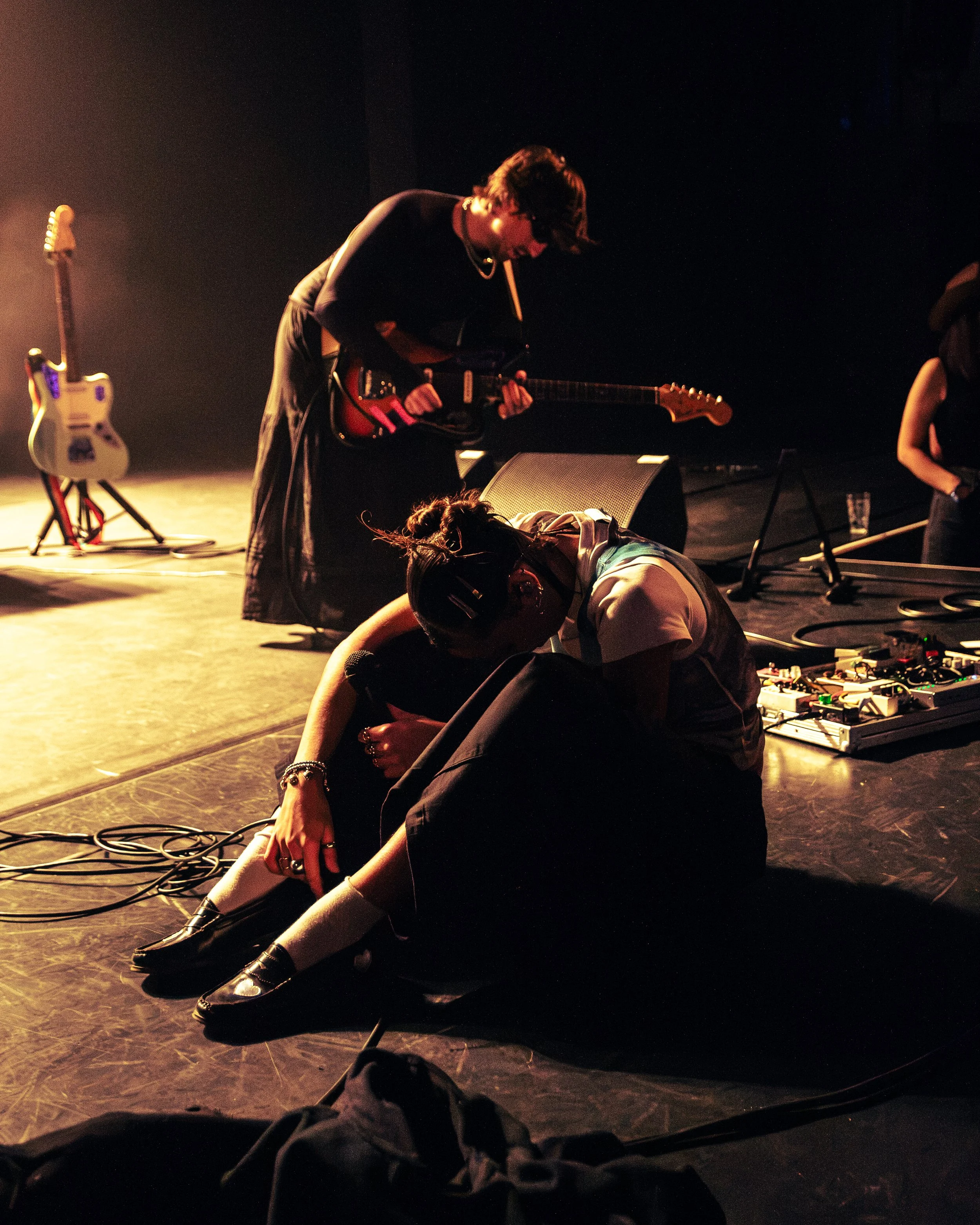
Graceful and decadent in its silences and blasts, Pales’ brand of noise rock is built around constant tension. Tension between sung and spoken vocals, four-on-the-floor beats and crashing cymbals, spiderlike guitar lines and harmonised dissonance, whispers that crawl their way through the seats of Theatre Rotterdam and shouts that echo off its walls. Pales’ whole set runs as one long work of tension, the songs’ beginnings and ends falling away in favour of a near-constant motion. Their drummer keeps his beats tightly wound; the transitions between songs resemble a DJ set in their smoothness, but outside that and some mild synth use there’s not much further in the way of electronic comparisons. Sure, parts of Pales could be slotted close to some of the techno noise rock I previously touched on, but this Strasbourg band feels closer to Sonic Youth than they do to Mandy Indiana. Like the former, they capture a distinctly modern and urban gothic through the language of distortion. Their sound captures the constant tension of the late-night existence, the small darts of danger dashing past your iris as you survey the street corners. Pales work best when they expose that tension, leaning on an almost trip-hop quality in their ability to capture atmospheric decay. They expand the image enough that even at its quietest it can cover the whole audience and then tear through it with a wall of noise. Célia Souarit leads the band with brilliant stage presence. Shrinking down for moments of emotion or fear only to expand upwards into leaps, twirls, and fist-pumping rage. She drives the band into the realms of high drama, her vocals managing to float brilliantly between assured and beautiful singing and Lydia Lunch-inflected spoken-word creep. Despite having an early slot on a large stage on the Saturday, Pales were able to win the crowd over with ease. Their set was an utter masterclass in dissonance and the joy of release.
Pushbike
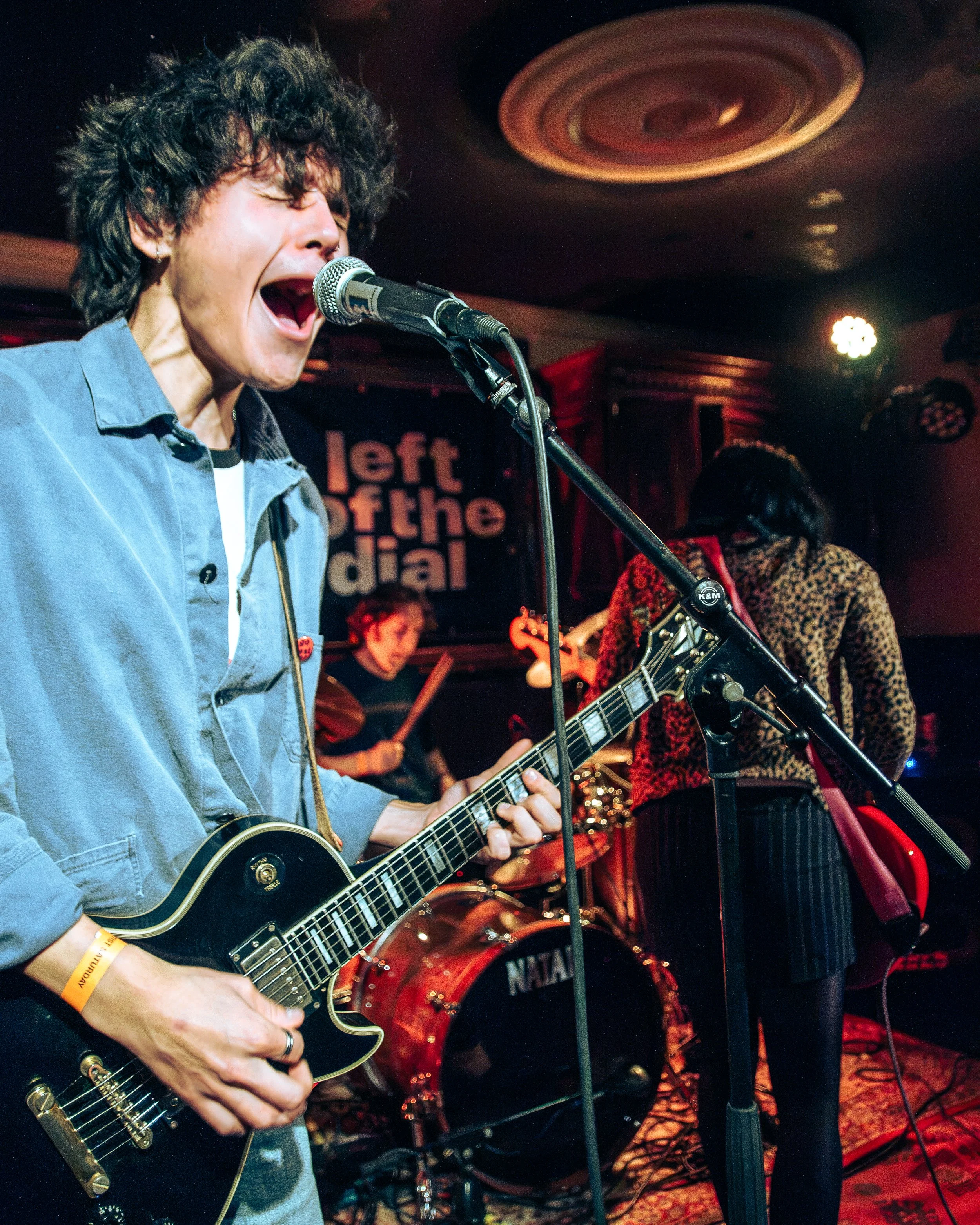
There was a period earlier this year where I became obsessed with the notion of Indie Elitism. It was a time when I’d become so sick of the landfill, so sick of the grunge revival and painful British attempts at alt-country that I began to reflect on where the phrase came from. Were there bands I could believe in? Was there anything truly DIY and independent left in this mess of a nation? Well, yeah, there was plenty of stuff, but none of it sounded the way I wanted it to, none outside of Pushbike and their sister band Bramwell. I unfortunately didn’t get a chance to catch the latter at Left of the Dial, but I was able to see the former on Saturday in Stalles straight after Pales. While it wasn’t my first time seeing the four-piece, it was easily the best set I’d seen them play. Maybe it was the sound or maybe it was all the extra touring they’d been doing. Whatever it was, it doesn’t matter; Pushbike are one of the best bands in the country. True guitar pop geniuses capable of brilliant harmonies and melodies who are smart enough to know that the best pop songs are very rarely over two minutes. They approach indie pop with the speed and ferocity of hardcore. Their drummer demolishes the kit with equal precision and fury as the guitarists line up, shred and harmonise alongside their vocals into power pop that blisters as much as it uplifts. As the set hurtles towards a conclusion, the songwriting drifts further afield. Hints of atmospheric slowcore enter the picture alongside more thrashing post-hardcore and Midwest-emo guitar lines. Yet maybe the best tool in Pushbike’s back pocket is their screams. Not shouty or sceney; no, these are true emo-core screams. Melancholic and anguished, they serve to punctuate the band’s ballads. These little moments of heaviness, whether it’s the screams, the d-beats, or the thrashing climaxes, serve to strengthen Pushbike’s pop into something as strong as steel. Watching them riff and shred on stage, you’re left with the sense that they might be one of the best bands in the country. Like Bathing Suits, they’re a group making heavy heavy pop. A group that realises that just because it’s something short and catchy doesn’t mean it can’t be deeply, deeply heavy.
Ringlets
At first glance it’s easy to mistake New Zealand’s Ringlets for a jangle band. In fact, they are a jangle band in a sense. There’s clear inspiration pulled from the likes of REM and their native eighties Dunedin Sound scene. The vocals are distinct and accented, their delivery reminiscent of Suede’s Brit Anderson or even Morrissey, and in a way the band’s guitar work is jangly. The only issue is the guitar tone is closer to Duane Denison than it is to Johnny Marr, and while their rhythm section does have that signature jangle pop bounce, they also have the crash of post-hardcore. The Smiths meets Oxbow might be the tagline here. Densely literary jangle combined with densely grim and experimental noise to create a sound that’s simultaneously charming and unsettling. But then that doesn’t manage to really capture the whole flair. Ringlets are one of those bands who exist inside a sound of their own creation. The various dissonant elements somehow work together in ways that feel unexpected. The heft of the near-done metal tone of the guitar combines with the marching rhythm section and charming vocals to lend a near neo-medieval flair on tracks like ‘Posh Girl Holds a Whip’. The soft honesty of the vocals melding with the heavy instrumentation in a way that reminds me of Richard Dawson. The way the voice becomes enshrouded by such grand and ornate sonics causing it to seem so small yet all the more tragic for it. Elsewhere, shouted vocals and backing barks from the guitarist give ‘Street Massage’ a serious heft. Despite playing to a half-full room in the middle of Saturday’s programming, Ringlets approach their set with a charming mix of seriousness and humour. Their deadpan stage presence and half-jokes between songs act in strong contrast to the energy of their performance. Classic indie romance and tragedy mixing with guitar swinging, amplifier pushing, drone riffery into a combination that works far better than it has any right to. The result is something hefty and poetic yet decidedly direct and unpretentious.
Leather.head
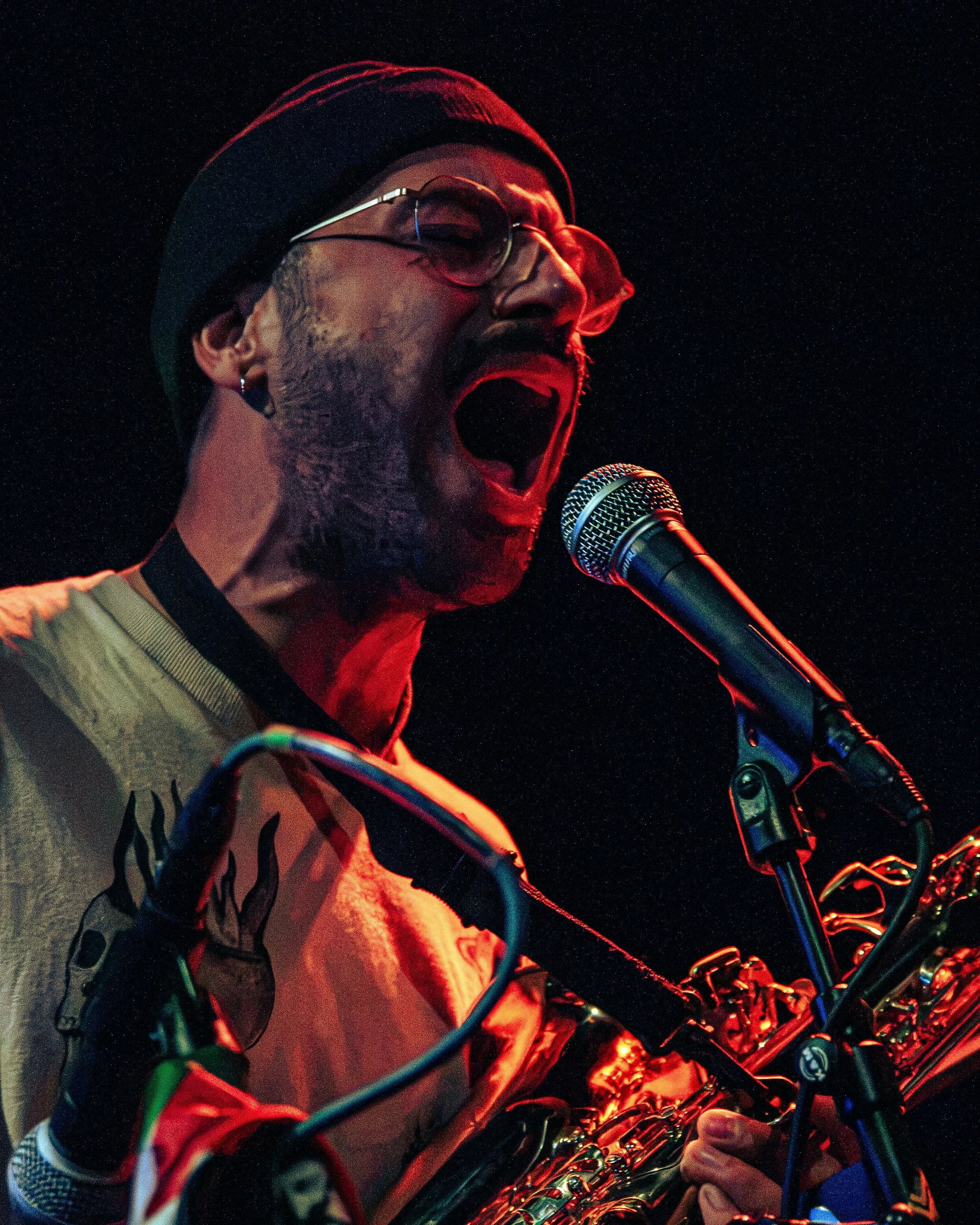
Leather.head treats songwriting as an act of composition. The various cues they take from jazz, screamo, slowcore and no wave are tools rather than genre crutches. Across their forty-minute set at a packed-out Uniek, each song feels clearly focused and impeccably constructed. Spiritual melodies echo on loop through the saxophones as they meticulously tune and prepare each song, the five pieces made up of two brother Aidan, Toby and Josh Evans-Jesra alongside Charlie Loane on guitar and Cole O’Neil on drums carry a jazz-like chemistry and precision. Their tracks are long leviathans, unfurling between mathy Midwest-emo riffs, sludge noise, and then poetry in their final tracks thanks to the assistance of excellent spoken-word artist Zia Ahmed. Toby’s subtle, melancholic vocals and looping guitar patterns give way to an avalanche of screams and emotion. The precise and percussive drumming lays a bed of unfurling textures and pinpoints around which the rest of the band loop and solo. Each track appears distinct and almost novel in its density. Even the shorter ones, like the thrashing ‘Bastards’, which sees O’Neil taking on vocal duty, carry the sort of resonance that most albums struggle to achieve. Across the set, I’m consistently awed by the power of their performance. The way they each sing is intensely physical, whether that’s O’Neil’s spasmodic movements and twitching stomps or their sax player’s tremendous screams. The sort of screams where you can see his whole body being focused around echoing out a wave of pain and solidarity. Solidarity being the core focus of Leather.head, all their emo tendencies being focused into pains both personal and further afield. They end their set with a declaration of solidarity and optimism for the Palestinian resistance; unfortunately, they’re the only band I see over the weekend to put such an important and resonant message forward. But it’s one integral to their set. With closer ‘From The River To The Sea’, that recurring sax motif played between songs takes the focus, with Zia’s spoken word giving way to a mournful horn chorus that gradually fades into shrieking blasts of guitar and anthemic screams of ‘From the river to the sea/Palestine will be free.’ The whole thing was performed with the near-orchestral strength of post-rock greats like Godspeed or Swans but delivered with crystal-clear emotion and intent. The various elements of heavy longform composition put together and directed towards something genuinely important and necessary.
Omertà
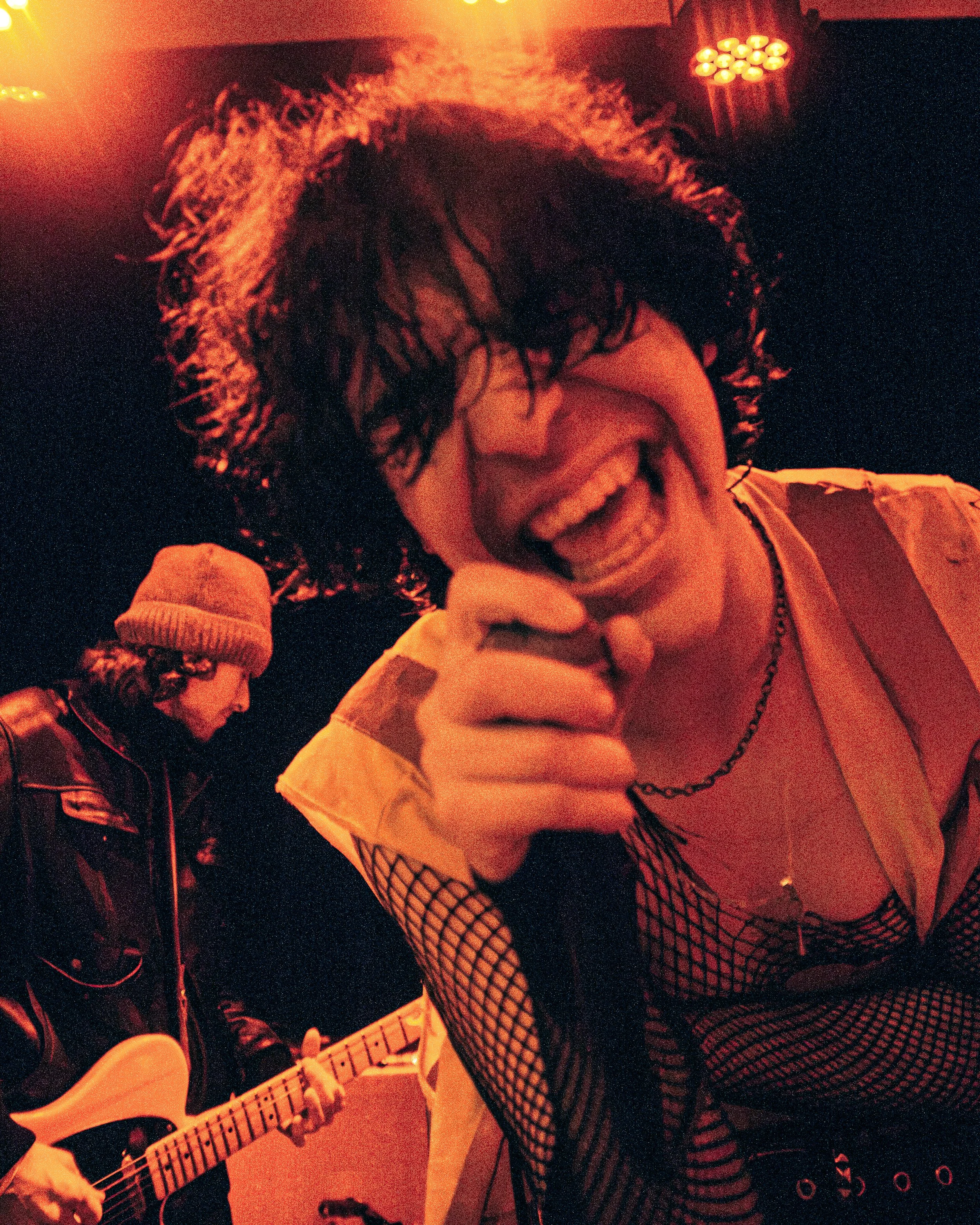
From the moment I touched down in Rotterdam, I knew Omertà would be the last thing I saw. The band of London noiseniks has gathered quite the reputation, though one built almost entirely around shock. Whether that’s through their merch that reads ‘Omertà are here to take your money, you ugly piece of shit!!! Hand it over!!!’, their lead single ‘Gay Hitler’, its follow-up ‘Autofellatio’, or lead singer James’s reputation for whipping his penis out on stage. It all seems from a distance a bit juvenile and overly edgy. The sort of band where you’re forced to ask if their edgelordery is boundary-pushing or just a way to roll around in the muck. Seeing them live in the red-tinted back room of local salsa club ‘Salsability’ put most of my theories of edge for the sake of edge to rest. It had been a rocky road for the band, three gigs played that day, one of which was rumoured to have ended in the singer vomiting on stage. You could tell that tensions were high, that this group of young synth punks had pushed themselves to their limits in the name of art and taking as much advantage as they could of Left of the Dial’s free bar. Across their set, they were on the verge of collapse, with arguments erupting and pedals breaking after each song. Yet despite all that, they may just be the best band I saw at Left of the Dial. For all his controversy, the band’s singer is one hell of a frontman. Moving and writhing across the stage with a real sense of danger, alternating between sasscore yelps and guttural screams with the ease of a trained professional. All of it’s covered by a bed of squeaking synths and one of the nastiest noise guitar tones I’ve heard in a while. The band ripped through their set with all the aggression and flair of a trained underground punk act. The crowd erupted into mosh pits as James screamed for all he’s worth. There are hints of The Birthday Party in their decadent degeneracy, a connection helped by a riotous cover of ‘These Boots Are Made For Walking’ which sends the crowd into ecstasy. And what a crowd it is, half the bands I’ve seen this weekend mixing with belligerently drunk old-timers and a legion of photographers desperate to get a look at the gorgeous car crash that is Omertà. By the end, James is so limp that the guitarist tosses him back and forth across the stage like a ragdoll. Throwing him into the audience only for them to lift him back up as he regains consciousness. And when he does, he’s near vampiric, a lanky undead monster of rock tearing his fishnets over his head as he retches out his grim yet oddly poetic lyrics. It’s an explosive set of gnarly nightmare punk theatrics. It’s a set brimming with moments of psychotic oddity, from an old woman sashaying on stage gently to the guitarist crowd surfing up to the ceiling of the club till his groin is rubbing against the disco ball. Yet the real highlight is when Omertà slow things down for the gorgeous ‘Bleed’, a brilliant slab of roadhouse desert rock that sounds like Rowland S. Howard at his grimmest and most fatally romantic gone shoegaze. It’s in those slower moments that Omertà show that they’re more than just edgy theatrics. They’re brilliant songwriters and a vicious live act who are almost trapped by their disdain for anything pure and earnest. But that disdain is what makes them so addictive. A clear fuck you to the hyper-sincerity of the post-Windmill generation. But not a fuck you that feels lazy or degenerative, rather one that’s backed by songs so violent and anthemic that it’s hard not to scream along with James as he wrestles himself in and out of consciousness.
I will say, as I look back on my favourite acts, it’s worth taking all these with the knowledge that Left of the Dial contains more bands on its lineup than even I think I see in a year. You’ve probably noticed across this list a common thread of genres and interests, and while that’s not all I saw and these happen to be my favourites, they’re also quite indicative of my personal taste. But that’s the beauty of Left of the Dial and its impeccable programming. If I wanted, I could have had a whole weekend of good vibes folk and blissful jangle pop. I could have spent the entirety of my Saturday seeing the various ways a violin can be repurposed through different styles of songwriting. On some level, Left of the Dial feels like an intensely personal festival, not just ’cause of the amount of craft put into it, but because, as an audience member, the festival can be whatever you want it to be. Whether that’s a totem to the power of indie rock, a non-stop noise fest, or a relaxed weekend in Rotterdam set to some tranquil good vibes tunes, Left of the Dial will make it work for you. Across the sites, I kept seeing signs quoting Guided By Voices’ ‘Salty Salute’, large posters that cried out to passers-by, ‘the club is open.’ It felt like more than just a call to attend or a cheeky reference to a piece of indie royalty. It felt to me like an expression of the freedom that truly great indie rock offers. A genre term so nebulous it can be whatever you want it to be, if what this is feels real and visceral enough to get you moving. That whole weekend in Rotterdam, the club was open, but the club could be whatever you wanted it to be. With such excellent programming and venues, Left of the Dial felt like it represented everything in contemporary indie without ever losing its own charm or specificity. It felt like a place of true blue indie rock believers to let loose and worship the genre, or at least whatever the genre means to them personally. That’s Left of the Dial’s real beauty. Its ability to be so all-encompassing yet so personal simultaneously.
Photography By: Henry Wade