
Gilla Band Approach Singularity On Pugnello
Gilla Band discuss pushing their sound to breaking point on Pugnello, embracing drum machines, Dara Kiely’s changing approach to lyricism and the painstaking process behind their fourth album.
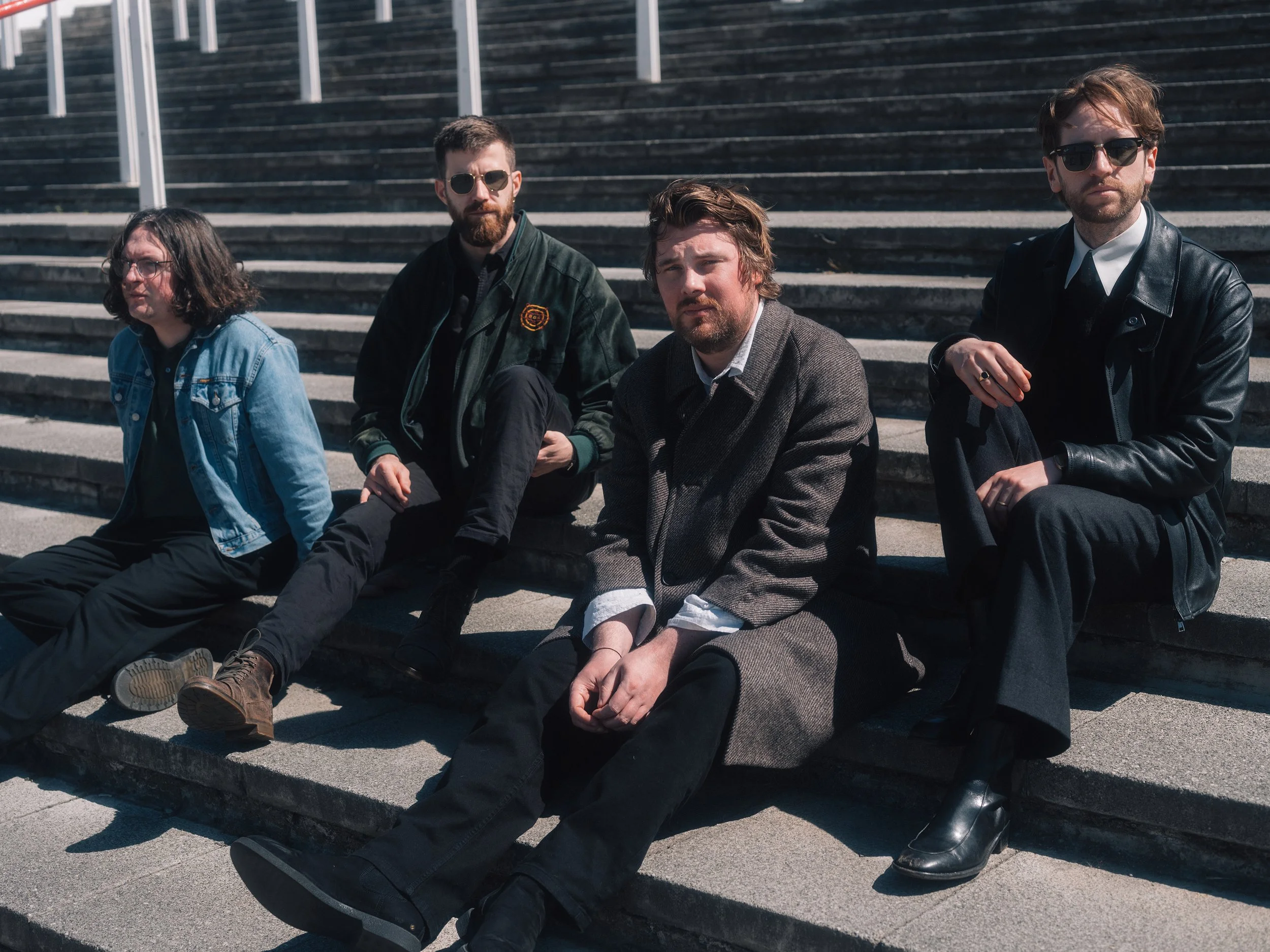
Gilla Band's fourth album, Pugnello, begins with a prayer, at least, that’s what the song is named after. Recited three times a day, the Angelus begins and concludes the workday with devotion to the Lord. It mixes spirituality with the raw realities of the physical world. It’s a fitting name for the opening track, ‘The Angelus’; it captures what Gilla Band do. The traditional rock band, guitar, bass, drums and vocals, reconfigured into something holy. Not religious, mind you, but holy in a sense. A biblically accurate, blister-eyed angel sense. The new album is a fitting soundtrack to both total collapse and divine intervention, constantly aching between punishing noise and more abstract soundscapes that carry a simultaneous divine and wretched quality. I’ve always felt that across each album Gilla Band have managed to push the language of rock and roll further into a flurry of transcendence. Their initial post-hardcore backbone becomes fractured and restructured through the hammers and tongues of no-wave, industrial techno and German kosmische. Sitting down with the band over Zoom, I’m not surprised to hear they agree. “We're always trying to push ourselves to try new things, challenge ourselves musically,” says bassist Daniel Fox.
“We consciously try not to repeat ourselves too much, so I think maybe naturally it might veer down a path like that, but I think it's more coming from an inherent curiosity or enjoying a challenge.”
That love of a challenge underpins much of the band's creative process and philosophy. Across four albums and a slew of EPs, they’ve consistently redefined what a noise rock band can be, by continually testing both their audience and their own expectations. In doing so, a slew of bands have cropped up both across their native Ireland and abroad bearing their influence. I ask if that cycle of influence feeds back into the band, but while they’re fans of their peers their influences are primarily one another. “It's very flattering when bands cite us as an influence; it's really, really cool. But I don't think we aim to do that. We aim to impress each other and grow as a band in the sound of it,” says Fox. “I feel like we probably pull more music influence from, like, outside of rock bands than inside our contemporaries.” It makes sense; the band's direction since inception has been a constant slip from easy categorisation. But with Pugnello that slip has turned into a freefall.
Coming out four years after their last album, 2022’s excellent Most Normal, Pugnello has been in the works ever since its predecessor dropped. In that interim time, the band's members have expanded their work into various other practices. Fox has lent his ears to producing many excellent records by the likes of Mandy Indiana and Psychotic Monks, to name a few. “Over time, I've made a bunch of records between now and then and refined a lot of method stuff.” The main lesson is in curation, or as Fox puts it, “getting good at being decisive with sounds y’know what I mean? So it’s helpful for the group, and then you pick up a few little clever musical things that people do, and you're like, ‘I'll keep that in the back pocket.”’
Whilst Fox has been busy with production, lead singer Dara Kiely has taken up painting. It’s his work in fact that adorns Pugnello’s cover. “The guys and I were talking about doing the artwork, and I think I said if I don't have anything by July just go with someone else,” Dara explains.
“So, what I did was maybe like 150 paintings or something. They're all on photographic paper. I put the album on the demos, and I'd paint to the records. So I was trying to, like, as lame as it sounds, I was trying to get what the album looked like while doing that, because they're all crap photographs from our tour, and so it was like a film over a lens or a blurred picture for someone who's out of focus. I painted on top of it, like, an abstract style; it worked for me anyway. But if it was a good photograph, whatever that means, and I painted on it, it just lacked something. So, the idea was kind of it's a bit cheesy, but it was to get like a positive out of a negative.”
The result captures the sound of Pugnello excellently: a ghostly image of a hand holding a cigarette beneath a cascade of waves resembling Joy Division’s Unknown Pleasures smudged into disarray. A mix of distorted familiarity, loneliness and distance overlaid with shards of violence and confusion.
Kiely’s process of making demo painting after demo painting mirrors the band's own process of making the album. While some tracks were, as Fox puts it, “relatively spontaneous, like, uh, Jacobson's kind of came out the bat straight away. We actually tried to change it around and then basically went back to the initial version. The Angelus was very spontaneous. We wrote that basically in a day.” But many of the others were far slower to construct. Lead single ‘Giraffe’, with its two halves, one side a splintering gang of four guitar, the other an industrial techno knuckle dragger, was made as an act of semi-collage. “There's a pretty long gap between writing the two,” says Fox. “We just kind of tried them together, so it was kind of like two separate pieces of music.” Most of the tracks were made gradually, with idea after idea being flung at the wall. The most extreme example of this process might be ‘The Megazord’, a shuttering piece of post-industrial dance that shifts between tense martial grooves and outbursts of emotive distortion. It's one of the album's most ambitious tracks, and the near-endless toil put into it: “I think it was, like, Megazord version fuckin' 47 by the end of it, y’know,” says Fox. “We'd been tinkering away with it for absolutely ages. Different melodies, different structures, muting bits out.”
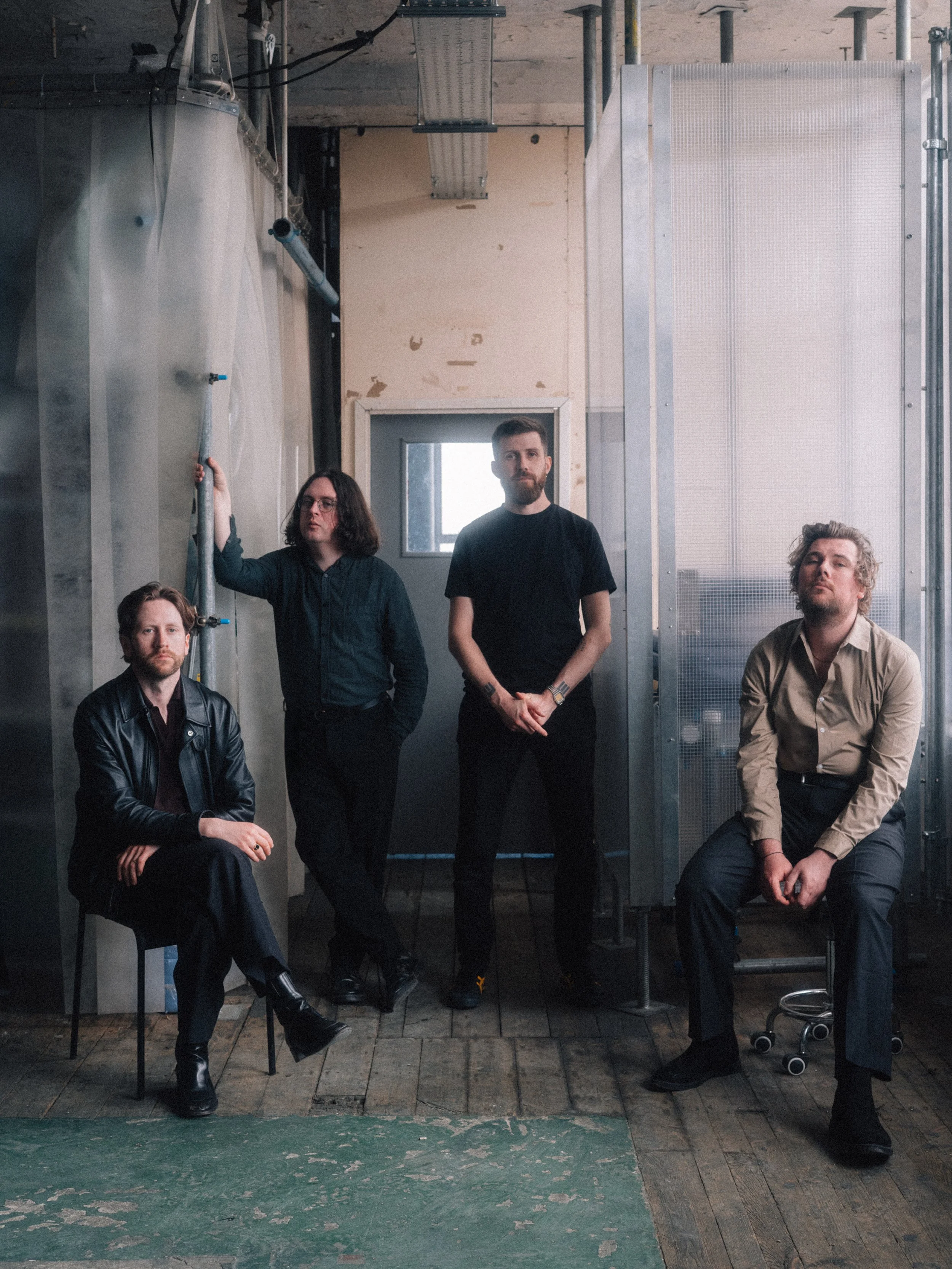
Some things have shifted in the band's songwriting process, the addition of a drum machine being the most major. In some ways it harkens to their clear love of dance music with Fox calling the genre part of “the DNA of the group,” noting “It's probably a little more obvious on this, because a drum machine is a trope of that kind of music.” But that shift isn’t necessarily radical, more an “opening of the door in a slightly different room” according to Fox. An expansion of creative possibilities but not a rewriting of the process. That process for Gilla Band remains that of slow deliberation and experimentation. A desire to impress one another and innovate on what they’ve done before. “Sometimes it's really easy, and you just vomit it out, and then sometimes it's a lengthy labour of love,” says Fox.
“It’s like solving a puzzle. We know there's a good thing in this; we just have to trust that it's worth keeping going. We have lots of tracks that we’ll start writing something and abandon it 20% of the way in, y’know what I mean? If no one's really getting the buzz off it, we'll abandon lots of stuff. We don't really finish songs and then not use them; we just kind of abandon lots of things before they're even half-finished. But sometimes you know that there's a good thing at the end of it, and it'll be worth it.”
There’s a purity to the band's approach. Ideas that fail to excite them are abandoned early; those that show promise are pursued until they finally click. It reflects years of experience and precision. Oftentimes watching Gilla Band live, I've come away thinking of them as a team of experienced technicians. Dissecting and reconstructing sonic ideas, drum patterns and grooves into unrecognisable idols of perfect shrieking symmetry. Yet on Pugnello they seem entirely unplaceable. Despite the record being made with much the same techniques and routines as their previous work, just with the addition of a drum machine, something sets it apart. Kiely suggests that it might be because their last records had “maybe a slightly more defined mood board;” whereas for Pugnello, “we were getting high off our own supply.” He elaborates that by now the band knew the “musical things that we wanted to do, so it didn't feel like we needed to pull from other records.”
It's an answer I expected, because it’d be hard to find any easy comparisons for Pugnello beyond the occasional synthesised vocals, a touch inspired by Kiely’s love of Neil Young’s Trans. Though the way it appears on the tracks ‘Computer Sadness’ and ‘The Gallop’, like a decaying chiptune voice mumbling into deletion, it’s quite a distance away from Young’s odd heartfelt attempt at synthpop. But then everything on Pugnello is at a distance from what's come before. Opener ‘The Angelus’ seems like a straightforward thrasher until it starts to devour itself. Eventually culminating in the instruments clashing into each other like steel beams in a collapsing building as Kiely screams “Elvis has left the building.” The dancier cuts like ‘Alogia’ are stained with a phantom-like ambience. Even a track like ‘Crisp Pop’, which is classically Gilla Band in its mix of techno and noise rock, feels more unhinged than any of their previous offerings. The bass and guitar morph into creaking, quaking waves of sound, sometimes resembling tsunamis at other points earthquakes, whilst the mix of electronic and acoustic drums rains and cuts like nails in a hurricane.
Punctuating it all is Kiely's voice, which flits between poses. Sometimes he's like a drunken crooner laying a few insults into their thinning audience. Other times he’s closer to an evangelist preacher recollecting a long life of memories, whilst being gutted and tortured. Like every Gilla Band record before it, Pugnello’s lyricism is a summary of the last few years of Kiely’s life condensed into a dense, hard-to-comprehend modernist scrawl. Some of them are absurd, like “Gary Lineker is a crisp maniac;” others call back to childhood. References to Bananas in Pyjamas collide with lines about his recent schizophrenia diagnosis and death of his father into a mesh of memories. “My favourite lyric when I was a kid was Top Cat close friends get to call him TC, I just thought that was the coolest lyric, and I still do,” he notes with a chuckle. “So, like, it was cool to get that, and Bananas in Pyjamas, and you know Big Brother and Crazy Frog and stuff. These kinds of things that have their own place in my memory or whatever. It was more like that was how I distracted myself when I was a kid and then nothing's really changed.” But the lyrics aren’t just absurdist distractions at points; they're a confrontation bordering on an exorcism. The process of dealing with his father's death, an event that hangs in the corners of the album, was a long one. “I didn't write it directly about him,” he insists.
“It's not about him as a person or as a father or anything. It's more of the feeling of what grief kind of did and does. I think it's a very unique thing for every person who goes through that thing. At the end, it was very cathartic. Particularly at the Gallop, the last track, I really was in the right kind of mindset to really talk about it directly.”
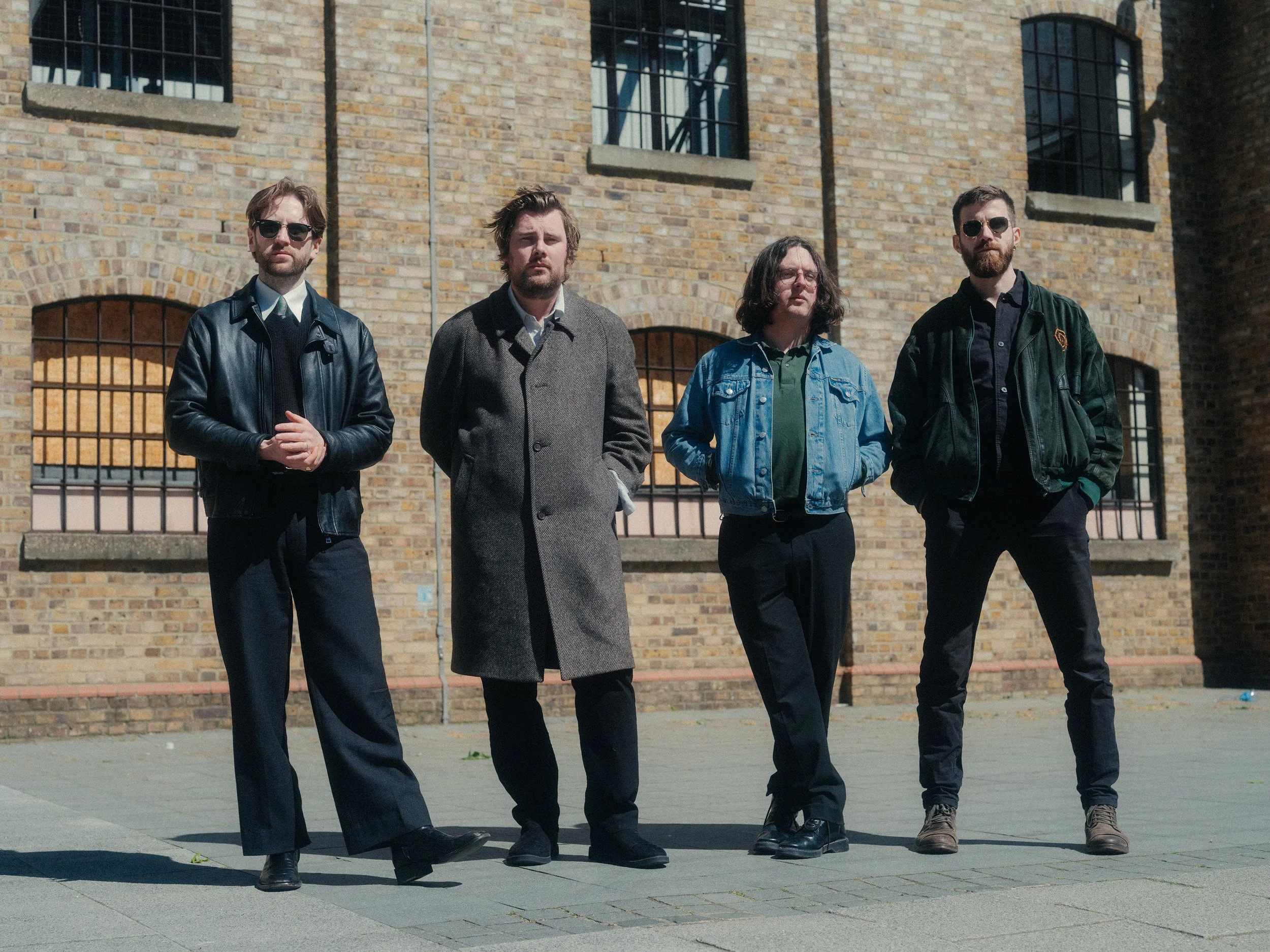
But Kiely continues to swear off overly direct readings of his lyricism. “I don't really like telling people what to think about music, y’know what I mean? So a lot of stuff on it I figure out in hindsight what it actually means, or one particular line means. I quite like stitching phrases and stuff together and like a lot of word play and stuff like that.” Wordplay is a key part of his technique. Despite the band’s well-documented love of The Fall, “getting caught copying the fall” actually grew out of a piece of songwriting advice. “I was told by Liam, who did a couple of records of Daniel, don't ever write Catch Me If You Fall, or those kind of lyrics like forever in a day. So, I was kind of messing around with lyrics, and that was like a nod to Catch Me If You Fall, and then getting caught.”
Kiely’s writing process is incredibly varied. “I mix it up loads,” he says.
“I always ask people how they write lyrics, like different singers or whatever. I take notes all the time on my phone. I have loads and loads of notebooks. I hate a blank page; it freaks me out, so I can't do that. I do morning pages the odd time where I wake up, and you write stream of consciousness writing, two or three pages. That was great, but the last two records, most of them on this, I'll get the demos of the band, or I'd write my own. I have this, tacky organ that has drum machines on it, so I just, hold down a note and try to get a melody from that. It's really cool, because I have, an infinite amount of takes so I can just chip away at certain words.”
Despite the mania of his vocals, every aspect of Dara’s delivery is underpinned by precision. He cites the best piece of advice he got as one from his sister: “She taught me some really cool stuff. Like if you're gonna hit a word, don't think of the big note that's later in the track because you have to do it step by step or else you'll mess it up. So you have to give every syllable your own attention. And that makes it not paint-by-numbers. That moment-to-moment thing about being present is really what she taught me.” Surprisingly, the biggest new influence on his lyricism is one of his own songs. Most Normal’s glimmering dance-punk closer ‘Post-Ryan’ for Kiely marked a clear personal turning point. “We needed to write a bit more direct, so I did, and then when I showed them that I had to leave the room because I was uncomfortable being in there, and then they were into it. Because of that, it opened the doors to do something similar. I think the closest one that comes to that on the record is ‘Alogia’. I used that idea of being direct after I found out about being diagnosed, and that was really cathartic and cool. I was able to write the lyrics on the track without being embarrassed or uncomfortable about it. I think that's what Post-Ryan did to my end of the writing. It just opened up a lot more possibilities for you lyrically.”
For all their focus on precision and texture, with Pugnello Gilla Band sound louder than ever. Kiely especially, his screams reaching James Chance levels of contorted mania despite his initial aims. “I was like, oh, for this record, I'm gonna croon. It's gonna be fine. I can save my voice, things will be okay. And then it's just we had that phrase in the studio of “give your full bollocks.” It's like I tried certain things and then when I was doing it live, it was recording it, and Daniel was like, I think you have to go full bollock on this one, and then it would kind of go up a bit. Sometimes you just have to let the music kind of tell you what to do, you know?” It’s a story that nails Gilla Band's duality: their mix of near-scientific sonic precision with raw rampant energy. Though the process has been long and arduous throughout all of Pugnello, the music has guided them, led them down the craggy path towards a record of true brilliance. It’s the band's most singular effort yet. A haunted soundtrack to looking back through all the mess and malaise with crystal-eyed clarity. Yet even then, with that gaze, things seem more intangible and distant. But throughout our conversation, one thing is clear: Gilla Band are looking out together. Across each record, their bond only seems to get stronger. Fox and Kiely aren’t just generous conversationalists; they're clearly genuine friends and allies. There’s something beautiful about their faith in music and artistic process, especially when it leads to a sound of such transcendentally beautiful terror.