
In a career-spanning performance, Björk makes the familiar almost unrecognizable and the extraordinary even more so.
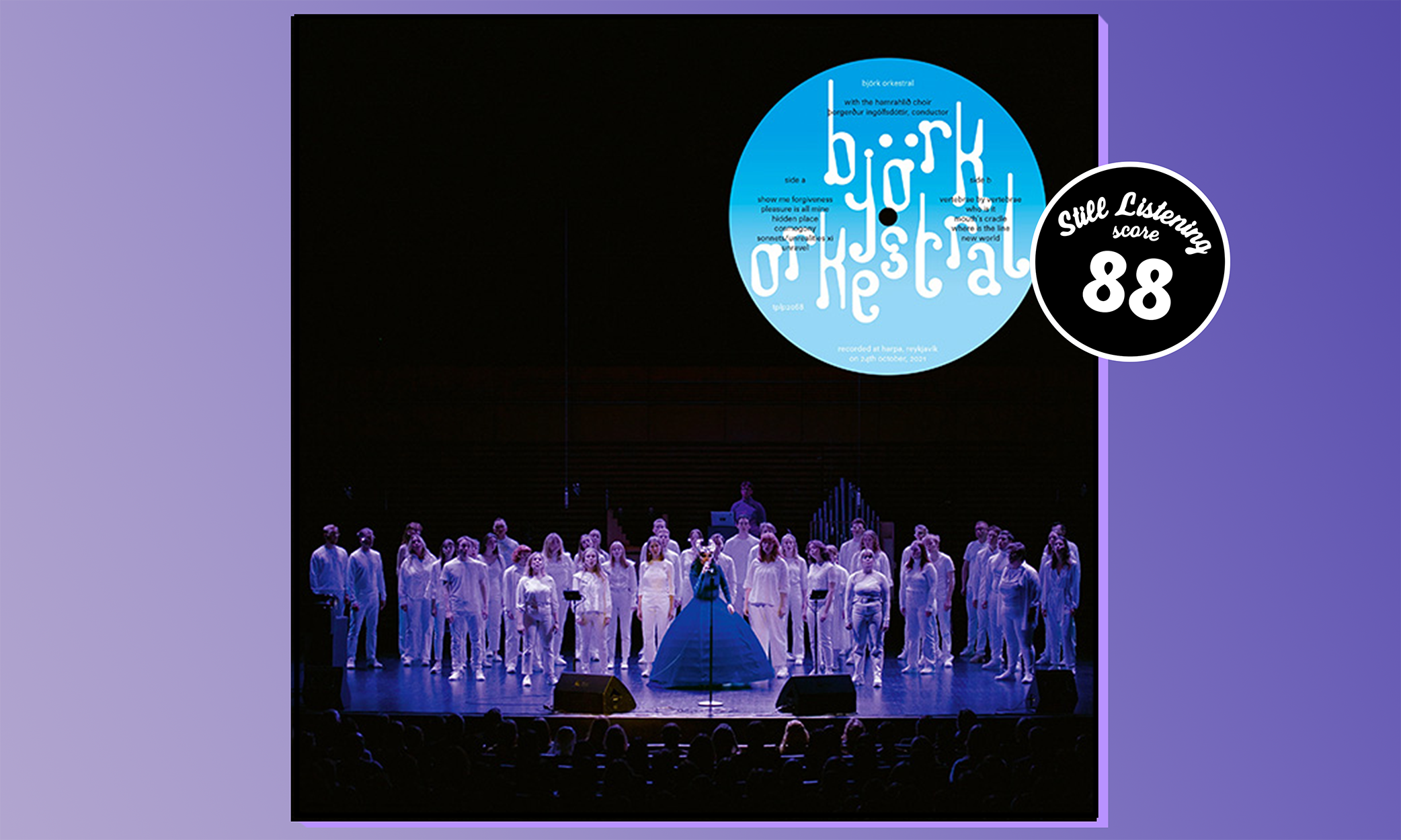
I was not expecting to have an opinion on ‘Mouth’s Cradle’ that I hadn’t already formed listening to Medúlla. Nor did I expect to find myself contemplating a standing ovation in my own living room. Björk Orkestral with the Hamrahlíð Choir managed both. Going back through the studio recordings afterwards gave me a consistent impression: what I’d found mild was now good, what I’d found good was now great, and what I’d already thought was great was chilling. An inconvenient discovery for anyone attached to the originals.
Recorded at Reykjavík’s Harpa Concert Hall in October 2021, the eleven-track live album reunites Björk with the Hamrahlíð Choir, conducted by its founder, Þorgerður Ingólfsdóttir. Much of the material comes from Medúlla (2004), a record on which Björk had already put the human voice to work in ways that make the idea of a conventional backing vocalist almost laughable. What interests me about bringing a choir into that particular world is that the songs were never exactly short of voices to begin with. What else could they have to offer? Quite a lot, apparently.
‘Show Me Forgiveness’ and ‘Pleasure Is All Mine’ make for an interesting opening pair. The former is so bare in its original form that the very act of asking for forgiveness feels uncomfortable; the latter makes a generous sentiment sound almost overwhelming. I like that this repertoire allows a choir to be something other than beautiful. Beauty was never going to be in short supply here. The question is what Björk and the singers can do with the less comfortable aspects of her work, too.
And then there’s ‘Hidden Place.’ I have a particular affection for the intimacy of the Vespertine original, a song about finding somewhere to put a feeling so precious you almost don’t want the rest of the world to know about it. On this recording, it becomes one of my absolute favorites. There’s something wonderful about having so many people involved in the construction of a private little universe. It shouldn’t feel quite as intimate as it does. And just when I thought I’d found my favorite moment of the album, ‘Cosmogony’ began.
Putting those two back-to-back was an excellent decision. The scale of the writing alone makes the transition interesting: from the universe two people might create for themselves to competing stories about how the actual universe came to be. But the emotional effect of hearing them together is more persuasive than any explanation I can offer for it. ‘Hidden Place’ makes me want to stay exactly where I am; ‘Cosmogony’ makes everything around me feel suddenly exceedingly small. I would happily revisit the album for those two songs alone.
‘Vertebræ by Vertebræ’ is my other standout. If the previous pairing is an argument for the choir’s ability to communicate tenderness, this is an excellent argument for allowing it to frighten us a little. The Volta original is already quite unsettling, with its preoccupation with the body and its insistent momentum. Here, the song’s physicality becomes even more imposing. The fact that the same ensemble is responsible for some of the record’s gentlest and most unnerving moments is my favorite thing about this project.
As for ‘Where Is the Line,’ yes, I can absolutely see why this was the single. Björk describes the song as an unlikely marriage of Icelandic choral tradition, death metal, and techno. On paper, that sounds like an ambitious argument with the shuffle button. In practice, it makes perfect sense: a song about the absurdity of telling somebody off when you’re hardly innocent yourself ought to be allowed a little musical unruliness. The live performance is exhilarating. If I’d been in that concert hall, I suspect I would have been less composed than I usually like to imagine myself.
The bigger surprise for me was ‘Mouth’s Cradle.’ I hadn’t particularly liked it before; I do now. That is worth more to me than another excellent performance of a song I was already predisposed to love. ‘Who Is It,’ on the other hand, remains my least favorite. I can hardly hold the arrangement responsible for a song I wasn’t terribly fond of in the first place, though. Even Björk and an entire choir cannot win every argument with my personal taste.
I’m not particularly interested in ranking this recording against decades of Björk’s studio work. What I am interested in is how much more I enjoy some of that work because this album exists. There’s something satisfying about an artist returning to her own catalogue and making a listener reconsider a judgement they thought was settled. I came for the songs I already loved, found a reason to revisit one I didn’t, and left wishing I’d been in the audience. I’d call that a rather successful live album.