
brandon flowers - thrasher Review
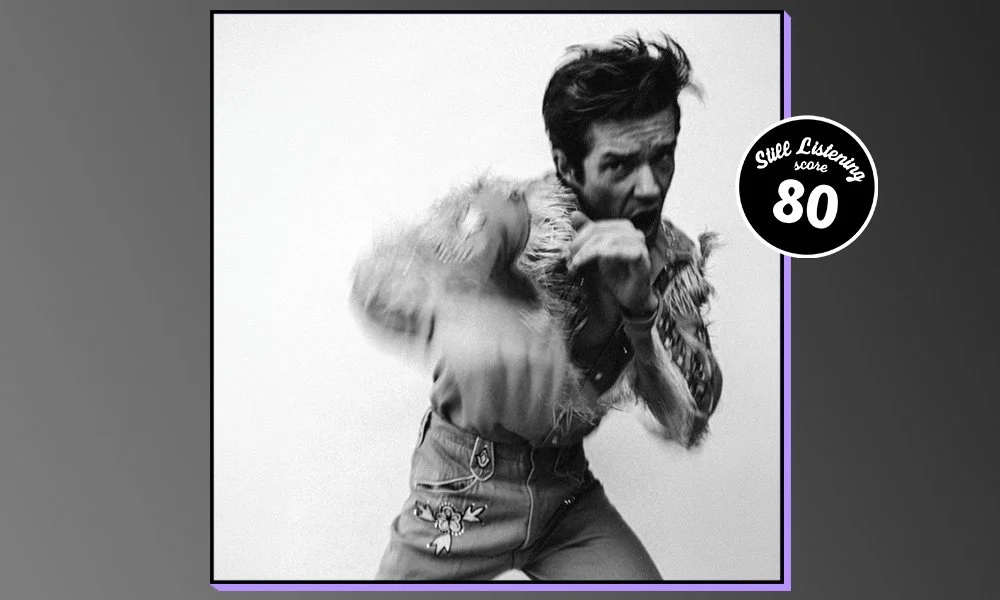
Country-western suits Brandon Flowers on the deeply personal THRASHER.
Those expecting ‘Mr. Brightside’ from The Killers frontman Brandon Flowers’ third solo album, following Flamingo and The Desired Effect, will be disappointed. Those more familiar with later Killers work like Pressure Machine, a career highlight, and Flowers’ solo records should feel right at home as the Las Vegas rockstar heads further down the well-trodden path into country music.
But one could argue The Killers have always had country in them, in much the same way Springsteen has always operated somewhere within that sphere. Even those fearing that THRASHER, stylised in all caps, might mark Flowers’ descent into Morgan Wallen territory have nothing to worry about. It’s yee-haw-tinted, yes, but there’s still plenty of The Killers in its DNA.
The closest contemporary country comparison is probably the maverick style of Sturgill Simpson, or maybe Chris Stapleton, particularly Simpson’s A Sailor’s Guide to Earth. You can hear it early on opener ‘Does It Ever Cross Your Mind’. It swings like a dream, evoking the memory of finding someone and realising you’re about to spend your whole life with them.
Pop clichés abound in Flowers’ lyrics. “I could’ve been born in Bangladesh / but I wasn’t, I was born here,” he sings, before asking someone to “go a’wishing on a star”. In lesser hands, lyrics like these would feel forced, awkward and cheesy, and to an extent they still do. But, as Flowers has done since the days of ‘The Man’, if not before, he jumps headfirst into the cheese and embraces it with the sincerity and conviction these lyrics absolutely require.
We next descend into the small-community storytelling of ‘One of Us’, where Flowers explores the loyalty that comes with a found family. “My big sister you built your house on stone,” he sings, pledging himself to the song’s subject and promising that, no matter when he called, they would pick up the phone. It’s a charmer, full of a real sense of wonder.
Flowers travelled to the historic RCA Studio A with longtime producers Shawn Everett and Jonathan Rado to make the record in country capital Nashville. History and lore are all over THRASHER, so returning to somewhere so steeped in both feels only appropriate.
THRASHER is, ultimately, a return to Flowers’ roots. We know the story of the casinos that adorned and influenced Hot Fuss and Sam’s Town, but age inevitably brings reflection. Much like Pressure Machine told the story of a small-town America that time forgot, THRASHER finds Flowers looking back at the Utah of his childhood and teenage years.
There, he listened to Johnny Cash and Waylon Jennings alongside the new wave, post-punk and Britpop inherited from his older brother. Cash and Jennings came from his dad. That mesh of Americana and pure distilled British music would eventually lead to The Killers being claimed almost as enthusiastically by Britain as they were by America. Now Flowers finds himself drawn back towards his father’s music: “country-western”, as he calls it, “a beautiful American tradition”.
Tradition drives ‘One of Us’, but it runs throughout THRASHER too. Its honky-tonk rambles and ballads feel lived-in and wholly alive, creating characters who seem to have entire worlds built around them within the space of a single song.
‘Tigers Blood’ revisits the runaway-train storytelling that defined the early tracks of Pressure Machine, looking back at childhood friends Flowers has lost touch with, people who, the last time he heard, were doing okay. The Killers have always been fond of returning to earlier stories, most famously with the murder trilogy of ‘Leave the Bourbon on the Shelf’, ‘Midnight Show’ and ‘Jenny Was a Friend of Mine’. Here, the rougher edges of Flowers’ arena rock are stripped back to their bare bones. The track feels like a homecoming, evoking a familiarity that works regardless of where your own version of home might be.
With all those stadium anthems, it’s sometimes easy to forget how skilled a songwriter Flowers can be. His collaborative instincts have been evident in his work with artists like Phoebe Bridgers and Weyes Blood during his time fronting The Killers, and THRASHER continues that spirit. Charlie McCoy, now 85 and a veteran of all four of Bob Dylan’s iconic Nashville records, appears alongside influential pedal steel player Bruce Bouton and David Rawlings on guitar. Together, they form a makeshift band that accompanies Flowers on this journey through nostalgia and memory.
The record’s more specifically weird images can occasionally lend it a quasi-Lynchian feel. “Elvis in a Tesla Model X” crafts an image of a man out of time, adjusting to a future he may not necessarily want, while “a Guinness World Record holder / for the longest fall living” revels in Flowers’ taste for the strange and hyperbolic. Images like these sell you on the characters and give THRASHER a welcome streak of weirdness.
He also makes room for ‘Miss America’, telling the story from the perspective of a young woman in an abusive relationship. It almost lands despite Flowers’ bluntness not necessarily being best suited to subject matter this hefty. Make no mistake, it feels uncompromisingly raw and honest.
‘Angel’ takes an even bigger swing. It tells the story of a Black baseball player who begins dating a white woman before being deployed to the Navy, becoming addicted to drugs and leaving his wife and newborn daughter behind. Eventually, he is pulled over by the police, with the song suggesting that his fate was somehow fixed and things were always heading this way.
It’s here that Flowers’ bluntness becomes a bigger problem. The song’s treatment of race is muddled enough that, without the wider context, its lyrics can feel caught somewhere between a critique of racism and an unintentional endorsement of the assumptions it is seemingly trying to interrogate. Peel back the layers and there is a deeply personal element to the storytelling, particularly in the parallels with Flowers’ sister being trapped in an abusive relationship and the construction of Payson, Utah, as somewhere she might escape to, miles away from Las Vegas. There’s a recognition here that women trapped in abusive relationships don’t always have an easy way out.
It feels like Flowers making a massive swing with bold storytelling, and while the imagery can be as vivid as Elvis sitting in a Tesla, something about ‘Angel’ remains misguided. It doesn’t quite land with the impact that this sort of subject matter demands. On ‘Angel’, it feels as though he has gone back to the beginning of his career, and not in a good way.
But it’s a blip, a wobble, on an otherwise excellent record. Being a fan of The Killers means accepting that there will usually be one or two songs on each record that don’t land quite the way you want them to. That’s doubly true of Flowers’ solo work, without the guiding influence of his bandmates around him.
As a whole, THRASHER is far more cohesive and in line with Pressure Machine than the anthemic singles of The Desired Effect. It’s a stronger record for it, and feels like something of a return to form from Flowers as well as his most accessible work in ages. It’s friendly, welcoming, warm and inviting and, ‘Angel’ aside, surprisingly in step with country’s current embrace within mainstream pop.
For a comparison point, it’s a little like Beyoncé switching gears for Cowboy Carter: in hindsight, an obvious direction, but initially a jarring one. Unlike Beyoncé’s squarely country effort, though, calling THRASHER entirely country would be misleading. It’s country-western, a modernised take on the genre that leaves Flowers plenty of room to remain himself.
Given the shift, it’s easy to see why Flowers might have worried about how fans would react. In a recent interview, he cited Walt Whitman’s famous declaration that he is large and contains multitudes. Flowers wants room for these other influences, beyond the British hits adopted from his brother, and some of the record’s most affecting moments come when he allows himself that freedom.
His dad’s influence is particularly evident on ‘Paradise’, where Flowers sings: “I cared for my old man right until the bell rang / He never really cared for me.” It’s deeply honest and raw, and gets to the heart of what THRASHER is really about.
Flowers seems to be working out who influenced his life and how those relationships shaped him. Where it would be easy to dwell on the negative, one of THRASHER’s core ideas is his determination to focus on the good that survived it all. That loops back to ‘One of Us’, the grief carried by Flowers’ sister and his relationship with a brother-in-law who had effectively been a brother to him since childhood. It becomes a story about the responsibility that comes with marriage and joining a family that wasn't originally yours.
These relationships are the defining influence on THRASHER. Quoting Martin Scorsese alongside Whitman in a recent NPR interview, Flowers talks about the idea that the most personal can also be the most creative. He has enough self-awareness to admit that he doesn’t consider himself particularly interesting in isolation. He has often operated almost like a Tom Cruise type of musician, keeping his personality at a distance and allowing the music to do the talking.
What he has realised is that he has spent his life surrounded by interesting people. People who have left a mark on him. That impact is deeply felt throughout THRASHER, as Flowers realises that his own stories are worth writing about just as much as anybody else’s.
Surprise, surprise, it’s Springsteen and Tom Petty who ultimately show him the way. THRASHER feels like an album that had to happen later in life, made by a man approaching 45 who can look back on his career and admit he had absolutely no idea what he was doing when he started out.
Ultimately, it boils down to the album Flowers’ dad had been wanting him to make all along. The result feels like the most deeply personal record of his career to date, flaws and all: the next evolution of Pressure Machine, a world away from the football terraces of the UK and firmly into peak Petty and Springsteen territory.