
Westside Cowboy - It Goes On Review
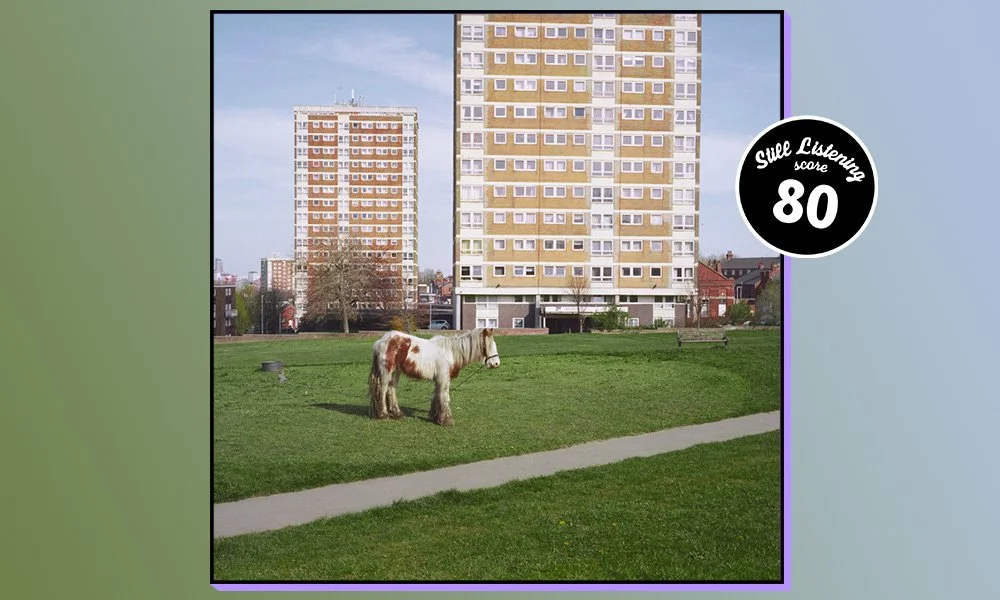
Giddy up! Manchester’s buzziest ‘Britainicana’ foursome might be averse to tearing up the rulebook, but their winsome debut cuts through modern-day noise with warmth and sincerity
There’s a photo of Westside Cowboy that captures the essence of the band more than words would likely do. Taken by Joe Moss, all four members sit cradling their instruments, cooped up together in a crowded bedroom peppered with fledgling slippers and cable detritus. Perched purposefully askew on a shelving unit sits the Velvet Underground’s Loaded. A few racks below sits a Tony Wilson biography. And behind singer and guitarist Reuben Haycocks is the bottom half of Pixies’ Surfer Rosa, framed on the wall. A busy explosion of DIY devotion, it’s a mise-en-scène undoubtedly familiar to uni dorms and musicians’ flats since time immemorial.
As a homely collage of influences both local and transatlantic, though, it’s doubly important for understanding Westside Cowboy, a band for whom authenticity to oneself and one’s formative cultural milieu is the pact that has set them on their course. They hold the simplicity of their compositions as gospel, too many chords spoiling the broth already stirred to boil in whatever room they’re in. They’re also unafraid to reach back and skip a generation, forgoing much of the daunting Mancunian musical legacies of the ‘80s and ‘90s to instead look to rock’n’roll from the ‘50s to the ‘70s.
Hence it’s telling that, in the Moss photo, Loaded is the VU album that takes pride of place: Lou Reed’s divergence from agitprop to pop that drew on country and doo-wop. It mirrors the Cowboys’ own exoduses from dissonance, drummer Paddy Murphy having been a previous member of both noise pop outfit DieKaiDai with Haycocks and Katz, a surf-punk trio that also included Jimmy Bradbury, now Westside Cowboy’s other vocalist/guitarist. To them, these expeditions into musical destruction were unfulfilling overcomplications of a formula that didn’t need avant-garde touches to justify its existence. Drafting in Aoife Anson O’Connell on bass and vocals, the four friends accepted that ‘three chords and the truth’ was still the maxim they wanted to represent in an increasingly over-knotty scene.
Admittedly there’s risk that, in retaining such close bounds to elements that could be seen as tropey or worn, the band become entrapped in a nostalgia cycle that prioritises comfortable musical stasis over any sort of innovation. And, true, It Goes On doesn’t stray far from the soft ache of their debut EPs. Coined in the early stages of the band’s development, their ‘Britainicana’ blend remains tenderly bruised by the 51 states’ alt-country and the first flushes of folk that raised them closer to home.
However, this pared-back approach is almost an innovation in itself. Much like the original westside cowboys – the horse-mounted crusaders who flanked the eager expansion of rail into small towns – the fourpiece take pride in riding alongside the headrush of trend, forging a scene saddled by community in a distinctly DIY spirit. They spearhead the charity project No Band is an Island, spotlighting Northern talent in support of Medical Aid for Palestinians. Over time, the John Donne paraphrase in its title has become more than solely a clever pun: it’s an ethos that extends to the knit sinews of their music, through their vocal matrimony, reaching a hand back out to the environment that gripped them from the get go.
You can hear this reciprocation immediately in opener ‘Kick Stones (The Boys)’, whose droning guitars’ relentless right-hand shimmers bounce from local legends Bernard Sumner and David Gedge to Sterling Morrison and his robust chiming on the Velvets’ ‘What Goes On’. When christened with the triumvirate vocal cords of O’Connell, Bradbury and Haycocks, something even more fluid emerges. ‘Kick Stones’ and ‘Worried Age’ peak gradually, instruments locking lips in a passion of toms and harmonics.
Graciously, they avoid the lusting lure of cheap crescendos, the album’s only orphaned quiet-loud escalations arriving on ‘Patchwork’ and ‘Coyote’. The latter climbs from O’Connell’s alt-campfire elegy into a requiem for the forest surrounding it, setting a backing propelled by hi-hat sprints against capitalism’s sludgy decline trampling “the most beautiful place on planet Earth”. Meanwhile, ‘Patchwork’ is a near instrumental that cleaves closest to a classic post-rock construction. Replete with piano and violin, it’s a concession that burrows too deeply amongst cliché than the rest of the album’s balancing act.
Undoubtedly, it’s a razor-thin line to straddle: hell, ‘Take My Leaving As I Leave You’ even confronts it lyrically head on, referencing “the delicate wires we stand upon.” Introducing a modern sensibility to the truisms as the band do here isn’t always enough to rewire our fatigue, but for the most part the scenes privy to many a songwriter’s angst are redrawn convincingly here. Resigned closer ‘You Could Have Died There on the Dance Floor’ bathes a crumbling relationship in the blue tint of a phone screen; elsewhere, ‘Big Wheels’’ satanic majesty haze draws on the nostalgia of “Blockbuster DVDs”, whilst ‘Paper Chains’ takes its waterlogged bass into the grey heart of corporate city living.
It Goes On is bighearted, unabashed and revels in its collaborative spirit. While there’s plenty of room for the band to break through the ceiling of inspiration and their triage chord impositions, treasure the sound of friendship and human communication suffused in every pore – none more vital as we catapult through the impersonality of 2026.