
Interpol - This Mirror Weighs a Ton Review
The NYC legends return from an extended creative drought in a more reflective mood, examining identity and technology on their finest record in years. If you stare into the void in sunglasses, does it still stare back?
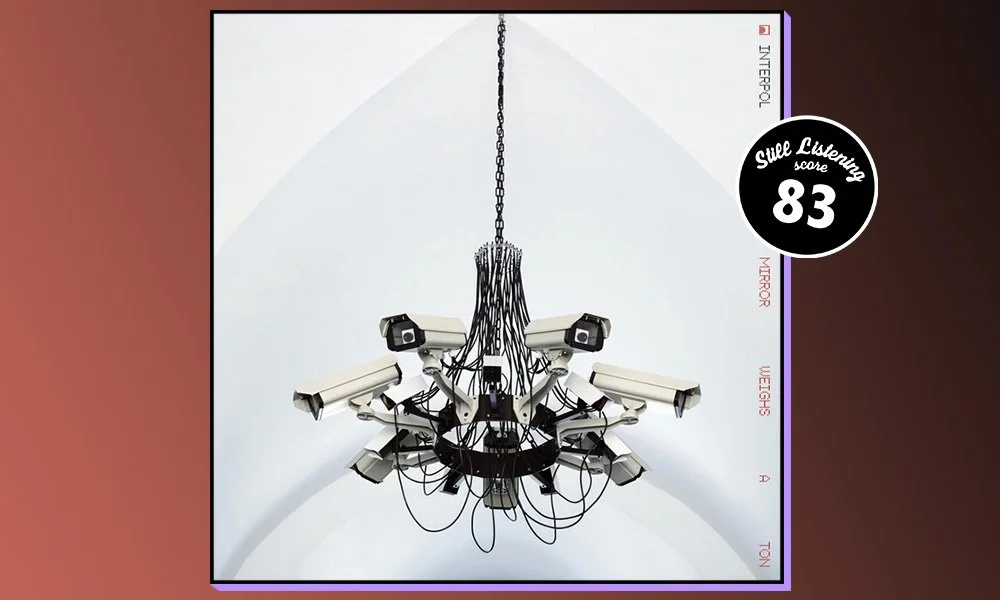
The early 2000s post-punk revival scene has had a somewhat conflicted relationship with moving into the present. Some of its vestiges have grown up: Arctic Monkeys have traded sticky club seats for chaise longues with their recent work’s baroque fixes, while the National have matured into the sad-dad balladeers they’ve always been destined to be. Others have remained unable to swell into adulthood: Bloc Party seem to be perpetually pubescent, stapling Silent Alarm’s earnest angst to more and more emaciated musical and lyrical fodder; likewise, Arcade Fire remain trapped in a parallel universe where their sickly optimism has curdled into platitudes that would make a bumper sticker wince.
Conversely, Interpol have never really had these pains one way or the other. Toting their romantically shimmering dream-pop / art-rock hybrid since 2002’s epochal Turn on the Bright Lights, Paul Banks’ post-Ian Curtis trenchcoat musings and Daniel Kessler’s indie-club-ready guitar licks ensured they were as attractive to those at the centre of the dancefloor as the introverts watching from the corner. Still slickly attired in suits and shades, and scarily ageless, one could easily layer photographs of the band a decade apart and be at pains to find differences – even in spite of original bassist Carlos Dengler’s departure in 2010.
They remained buoyed through the 2000s on the back of their musical formula remaining as uniform as their dress code. Sophomore effort Antics was a more direct communication of their swooning sexuality – reaping a crop of huge alternative hits in the process – but maintained the same palette of clipped riffs and jangly abandon as its predecessor. 2007’s Our Love to Admire ushered in a tendency towards gothic atmospherics, though it remained unmistakably Interpol.
All are incredibly strong albums: any trilogy that contains ‘PDA’, ‘Evil’ and ‘Rest My Chemistry’, to name a few, is guaranteed to distract from any stylistic replication. It takes that songcraft drying up for those similarities to start rising like sludge to the surface, a prophecy the group ultimately fulfilled. Beginning with 2010’s self-titled effort, the band became mired in a dry spell that expanded into the 2020s with a series of weakly produced and written LPs. Whilst not bereft of alchemy – 2014’s El Pintor being the main exception to the decline in quality – none of these albums really attempted to push beyond the Interpol stock-in-trade, released at an alarmingly regular pace that felt more like the band punching the clock rather than engaging in any untapped creative wells.
Perhaps this monotony finally seeped through, as at the advent of their customary 4-year interval, Interpol have returned from this dismal stretch with a project that is not only brimming with some of the best songs since their 2000s purple patch, but also leaps headfirst into an experimentation that many fans were likely assuming may have become an impossibility. And they weren’t coy about it either, unleashing the completely atypical title track on a double A-side single as the record’s first teaser. Operating within a weightless trip-hop indebted groove, it also straddles post-rock amongst twinkling keys and some of Kessler’s most liquid guitar lines to date, feeling like a breath of cool air despite the lyrical melancholia. Hunkering down with Andrew Wyatt as producer seems to have reminded the band of their command of space and quiet – a welcome surfacing from the overstuffed mixing that characterised Marauder and The Other Side of Make-Believe.
Thankfully, the comfort zone continues to be breached further through the tracklisting. ‘Wounded Soldier’ flirts shockingly successfully with dub textures, new bassist Brad Truax’s low-slung antics (pun intended) riding over sympathetic piano-led syncopation. Another ‘70s cornerstone, disco, jives into ‘Darling Thoughts’ shaker ‘n’ all, refracted through synth swells that would make any new wave outfit green with envy. It’s not the only danceable track either, as ‘Wake Up’ careers through bongo fury and an enervated soukous guitar part, sure to be a future live favourite.
Even the more standard Interpol numbers are gussied up by the group’s dalliances into electronica. The flip to the title track on that first single, ‘See Out Loud’ floats around its classic angular shrapnel, a lattice of synth distortion and layered vocals (amongst which is the first spate of Daniel Kessler singing since ‘PDA’). ‘Wings on Fire’ pulls a similar trick, both upgrading their well-worn style for a more sedate age.
Indeed, it’s hard not to pinpoint our ever-hulking technology-induced anhedonia as another confluence point for This Mirror’s galvanising gestation. Banks’ lyrics direct outwards more than ever, honing in on the rise of the corporatisation of humanity. Single ‘Iron City’ is a pleasingly subtle examination of our increasingly dependent relationship with AI (“you left a crumbling heart, who let me take it too far?”) whilst ‘So Rides the Reindeer’ tackles the ramifications of online misinformation over a yearning New Order-esque electro-indie pulse: “up is down, tonight we drown.”
There’s no clear way out of this mire, he implies, the closer ‘Sudden’ a downbeat finish that suggests he’s only willing and able to take the future as it comes, despite a knowledge of the dark avenues it’s heading towards. It’s a more measured philosophy that feels indicative of the album as a whole: an alliance between new and old that could very well be as fleeting as it is fruitful. If this is a one-off, then, let’s enjoy its rewards while they last. As Banks is now ready to admit, “time was born uncertain – that’s what keeps me intact”.