
Prince - Timeless Review
A decade after Prince’s death, Timeless opens the vault on ten demos spanning the icon’s extraordinary, genre-defying career.
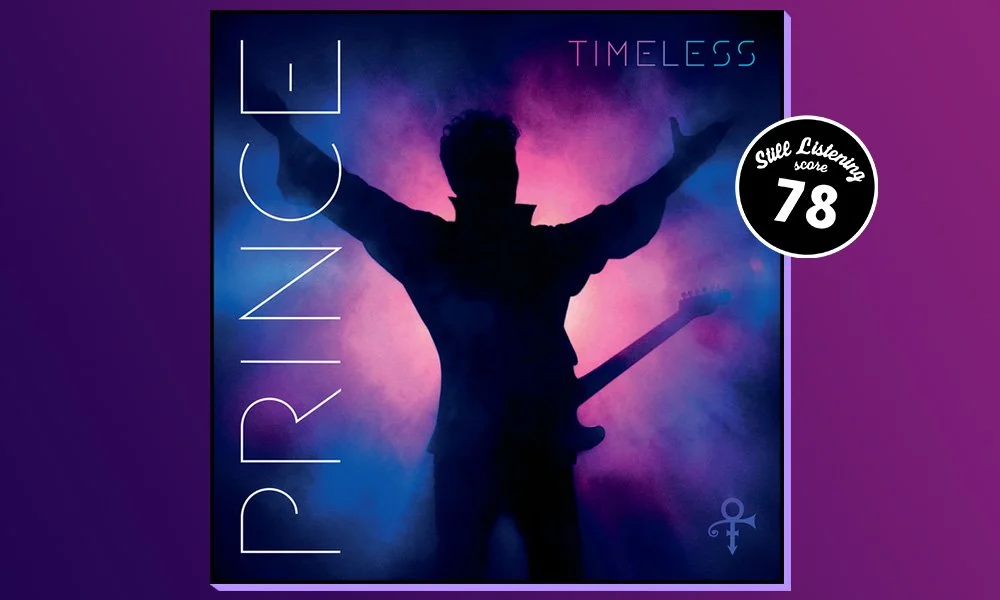
It’s somehow been a decade since Prince’s shocking death in April 2016, the loss of the icon leaving a hole in the music industry that has yet to be filled in relation to experimentation, creative freedom, and sheer boundary-pushing artistry. Since his introduction to the culture with 1978’s For You, of which every instrument featured was performed by himself, Prince has been a figure difficult to define and musically categorise. Transcending the limitations of genre and challenging societal boundaries of stereotypical masculine presentation throughout his decades-long career, Prince has been prized since his debut as a non-conformist whose artistry deconstructs the traditional hierarchies of race, gender, and sexuality.
Releasing 39 studio albums during his lifetime, Prince was a musical prodigy who, in a similar vein to Blur and Gorillaz frontman Damon Albarn, viewed music-making as a constant, daily need. This creative impulse has granted audiences Prince’s second posthumous release, a compilation album of demo tracks entitled Timeless. Whereas the first compilation album since his death, 2019’s Originals, featured the original demos of songs written and recorded by Prince before being given to other artists, Timeless’ tracks were intended to be released by the artist and had yet to be heard - outside of ‘Tick, Tick, Bang,’ (which was rewritten and reworked for the album Graffiti Bridge) and ‘Wish This Tear,’ the latter of which was given to Celine Dion for her 1992 self-titled album.
Sequenced chronologically by their known or attributed recording dates, the ten tracks span the length of Prince’s illustrious career, from the 1970s (‘I Am You’) and 80s (‘Tick, Tick, Bang,’ ‘Heaven,’ and ‘I Wonder’) to the 2000s (‘Calabama’ and ‘The Guilty Ones’) and 2010s (‘Bestest Friend’). The album’s opening track, ‘I Am You,’ exudes the sonic energy of Prince’s first few albums, with genre-blending sensual post-disco soul-pop sounds, soaring falsettos, and sexually suggestive lyricism. The sumptuous guitar strut and funk grooves are highly reminiscent of the 1999 track, ‘Lady Cab Driver,’ the 1977 demo featuring the same squiggly synth hook and squelchy melodies. ‘Tick, Tick, Bang’ forays much more into punk and funk-rock sounds than its reworked and re-recorded counterpart included on 1990’s Graffiti Bridge. Full of sexual innuendos, velvety vocals, and sensual moans, Prince’s electrifying and too frequently underrated guitar skills are on full display, his signature funk flair retained throughout the song’s blend of sounds.
Opening with prominent drum machine thumps, woozy synths, and pangs of psychedelic rock, ‘Heaven’ sonically resembles the experimental soundscapes of 1982’s drum-heavy 1999 and 1985’s synth-funk Around the World in a Day. Alongside its love-focused spiritual lyricism (“Heaven will be here on Earth, if we just try to love”), the track would fit very well within the tracklists of Prince’s early-to-mid-’80s records; specifically reminiscent of the lush and atmospheric ‘Still Would Stand All Time’ in both resonant instrumentation and lyrical conceits (à la, “No one man will be ruler/Therefore love must rule us all”).
‘Calabama,’ likely written and recorded post-1990s ownership battle with Warner Bros. Records, lyrically espouses the useless, manipulative, and predatory nature of mass music record labels. Over a heavy thumping bassline, bright punchy horns, and rhythmic guitar grooves, Prince, in a relaxed, borderline spoken-word style, croons, “Record labels used to be a friend of mine/Now they’re just a monumental waste of time.” Further doubling down in the next refrain, he elaborates with even more detail, lyrically evoking the image of his 1993 protest, where he wrote the word ‘slave’ across his cheek and changed his name to an unpronounceable symbol as part of his wider dispute with Warner Bros. over his recording contract and control of his music: “Seven years of grind like it’s only your name/Is what you pay to keep yourself a slave to the game.”
‘The Guilty Ones’ features a fun, jagged guitar solo amongst its more watered-down and flat production, with the album’s closer, a live rendition of ‘How Come You Don’t Call Me Anymore’ serving as a tranquil insight into Prince’s on-stage personality. Nevertheless, the final three tracks are less notable than the first chunk of the album. However, that likely has more to do with the indisputable fact that these songs are demos and were not intended to be released in the state in which they are presented to audiences in Timeless.
Regardless, hearing new music from Prince, even if it was first written and recorded back in 1977 or 1990 and remains unfinished today, is an unexpected blessing. First introduced through my mother’s gushing crush on the man and love for his music, I feel fortunate to have been old enough to appreciate the icon while he was still alive, his Super Bowl halftime show and ‘While My Guitar Gently Weeps’ guitar solo at the Rock n’ Roll Hall of Fame still of regular discussion in my family. I vividly remember visiting his former home and now museum, Paisley Park, a few years after his death and being lucky enough to hear a few seconds of select unreleased demos when touring his recording studio. I can’t help but wonder, almost a decade later, if what 17-year-old me heard snippets of that day made its way onto the tracklist of Timeless. If nothing else, the recent release is not only a celebration of Prince’s legacy and formidable career, but a bittersweet reminder of the breadth of creativity, musical virtuosity, and unwavering sexual vulnerability held within the 5’2” frame of the enigmatic icon lost too soon.