
On their 16th studio album, U2 revisit their familiar sound while exploring themes of faith, hope and humanity.
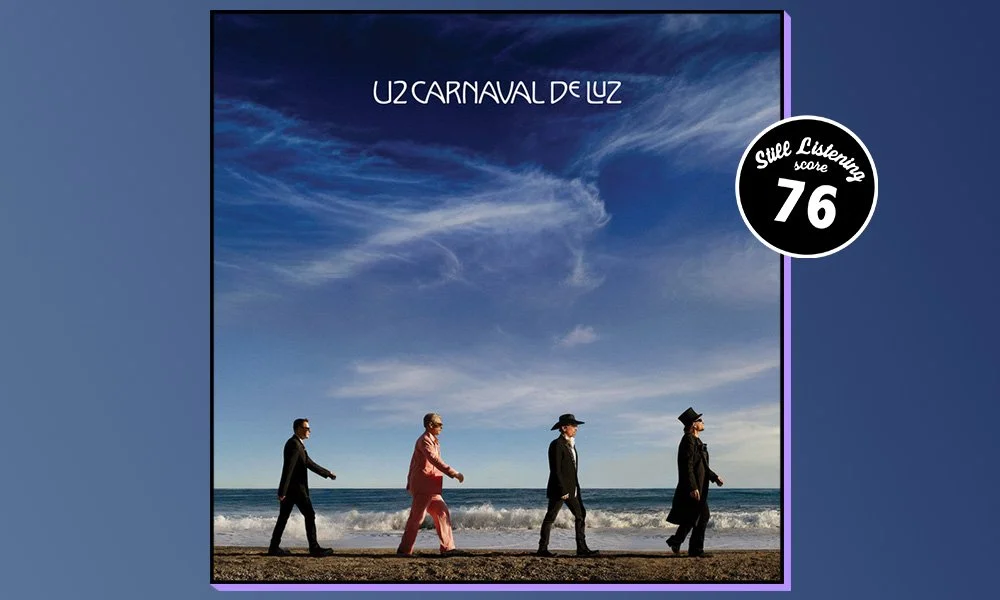
U2 are back with new music, and their album Carnaval De Luz has something unique and familiar to offer despite being their 16th album, the first comprised of new material in nine years. The band formed in Dublin in 1976 and remain one of Ireland’s biggest rock music exports. Carnaval De Luz is absolutely faithful to the band’s core identifying sound, full of Bono’s trademark religious references and tracks reminiscent of past albums, and yet still manages at points to do something new.
The album begins with the synth-heavy ‘Go (Carnaval De Luz)’, whose long, heavy electronic intro and strong drumbeat are theatrical, like a circus master preparing you for the show. Carnaval itself refers to the Catholic festival, and the album is rich in references to the Hispanic world. As the album moves forward, ‘La Reina’ verges on too-clean rock energy that might be done more justice in a stadium, as its recorded version comes across as slightly repetitive. However, ‘Street of Dreams’ excels in its form as a classic U2 anthem of hope, reminiscent of ‘City of Blinding Lights’, with its imagery, driving bassline and processed layering making it a strong pop-rock track even if it is not the record’s most groundbreaking.
‘Superficiality’ boasts a fun melody and satisfying guitar riffs from The Edge. It has been described by the band as having disco and punk references, but ultimately feels quite poppy, with lyrics that fail to make an impact in comparison with the other tracks, and a structure that never fully develops. In contrast, in ‘Silencio’, found later down the track list, both edge and punk are brought by the punchy drums and garage-rock sound, while the autotuned harmonised backing vocals in ‘If The World Is At War We Better Not Be’ fit well with the nostalgic and religious lyrics to make a textured and inspiring track.
‘The Mirror Maker (Rosalía)’ pays tribute to Rosalía and her recent album Lux, as U2 seem to find affinity with her preoccupation with ascendance and the supernatural. Referencing saints, prayer and the power of music, the track is appropriately dramatic, and the falsetto works to complement it rather than feeling forced, as it slightly does in ‘Superficiality’. ‘Glorify’ is acoustic with a strong rhythm, but the dark melody feels slightly off-balance with potentially underbaked lyrics about connection. ‘Can’t Stop Us Now’, atmospheric and thought-provoking, is a very strong track, with textured bursts of interesting basslines and more provoking lyrics such as ‘why the leaf won’t leave the branch/’til the branch becomes the tree’.
The track, ‘The Greatest Show On Earth’, might be the album’s best, and indeed one of the band’s best ever. The slow instrumental crescendo feels neither rushed nor underdone, and one can’t help while listening but feel immersed in reflecting on ‘the greatest show on earth’, which seems to be humanity itself. It feels fitting when the track asks ‘have we made God feel like a stranger here?’
Despite the sobering reflections that this track might inspire, there is much hopeful music to be found in the album as a whole, as Bono puts it in the album’s accompanying zine: ‘if you have a chance to hope you have a duty to hope…the awful evidence of our eyes will not defeat the beautiful evidence of our souls.’ ‘Midnight Sunshine’ represents one of these calls for hope. Its upbeat piano and guitar, and cheerful yelling vocals, soundtrack lyrics that position hope as a deliberate and necessary choice. It is almost absurd to hear that it is ‘time to take cover’ from the bleak world around you against the addictive groove of the bassline. The message, as you listen, is one of hope that will persist. You could ask if the song denotes a lack of real engagement, as Bono advises ‘don’t want to make a devil bigger, stop repeating his name/you say God’s no longer for us/I say the stars are only there for us’. However, dwelling on the bad is not what U2 is in the business of doing.
A touching final track, ‘Torn’, is found in the last song ever recorded by Dolly Parton. Even if its mellow tone is not totally harmonious with the rest of the album, its theme of reflection on a family, and indeed world, at war with itself, is welcome and moving.
The band frame the album as a whole as a return to U2 itself, and as such, the record is advisory and wise, as U2’s music often is, with guitar instrumentals and characteristically provoking lyrics that give it rousing, inspiring and satisfying depth. You cannot help but agree that Jacknife, who produced the album, has succeeded in his aim when he ‘urged U2 to be more U2’, who, despite being on their 16th album, are still producing music that is engaging and relevant.