
Start Listening To: Dééfait
The Paris-based band discuss Wednesday-night improvisations, multilingual vocals and the search for pleasure in music’s stranger corners.
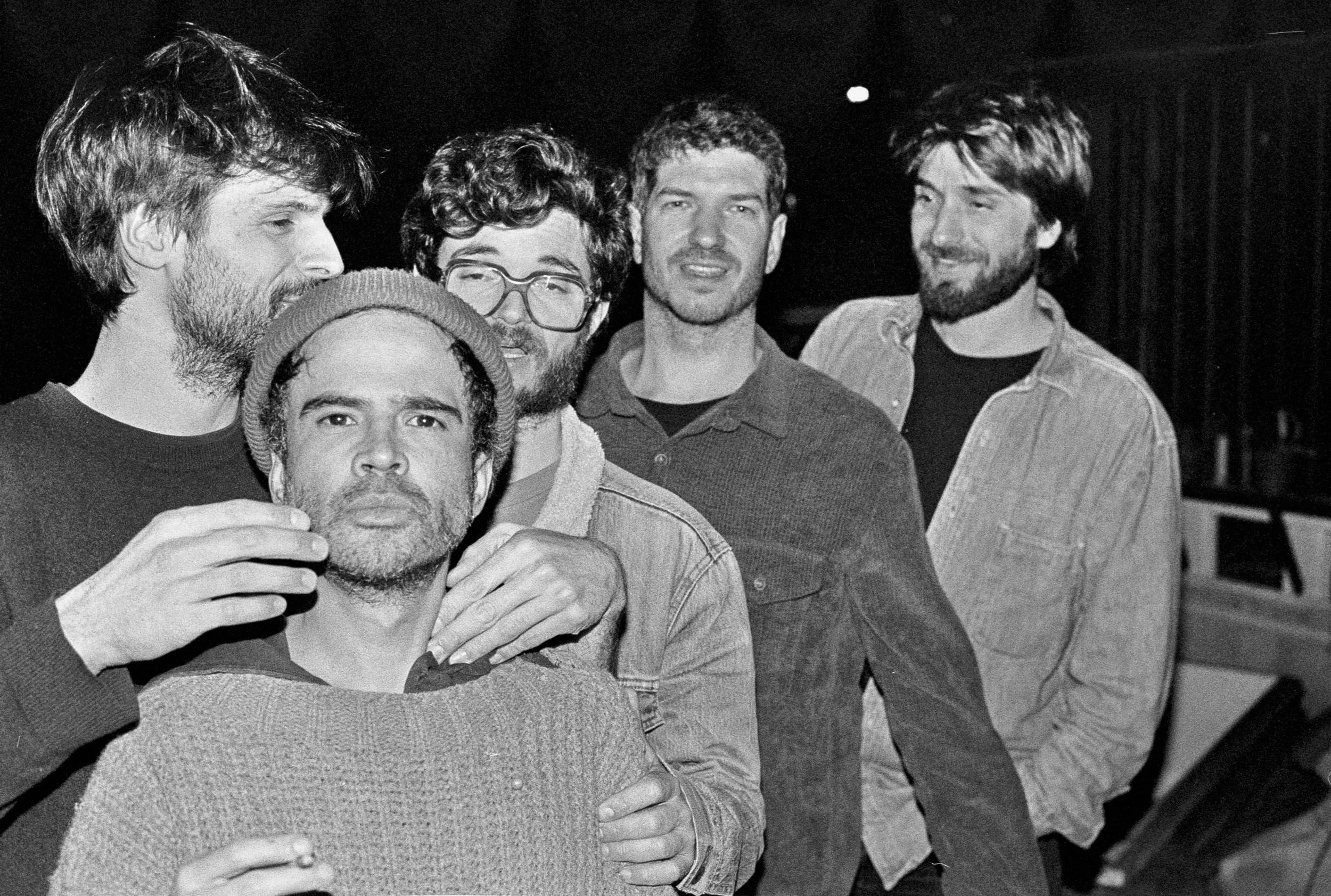
Dééfait’s music begins without much of a plan: five people in a rehearsal room in Pantin, following whatever happens when they start playing. The band grew out of Stay Hungry, a collective project that brought musicians together during lockdown, and their shared interests stretch from punk and electronic music to cinema, literature and altered states. That freedom runs through their approach, with Ric moving between English, French and Spanish according to how the words feel against the music. Here, they discuss the conversations and friendships behind the band, recording at Black Box, the influence of Roberto Bolaño and why even sending emails about get-in times can be a pleasure.
For those unfamiliar with your music, can you tell us who you are, where you’re from and about the music you make?
Pablo: We are Dééfait, a kraut/noise/punk/psychedelic band based in the eastern part of Greater Paris. Our music comes from long improvisations we make every Wednesday night (and sometimes other days of the week) in our rehearsal space in Pantin, a city on the north-eastern border of Paris. We never discuss the direction we want to take before we play. Since we all like altered states, we try to enter a form of trance with our music.
Ric: I’m Richi, or Rick, or Ricky. I’m from Mexico, from Mexico City, what we used to call the DF.
The music we make comes partly from rock, I guess, but it’s fed by a huge number of influences and by all the sounds we listen to. It ranges from ambient and electronic music to rap, different kinds of rock throughout history, punk, noise and so on. So it creates a pretty particular mix.
We never really wanted to make rock, or anything specific. We just followed a kind of music that sounded like this, something quite intense, quite trance-like, that can put you into a sort of trance state. There are a lot of sounds that can remind you of all kinds of different things.
Maybe in terms of attitude, there’s something that comes from rock and punk, but there’s also this whole dimension connected to electronic music, partying, going out, dancing. It’s a mixture of all those things.
The band grew out of Ric’s Stay Hungry project, which combined home recordings, unusual instruments and interviews. What were you hoping to discover through those sessions, and how did you recognise the people you wanted to keep making music with?
Ric: Stay Hungry was originally my idea, but very quickly it became a collective project, which included EnirDa and Greg among others.
Everyone more or less had their own place. For instance, EnirDa worked on the sound, Greg on visuals and editing, and I directed, but we all did a bit of everything.
We were looking for emerging bands in Paris and the surrounding area, and that’s how we met people with whom we shared a lot of tastes, a similar sense of humour, parties and concerts. One member of the collective, Tom, introduced us to Pays P., in which Pablo and Luca Valero were playing drums and guitar.
We had a lot in common, we spent time together, partied together, went to concerts, and gradually Pays P. split up. That’s when we decided to form a band with the two brothers.
On my side, I already had a punk band in Mexico in the late 1990s and early 2000s, but I hadn’t played music for a long time. So Stay Hungry was also a way for me to gradually get back into music.
EnirDa: The idea was to start a short series people could watch online to discover bands and musicians they did not know. We really wanted to meet musicians we did not know either and see how they could adapt to playing unusual instruments.
But the real starting point of these sessions was COVID. Working on that project was an occasion to gather, play and enjoy music, talk over nice meals, drink and party during COVID times… That was the primordial goal of these sessions. Forming a band was never a goal, though. It just happened; we did not plan it.
Stay Hungry folded conversations back into the music as voiceovers. Has that interest in the speaking voice carried over into Dééfait, and did the interviews change how you listened to the musicians involved?
Ric: Yes, I’m very interested in the spoken voice, partly because I have a background in cinema. I studied film in Mexico and made short films, documentaries and fiction.
During lockdown, I couldn’t sleep very much, and I started watching a huge number of films again. I was rewatching Sans Soleil by Chris Marker, 8½ by Fellini, Querelle by Fassbinder. And there was something about the voiceovers in those films that really interested me: their very atmospheric, melodic, almost musical quality.
In Dééfait, I really like the idea of ‘scribbling’ with the voice, making these kinds of brushstrokes with it, bringing different voices in at different points.
As for the Stay Hungry interviews, I don’t really know whether they changed the way I listened to the musicians who took part. I don’t remember it well enough to say that they did.
Your name connects Mexico City’s DF with Roberto Bolaño’s The Savage Detectives. What first drew you to the novel, and how has its spirit of searching and experimentation affected the way you work together?
Pablo: I first read a Bolaño novel during the summer of 2017 because I was working all summer in Paris and had a very long metro ride to work. So I randomly took the thickest book at the second-hand bookshop, and it was 2666, and I fell into Bolaño.
I don’t know if there is a direct link between Bolaño and the music of Dééfait, but the freedom of forms and themes in his writing, along with his wild imagination and his way of creating worlds of their own, are an inspiration! And when we were thinking of a name for the band, the pronunciation of ‘DF’, the nickname of Mexico City, came up both because of Bolaño’s The Savage Detectives and because Ricardo is from el DF, but also because ‘défait’ in French can mean ‘stoned’.
Ric, you sing in English, French and Spanish. What makes you reach for a particular language when writing, and can changing languages take a song somewhere you weren’t expecting?
Ric: English comes largely from my musical and cultural upbringing. When I was seven or eight, I watched MTV, I saw films and cartoons in English, and American popular culture was very present in Mexico, especially in the social environment I grew up in. Mexico is also obviously very close to the United States.
French became an everyday language for me after almost twenty years in France. I speak French all the time, and I often think in French. And Spanish is my first language, so of course it comes back too.
But when I sing, I mostly choose a language for the sound. Sometimes I just think, ‘Fuck, that sounds like English.’ Or it sounds French, or Spanish.
During jams, I throw vocal ideas onto the music, and English often comes naturally, but the other languages can appear too. And sometimes simply changing languages takes the song in a completely different direction from the one I had imagined.
I don’t have a huge amount of technical knowledge when it comes to songwriting, so I work very intuitively. I try something and see where it takes me. If it works, I keep it; if it doesn’t, I change the language or get rid of what I was doing completely.
The direction of the song gradually emerges. It’s only at the end, when I consider the song finished, that everything really becomes fixed. At that point, I don’t change the languages or the lyrics any more.
You’ve spoken about bending words to suit timbre and rhythm. When you’re writing, how do you work out which words need to be understood and which can become part of the sound?
Ric: Basically, for each album (well, we’ve only made two so far), there’s a big overarching theme, with several sub-themes. And for each song, I choose one part of that larger theme, an atmosphere, an idea that I want to explore.
Since I already have a melodic and rhythmic foundation that comes from the jams, at first it’s just mumbling and fragments. I start looking for words that have that kind of sound, that resemble what I’ve already sung, while also going in the direction of the idea I’m trying to express.
From there, I start making puzzles, building things. It can become more or less narrative, more or less like a story, more or less poetic, or on the contrary, very abstract. But I always try to make sure there’s some meaning there.
It’s not very rational. It can go in all sorts of directions, but there’s a kind of coherence because there is meaning behind the sentences: I’m still trying to talk about something.
So there’s a kind of constraint created by the sound that was already composed during the jams. I’m somewhat restricted by what I’ve already sung, so I choose the words almost one by one, according to their sound, rhythm, metre, phrasing and number of syllables. The number of vowels or consonants is also very important, because the music and the vocal line already exist.
So a word can be very important to the meaning, but if it doesn’t work with the sound, I get rid of it and look for another one. Even if that changes the sentence, I’ll try to rebuild it from the sound. And sometimes, instead of finding a word, I’ll simply use an onomatopoeia.
So it’s a balance between sound, rhythm, metre, phrasing and syllables, while at the same time preserving the meaning. I try to stay close to that sound while continuing to talk about something I genuinely want to explore.
And I don’t consider myself a poet or a lyricist. I love writing, but what I’m doing here isn’t really what a lyricist does. It would actually piss me off a bit to have to ‘write lyrics’. I prefer to think that I’m building something between sound and meaning.
And in the end, it produces these slightly strange lyrics, and I actually like that.
Your music has picked up the ‘heliumcore’ tag. How did that description come about, and Ric, how did you find the vocal approach that sits at the centre of these songs?
Ric: I think the term ‘heliumcore’ was used by someone to describe my voice, because I have quite a high voice, and it can get very high. And ‘core’, obviously, refers to that whole family of subgenres (hardcore, post-hardcore, post-punk and so on). I don’t know exactly who came up with the term; I don’t really remember.
As for my vocal approach, I think it started with a lot of artists I love, and whose way of singing or using their voice I really like. I tried different things simply to see what could work with our music. And gradually, through jams and rehearsals, I found what fitted the music and my own voice best.
It’s something very spontaneous. I don’t come in with a preconceived idea thinking, ‘This is how I’m going to sing.’ I put myself into the music and see what works best with it, and with my voice in particular.
And I think the way I sing will continue to evolve. It already changed a lot between the EP and the LP. When I recorded the EP, I was still learning how to sing. Sometimes I was technically quite bad at it, I was hurting my throat, and it was exhausting me. So I took singing lessons to acquire some basic skills and learn how to use my voice better.
Today, I sing differently. I use different parts of my body, different ways of producing sound, and that gives me a different tone. Over time, I started to understand what I could do easily, what worked better for my voice, and what I liked.
So I started building a kind of toolbox of different sounds and different ways of using my voice. Some are easier for me, others I particularly like. And all of that comes from very different influences.
Sometimes I listen to my own voice and think, ‘Fuck, that sounds like a Mexican bolero.’ At other times, it makes me think of extremely experimental artists. Laurel Halo, for example, or Rrose, or the French artist Carte Noire, who works a lot with machines and sounds. There aren’t really voices in his music, but some of the sounds can give you the impression of hearing monsters. I really like interpreting that kind of thing with my voice.
I also find inspiration in Cosey Fanni Tutti, Gazelle Twin, Moor Mother, things like that. And bands like Swans or BIG|BRAVE. There are so many different artists and forms that inspire me.
But what inspires me most about all these artists isn’t necessarily their sound itself. It’s their freedom. They show that you can do so many things with a voice, that you can produce sounds that are sometimes beautiful, sometimes strange, sometimes almost painful, sometimes completely insane.
That freedom is what interests me. Not the idea of copying someone, but thinking: ‘Fuck, actually, you can do all this with a voice.’
And since nobody in Dééfait has ever told me, ‘Do this’ or ‘Sing like this’, I’ve always tried to do whatever seemed to work with the music. That’s how this vocal identity started to take shape.
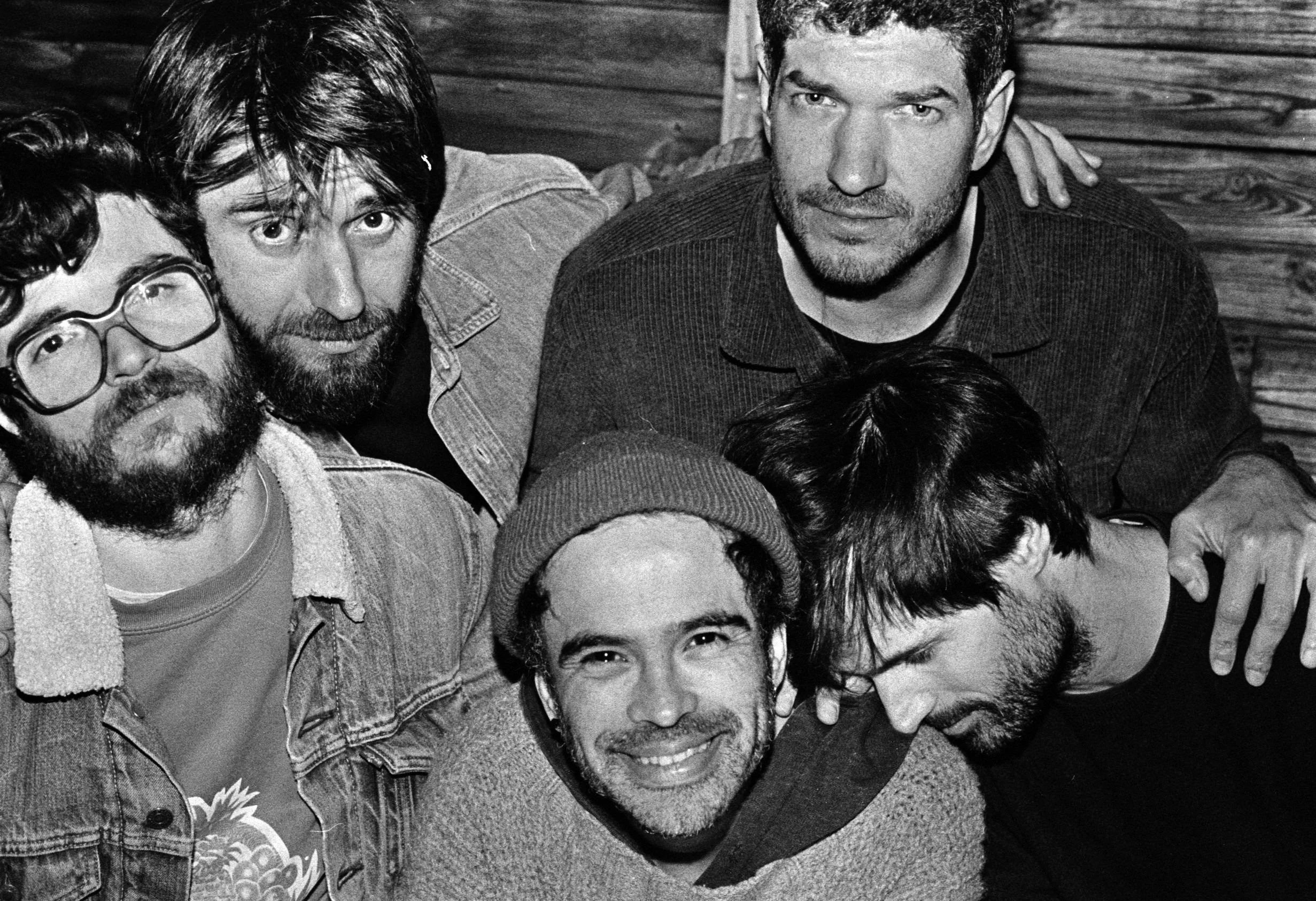
With the bass providing a foundation and the guitars trading places around it, how do you build an arrangement together? What tells you that another layer will add something, or that a song already has enough going on?
Greg: The songs usually come together during jam sessions, where the five of us play, improvise and let ideas flow based on the moment. That generally allows EnirDa and Pablo to lay down the rhythmic foundation, and then the guitars and vocals come in to shape and fill out the musical structure. We’re very interested in the idea of a wall of sound, but it’s true that sometimes when we listen back to our demos, we realise that not every layer has to be there all the time. That’s why, on certain tracks like ‘Endlessly’, for example, we felt the need to open up more space. Some quiet moments without guitars bring more dynamics to the songs.
‘I Promise To Divide You’ is an intriguing introduction to the album. Where did that promise come from, and what made this the song you wanted people to hear first?
Pablo: The single was chosen for a release at the beginning of the summer, which is supposed to be a joyous time of the year, in opposition to the end of summer, which is supposed to be melancholic, so we picked the most joyful song we had on the record! I think it is a really ‘autumny’ album and it perfectly suits its release date, 2 October, but before that we didn’t want to spoil anybody’s summer!
Greg: It’s also one of the first tracks on the album to be written, if I remember correctly, and it had a slightly more pop-oriented feel that stands out quite a bit from what we usually do. The idea of releasing it first struck us as interesting and highlighted an aspect of our music that’s very important to us: all our songs do seem to share a common sonic framework, but we like to let ourselves be guided down different paths.
You recorded at Black Box with Peter Deimel, with Andy Blundell handling the mix. What did you want to capture from the band’s live sound, and what did working in the studio allow you to explore further?
Pablo: Recording at Black Box was bliss in every way. First of all, it’s far away from Paris, which allowed us to spend the recording time together without being distracted by our daily routines. The equipment at the studio was extraordinary, both in terms of instruments and the technical setup. Peter was very kind and patient with us, even when we did a thousand takes or when we were a little lost. He knew exactly when to step up with advice or when to let us take the lead. In addition, it was very good to have a PS3 with the game Skate 2 and a VHS player with the movie Total Recall. We had a very good time there.
Greg: It was also an opportunity to start by recording all five of us together, playing with the amps turned up extremely loud, which allowed us to try to capture that live energy that’s so important to us. We tried to capture that raw, physical power of the stage, which is never easy to reproduce on a recording. Afterwards, we were able to add overdubs, taking a little more time to work out the details of certain parts.
And as Pablo says, it wouldn’t have been possible without Peter Deimel, who was like a sixth member of the band during those five days of recording.
You describe pleasure as a recurring theme on the album. What kind of pleasure were you interested in, and how did it find its way into some of the record’s harsher or more unsettling moments?
Ric: Actually, pleasure is at the centre of both albums, even though it isn’t exactly the main subject of either one. To me, pleasure is like a state of truth. There’s something very aesthetic about pleasure. In a way, it exists beyond good and evil.
In the world we live in today, I feel that pleasure can become a kind of centre, or a source of wisdom, from which we can recover a calmer and more accurate understanding of life.
I’m thinking more about a form of heightened sensuality, almost cathartic. A sensuality that can go very far, almost to a limit, and that can move either towards something very dark or something very bright. And that’s precisely what interests me.
I’m very interested in bodily pleasure, altered states, and looking at things: films, paintings, photographs, reading… All these pleasures interest me a lot.
What’s important is precisely that this heightened sensuality isn’t necessarily something ‘good’ or ‘bad’. It can take you towards a very gentle, comforting light, but it can also lead to a brutal descent into something very dark. And that darkness can itself have a redemptive dimension.
I don’t know if ‘pleasure’ is exactly the right word. Maybe I’d rather talk about sensuality, hedonism, aesthetics, a certain kind of aesthetic way of living.
For me, this search for pleasure can also help relieve a lot of the anxieties connected to social, political and existential pressures, or simply the pressures of everyday life. It’s a kind of centre that allows you to regain your balance.
And sometimes that search plunges very deeply into the darkness of life, into very dark subjects. But even there, I can find something beautiful. It can become a form of salvation. And sometimes it’s much brighter and clearer, and that’s beautiful too.
I’m interested in both sides.

What do you love right now?
Pablo: Right now I love making music with my friends in Dééfait and my other band Pays P., doing concerts, working on recordings, writing music, even doing posters or sending emails to ask about get-in times. Everything about making music with my friends makes me happy!
Greg: Looking forward to those moments of shared ecstasy that come from playing together on stage, and the joy of seeing the audience lose themselves with us.
Ric: Right now, I really love weekends when I can sleep. I really love that feeling of thinking, ‘I can sleep now’, and being able to sleep for a long, long, long time.
I’m listening to a lot of Laurel Halo. I really like Remscéla by Milkweed. And I recently discovered Yu Su, whose album released in 2026 I really love.
And I also like this feeling of resignation that can sometimes make me laugh and give me some relief: thinking that, from my own point of view, most of the things that happen in existence are somehow my fault, and that other people have nothing to do with it.
What do you hate right now?
Pablo: Right now the French police are shooting high school students with rubber bullets in front of their school for protesting against the poor state of the education system. One has lost an eye, another a hand, and crazy images of cops beating teenagers drop every day.
Greg: Yeah, the police are totally out of control in France right now… And I think we’re all very afraid of what might happen in the 2027 French presidential election.
Ric: Right now, I mostly hate this kind of guilt connected to the way I love people. But I don’t really want to get into my private life.
And I hate waking up when I’m completely exhausted, having to fight just to manage to wake up. That’s something I really hate.
But above all, in music, cinema, literature, comics, and even in the way political and social issues are discussed, I hate this kind of standardisation that seems to be becoming more and more present. This homogenisation is really pissing me off.
Name an album you’re still listening to from when you were younger and tell us why it’s still important to you.
Pablo: Cuckooland by Robert Wyatt. I bought it in 2003 and have never stopped listening to it. It is a very complex album in the sense that it is filled with a lot of different emotions. Sometimes it feels like falling in love, and right after it feels like losing someone dear. The song ‘Cuckoo Madam’ is still one of the most beautiful works of art I know.
EnirDa: Is This Desire? by PJ Harvey. A powerful album that made an impact on me and which is still precious. It tells a story from beginning to end. It sounds sincere and full of emotions of all types. On top of that, I truly admire the art of making something sound simple!
That’s without even mentioning PJ Harvey’s vocals… I mean, watch her perform ‘Rid of Me’ live in Sydney, Australia, in 2001. It gives me chills every time.
Greg: As for me, I’d say Hex by Bark Psychosis. I discovered it around the same time I discovered Talk Talk (Lee Harris participated in the recording sessions for Hex), but I have a slightly more special connection with Bark Psychosis. I’m still discovering new facets of it, and I remain completely fascinated by its strangeness and the uniqueness of its production and recording. I’ve rarely experienced a feeling quite like this when listening to an album and its mix, at once incredibly expansive and very tight and minimalist, as if everything were happening right next to you. And ‘Fingerspit’ remains one of my favourite tracks of all time.
Ric: There are quite a few albums I come back to, but actually I don’t listen to that much of the music I listened to when I was younger. From time to time, when I’m driving for several hours, six or seven hours on the motorway, for example, I like rediscovering some of the things I used to listen to back then.
I could name several albums, but I might choose something I had when I was around twenty: a Ramones compilation. I listened to it a lot, especially in the car. In Mexico City, because it’s such a huge city, I spent a lot of time driving, so that music was really part of my everyday life.
I still put it on sometimes when I’m driving, and I even play it for my daughter. There’s ‘Surfin’ Bird’, in their version, which she likes.
What I love about the Ramones is that I find a certain essence of the punk of that period in them. There’s something very trashy, very strange, very ‘I don’t give a fuck’. Even the people in the band are incredible: Dee Dee Ramone had this completely trashy, fucked-up side, Johnny had something very strange and very particular about him.
And I find something of that spirit in some of the music I like today: certain kinds of trap, reggaeton, very party-oriented electronic music, techno, club and dance music. There’s this idea of hedonism, excess, pleasure, and also a kind of I-don’t-give-a-fuck attitude.
Back then, the Ramones represented a kind of relief for me. And looking back, I think it was already my first encounter with this idea that keeps coming back in our music: aesthetics, hedonism, pleasure as a way of finding some kind of balance beyond good and evil.
When someone hears your music for the first time, what do you hope sticks with them?
Pablo: That they feel the complete freedom of creation we work in and the fact that we never do something as a pose.
Ric: I’d like them to take away an experience. To come out thinking, ‘Fuck, what the hell was that?’
A bit like when you go see a film and come out thinking, ‘What the fuck was that?’ Or when you go to a concert, a show, and you think, ‘Wow, that was really an experience.’
I’d like our music to produce that: something slightly disturbing, very intense, almost a kind of trance, something a little crazy. That’s what we experience ourselves when we play, and I’d like people to be able to experience it too.
And ideally, I’d like them to leave the show, call their friends and say, ‘Fuck, you have to come see this.’ For them to buy loads of tickets, so that we can keep making music all the time, make a living from it, and get invited to play all over the world.
But ultimately, what I’d really like is for them to have experienced something.