
Start Listening To: Disgrace
Manchester folk-rock band Disgrace reflect on a chance meeting at Green Man, finding their sound and making peace with a different idea of success.
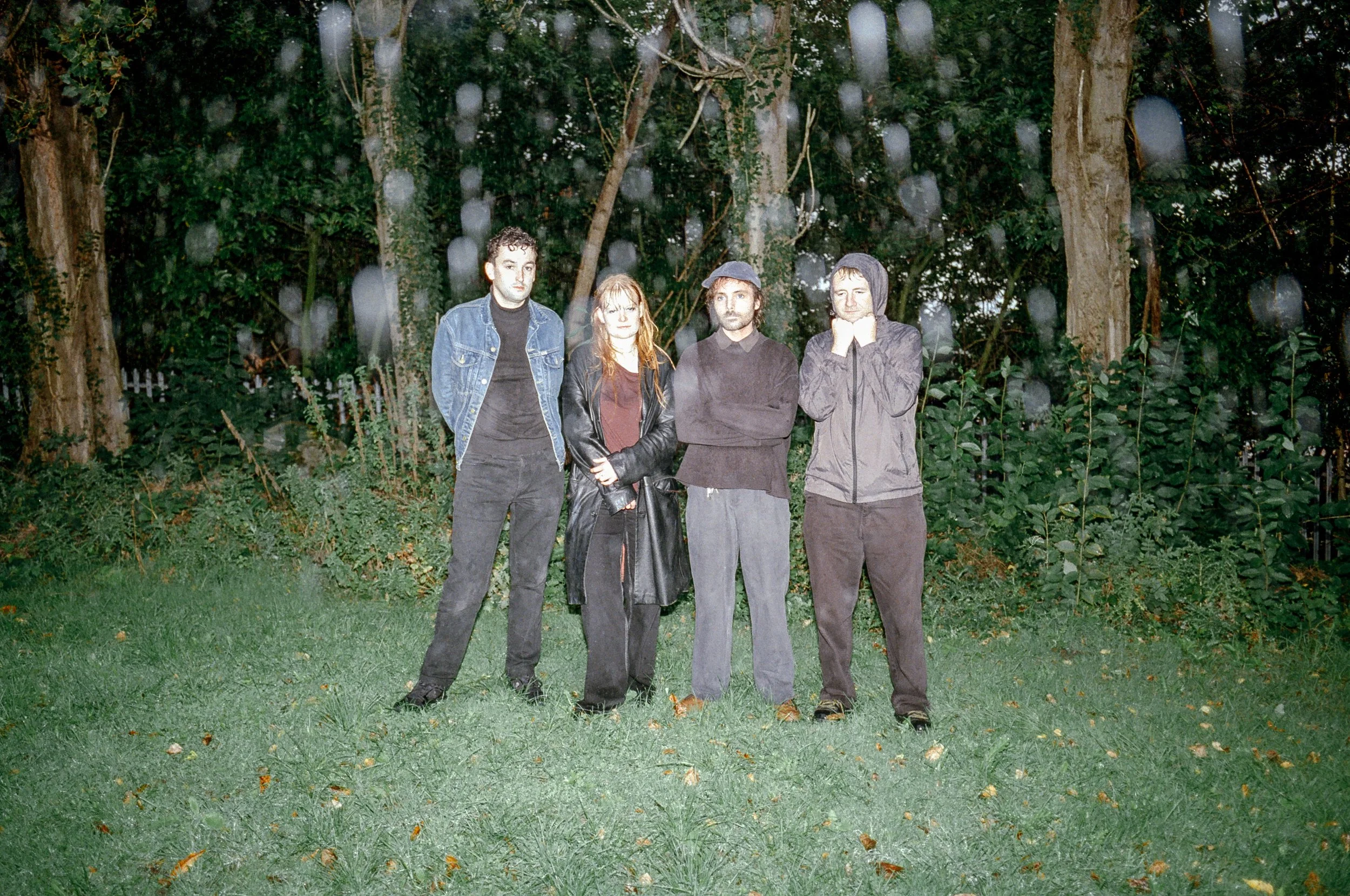
Disgrace’s four-piece line-up began with a drunken request for a violinist, apparently addressed to the universe, on a bench at Green Man. Stella Stevens happened to be there, happened to live in Manchester and, crucially, met Daniel Bluer’s joking demand for a grade 8 qualification. Back home, her violin and backing vocals gave the band’s songs room to breathe, helping shape Searcher Ride Dark Horse, a record concerned with change and the parts of your younger self you keep or leave behind. Recorded in an Ancoats practice room with borrowed microphones, it also reflects a shift in what the band want from making music: something that moves people, with success measured on their own terms. We caught up with Disgrace to talk about that first meeting, the freedom of stripping songs back and the particular catharsis of playing them live.
For those unfamiliar with your music, can you tell us who you are, where you’re from and about the music you make?
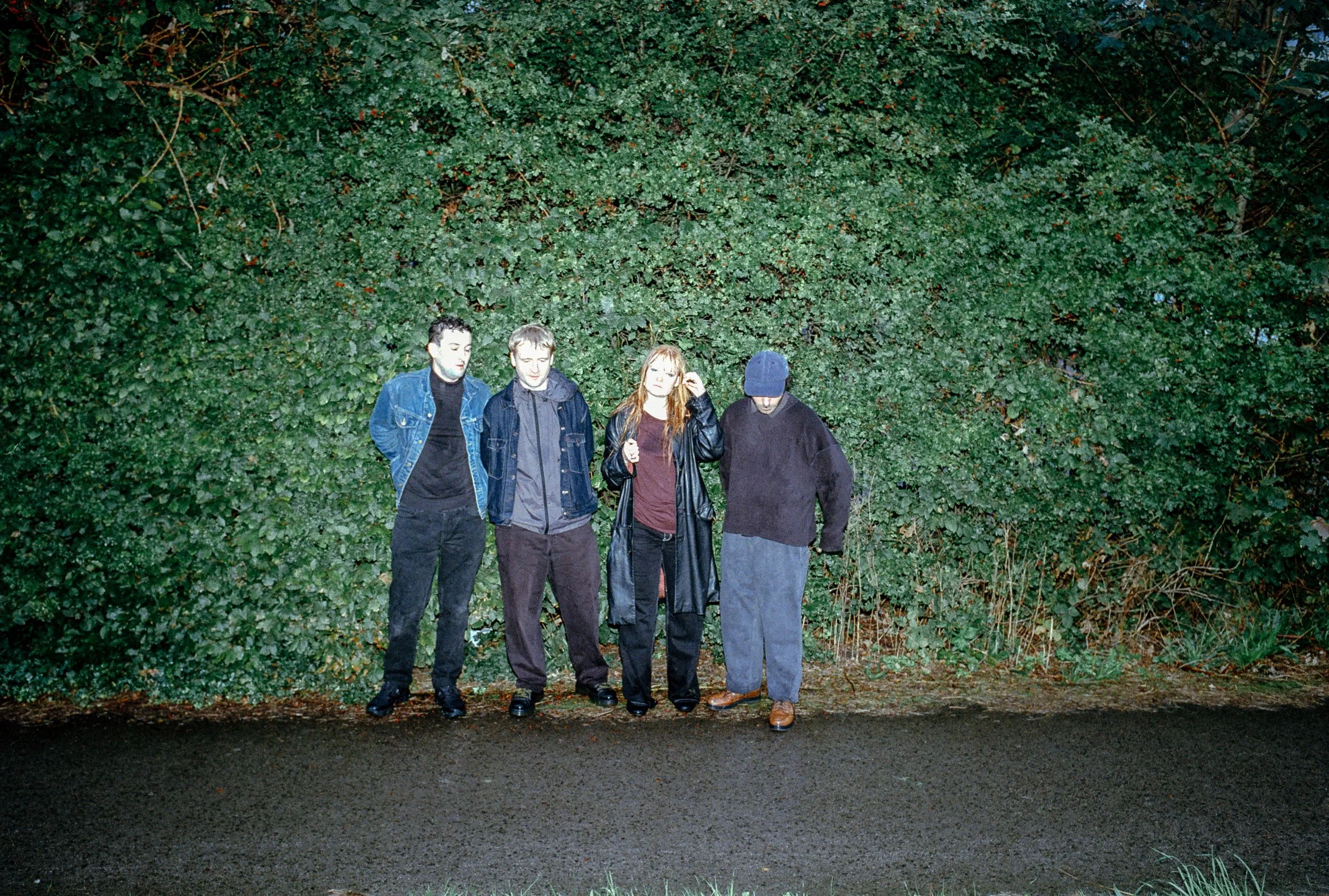
We are Disgrace, consisting of Daniel Bluer on vocals and guitar, Stella Stevens on violin and BV’s, Nathan Bailey on bass and Daniel Cowman on drums. We are from Manchester and we make folk rock.
Stella joined after a chance meeting on a bench at Green Man. What do you each remember about that conversation, and how quickly did a drunken suggestion turn into an actual rehearsal?
I’m not against the idea of fate or synchronicity and this felt like one of those moments. Hard to be a 100% reliable witness to that night but in my mind I announced into the ether that I wanted violin in our project and Stella appeared. I drunkenly joked that we would accept no less than grade 8 (despite being self taught at best). She retorted that she was, and lived in Manchester. Besides all of the circumstances being perfect, something just felt right, and it was. I have no memory at all of this but I asked Stella and she said I bumped into her the next morning (still at Green Man) and said ‘have you learnt all the songs then?’. She also said she was surprised I actually messaged when we got back to Manchester, a lot of plans made in times like these come to nothing as we all know.
You’d already been practising as a three-piece before Stella arrived. What was the first thing you played together that made you realise how much the violin and backing vocals could change the band?
So when we got home just myself and Stella arranged to meet at our practice room to go over the song ideas at a slower pace and see if instincts were compatible. I still had a bit of a festival glow and got quite emotional because it felt so good right away and I knew this was the missing ingredient. Future Actor was the first song that was massively transformed by Stella’s input, we were able to strip it down from a previous, messy incarnation and rely on the violin and backing vocals to make more subtle parts come alive.
Some of you came into Disgrace feeling stung by previous experiences of trying to ‘make it’. What did you want to do differently this time, and has that changed what you consider success?
I think a few years ago, certainly pre-Covid, the idea of a career in the arts didn’t feel insane. But in the last few years a lot of things feel like they are contracting, including the eye of the needle many have to squeeze through to earn money in the fields they are passionate about. There is some bitterness that comes with this but ultimately you have to be focused on your art more than anything else. If any success or plaudits come from that, great, but it can’t be the object. I think with this project we are more aware of and comfortable with that and not looking to make compromises to things that are important to us. Success is our music moving people, not boosting our ego.
You recorded with borrowed microphones in a slightly derelict practice room. Can you paint us a picture of the space and a typical session there? At what point did these stop feeling like demos?
Our practice room is in a district of former mills in a place called Ancoats in Manchester. It has always felt like a space with significance, a fairly obvious symbol of the cultural and political history of the area. Adding to this, we used to practice in a neighbouring mill that had housed upcoming Manchester artists for years at an affordable rate but it was bought out by property developers and is being turned into luxury flats. To make it affordable we cram a lot of bands into the room so it is pretty hard to keep it presentable but we feel comfortable there. The recording sessions certainly felt a little ramshackle and improvised but I think something about that lack of formality led to a good relaxed, creative atmosphere. Lee, who recorded the album with us was such a pleasure to work with and it became evident that he was working some sort of magic and bringing out really excellent sounding stems within limited conditions.
You worked closely with Lee Calpee, including sitting in on mixes at his flat. What were you listening for in those sessions, and what did Lee hear in the songs that you might have missed yourselves?
We were probably still thinking these recordings may be demos when the mixing process started so didn’t go into it with huge expectations of how we wanted it to sound. We sent over a playlist of reference tracks with stuff like Bill Callahan and Big Thief as a guide. It’s good to have a north star, but I like to keep the aims a little more general to leave you enough room to roll with the punches, if something starts to feel exciting in a different way to how you initially thought, it’s good to be able to follow it down a rabbit hole. Just being open to the process I suppose. Lee is a bit of a metal head and a lot of his experience is working with that kind of music, he was hearing many of our references for the first time. Despite this, his instincts were perfect, I couldn’t tell you exactly what he heard in the songs that we didn’t but I can say that he would take a track after a mixing session that had it sounding good and add the finishing touches that made them sound great to us. He exceeded our expectations of what we could do on this project in a big way.
Daniel, you’ve described Searcher Ride Dark Horse as charting ‘the transition from one adolescence to another’. What does that second adolescence look like, and how did that idea find its way into the record?
I think, to be able to create effectively you need to maintain a sense of awe and wonder that is maybe more ascribed to youth. This, amongst other things I wanted to keep. But there was definitely some aspects of my younger life that I was ready to let go of. I use the term adolescence because I think despite the passing of years and hopefully some maturation, we are a lot closer to the children we were than many of us would like to admit. There is no fixed point when you become an adult and everything stops changing. Lyrically, I’m more into painting pictures than explaining what I mean but a lot of the feelings I am expressing come from the place I was in at the time which was very much in a period of change. I’m really glad that happened and continues but there is a necessary excavation that is a mixture of pain and catharsis and you hope it leads to better things.
‘Future Actor’ changed quite dramatically after Stella joined. How did you decide what to strip away, and what did the new version reveal about the kind of band you wanted to be?
I mentioned this one previously but it definitely felt like a bit of a watershed moment. The process of stripping away was a recognition that now we had enough aspects to our sound to write the subtle parts more confidently and lean into dynamics and structure more. Obviously the start of the song is minimal and slowly Stella starts to weave in and out and dance around the base that I’m laying down. It feels like a proper introduction to the record and then when the drums and bass kick in it feels like something has really started, there is a confidence to it that I think the structure really punctuates and then as the song goes on the intensity builds and builds which hopefully adds to the emotional impact.
You’re drawn to both subtlety and big emotional moments. When you take these songs into a room with an audience, what do you hope happens, and what are you still discovering about them through playing live?
We really try and embrace the dynamics of the rises and falls of the tracks live. We really love the songs in themselves and how they are recorded but see the live setting as a chance to use the dynamics and structures to enter states of flow and emotional catharsis. It really feels like you are coming out of your own head, getting a lot off your chest and when an audience comes along for the ride with you it’s a really special. In terms of discovery, the lyrics aren’t so prescriptive and a bit more abstract in places so it feels like meanings can be up for grabs for the band and the audience on any given night which is a process I enjoy.
What do you love right now?
We love pallet cleansers (mini breaks in practice sessions to listen to some music and go on tangents and maybe smoke a cigarette)
What do you hate right now?
We hate phonies
Name an album you’re still listening to from when you were younger and why it’s still important to you?
I have a shaky memory at the best of times and I didn’t grow up in a very musical household so listening to full (good) albums came a bit later but I can remember very clearly watching Walk the Line on DVD around age 14 and becoming obsessed with Jonny Cash. I used to listen to a greatest hits album a lot and also had ‘Hurt’ on an ipod. I recently re-listened to American IV Man Comes Around and thought it was insanely beautiful, a heart broken, defiant titan of music with his body waning but not his spirit.
When someone hears your music for the first time, what do you hope sticks with them?
We hope that they come away thinking that they saw us express something true from inside of us. Whether they like what we expressed is a subjective matter but we hope it comes across as honest and having some depth of thought behind it. We find these things moving in other music and would be thrilled if that sticks with people. But at the end of the day it is beyond our control.
Photography By: Chan Yang Kim