
The Bristol-based band talk unusual time signatures, their new EP PREY TIME and the joy of making music together.
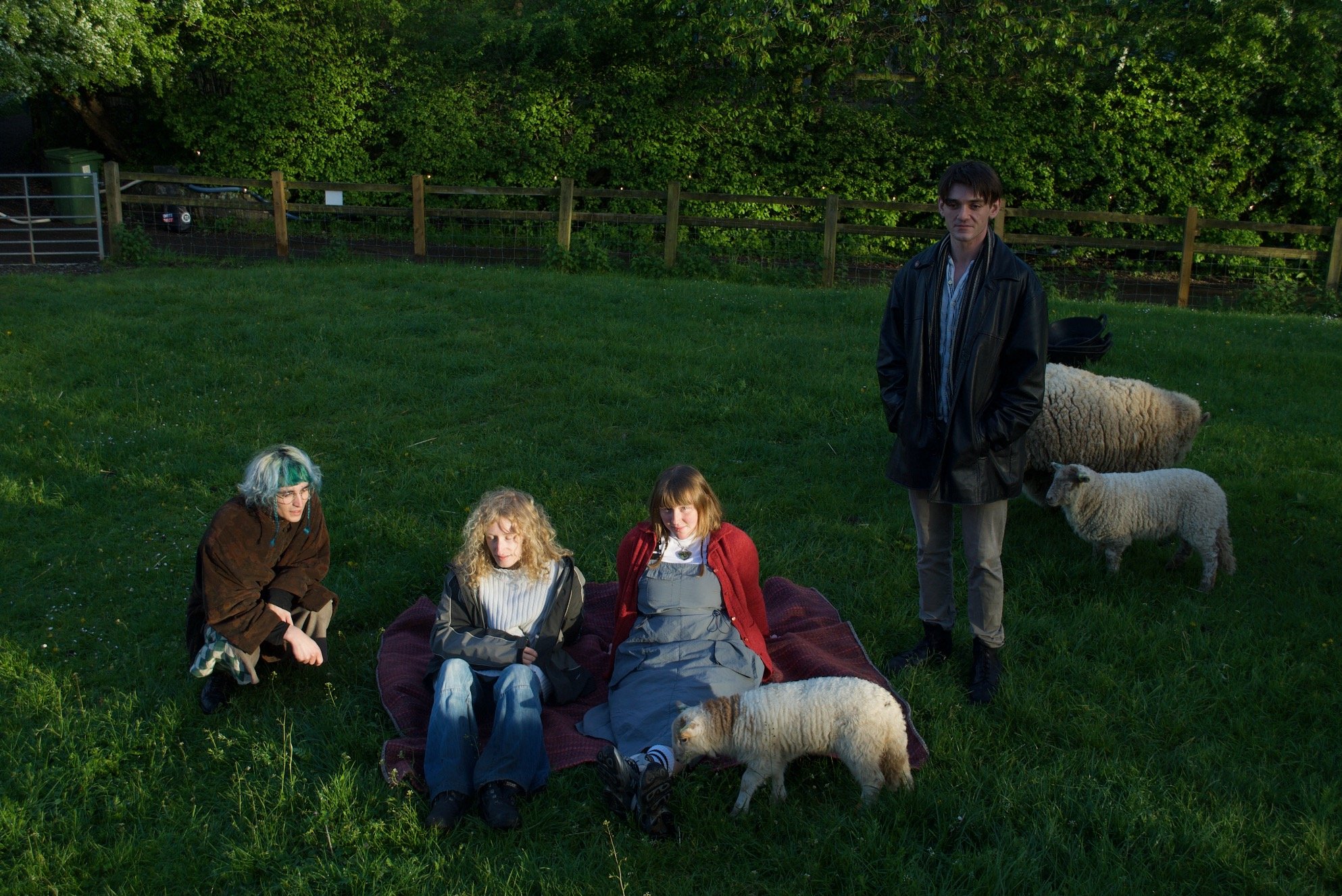
foot foot describe their music as ‘art frog snail prog’, which gives you a sense of how much fun they have making it. The Welsh band, now based in Bristol, take their songs apart and put them back together, experimenting with time signatures and letting each instrument find its own way through. With their EP PREY TIME on the way, they tell us about writing ‘callous wall’, the spaces and musicians that inspire them in Bristol, and the albums they still return to.
For those unfamiliar with your music, can you tell us who you are, where you’re from and about the music you make?
We are Esther (singer, guitar, she/they), Llŷr (drums, she/her), Ethan (bass, he/him), Sam (violin, he/him).
We hail from Wales but are based in Bristol. We make music that takes influence from many different places, we write songs that tickle our brains and try not to place ourselves in any kind of box or limits to what we should be.
You took your name from The Shaggs. What first drew you to them, and is there anything about their approach to making music that you recognise in yourselves?
We are really inspired by outsider music in general, but I guess The Shaggs have this naivety in their music that we love. We like to think we have a similar approach to making music, most of us aren’t classically trained at all, so we don’t use our instruments in a conventional way.
Where did ‘snail freak prog’ come from, and how useful has it proved when someone asks what sort of music you make?
We tend to call ourselves ‘art frog snail prog’ these days. We find it’s more interesting than just listing a bunch of different genres. Sometimes when people ask and I say ‘uhhhh I guess it’s like mathy folky blah blah’ I can see the light leaving their eyes. ‘Snail freak prog’ feels more like us.
Esther, you’ve said ‘callous wall’ arrived almost fully formed in one session, which is unusual for you. What does writing a foot foot song normally involve?
The way it usually goes with us is I (Esther) bring in a very raw idea, like maybe two or three chords or a riff, and it’s usually Llŷr who urges us to try a different time signature. Then we all dismantle it or try to find a less obvious way of playing it. It’s very hard to write something that hasn’t been done, so this is the way we like to create something that feels special to us. We might rotate a single chord progression for a couple of sessions, trying every iteration of it until it feels right to us. How it feels right to us is more mysterious, it just somehow fits.
‘callous wall’ was written back in 2023. Has it changed much since then, or have you been trying to preserve what happened in that first session?
The main body of ‘callous wall’ has remained the same, with minor tweaks here and there. It felt so complete in that first session, the song didn’t require much else.
You’ve described it as possibly the sweetest song you’ve written, with something slightly off-kilter still finding its way in. Do you ever set out to write something straightforward and find the band has other ideas?
All the time! Like we said earlier, it usually starts with a little phrase or part of a song from me (Esther), then everybody tries their own ideas over it. Nothing is sacred in foot foot and we’re always up for trying things in whichever way people would like to. Sometimes that does mean we end up coming back round to how it started. We’re not doing weird for weirdness’ sake, or complicating things unnecessarily. We just like to experiment a lot.
The song captures that feeling of being so swept up in someone that anything they say seems magical. How did you find words for that without feeling too exposed or talking yourselves out of the sweetness?
We never like to directly say what a song is about, that’s always up to the listener. We don’t like to take the agency away from the art like that. I suppose lyrically I tried to keep it simple but also abstract.
With the bass holding a repeating pattern while the drums, violin and vocals move around it, how do you work out who needs to stay put and who gets to wander?
Generally we like to take it in turns to be wanderers. We don’t really hold the idea that an instrument has to hold a certain role. However, in ‘callous wall’ from the get-go we wanted the melodic section to float upon the more repetitive elements, like the violin and vocals are dancing with each other.
What connects the songs on PREY TIME, and where did the title come from?
They were all written after we had pretty much finished the album. We like to think they sound like us but more mature, we’ve gotten better at our instruments and are refining our sound. PREY TIME articulates complex ideas more successfully.
Esther: I wanted to call the EP PLAY TIME, reflecting perhaps a more playful nature within the band, but then I saw a cat catch a massive rat and I was like, damn it’s PREY TIME. Bloodthirsty creatures and all that.
You put out still waters, empty house yourselves with very little promotion. How did you first realise people outside your immediate circle were finding it, and what’s been the strangest route someone has taken to your music?
One of the first reviews the album got was from a random Italian blog, it felt very surreal that anyone outside of Bristol had heard our music. People stumble across us in the digital world which is very cool.
What has Bristol given you as a band? Are there particular people, spaces or gigs that helped you feel there was room for what you wanted to make?
Bristol is like this crazy little hub for all things improv/experimental and it has this super tight-knit scene with artists from so many disciplines. Harry Furniss of Improv’s Greatest Hits puts on these improv nights where he asks lots of different artists to play an improv set together, and we’ve all done it and had loads of fun. Also spaces like Cafe Kino and the Cube are great co-op or volunteer-run spaces that put the more fringe artists at the forefront. We love Bristol and are never lacking in inspiration living there, bands like Broadsheets and Ex Agent are some of the best bands in the UK right now (in our opinion, lol).
You’ve supported Deerhoof and Horse Jumper of Love this year. Was there anything you noticed watching either band that made you think differently about your own live show?
Deerhoof are so in tune with each other which makes sense as they’ve been making music together for nearly two decades, there’s something always very inspiring to me about seeing people who are still doing it after that long and it is really a testament to friendship and connection through the art. We hope that in 20 years we’re still playing our weird music together. With Horse Jumper of Love, there was a real intimacy and earnestness at their show, which made me think I should maybe open up a bit more on stage instead of joking about everything.
What do you love right now?
Sam: The fresh crisp air.
Ethan: Cheese toastie.
Llŷr: The return of autumn and having my brother’s MUBI account.
Esther: My kittens, Cyril and Reynolds.
What do you hate right now?
Sam: The cold brisk air.
Ethan: The gruelling passage of time.
Llŷr: The state of the world.
Esther: There is no hate in my heart :3
Name an album you’re still listening to from when you were younger and why it’s still important to you?
Esther: I heard Horn of Plenty by Grizzly Bear for the first time when I was 12 and still come back to it all the time. It’s their first album and pretty much a solo album of Ed Droste (before Daniel Rossen joined). It has this longing that I have literally never stopped identifying with over the past 15 years. It’s just perfect to me.
Llŷr: I found the album Trading Basics by Palm on Bandcamp when I was in my mid-teens, it’s definitely an album I think people should talk about more. Their first two albums and EP have had a big influence on how I approach my music in regards to time signatures and part writing, I think they create like one big instrument with how they place their parts in their songs.
Ethan: I love Innervisions by Stevie Wonder, it never gets old. ‘Higher Ground’ lyrics are so dumb but I don’t care it pops off.
Sam: English Settlement by XTC, it confused me when I was a kid but I’d listen to it all the time anyway, it’s been great to listen to as it seems to make more sense every time I listen again. It will always sound fresh!
When someone hears your music for the first time, what do you hope sticks with them?
Joy and friendship but also sad sad loneliness, with a sprinkle of special sauce.
Photography By: Ben Fudge