
Written around a vintage piano in her Berlin flat, Gloria de Oliveira’s The Lying Swans draws on folklore, Brazilian music and the possibility of starting again.
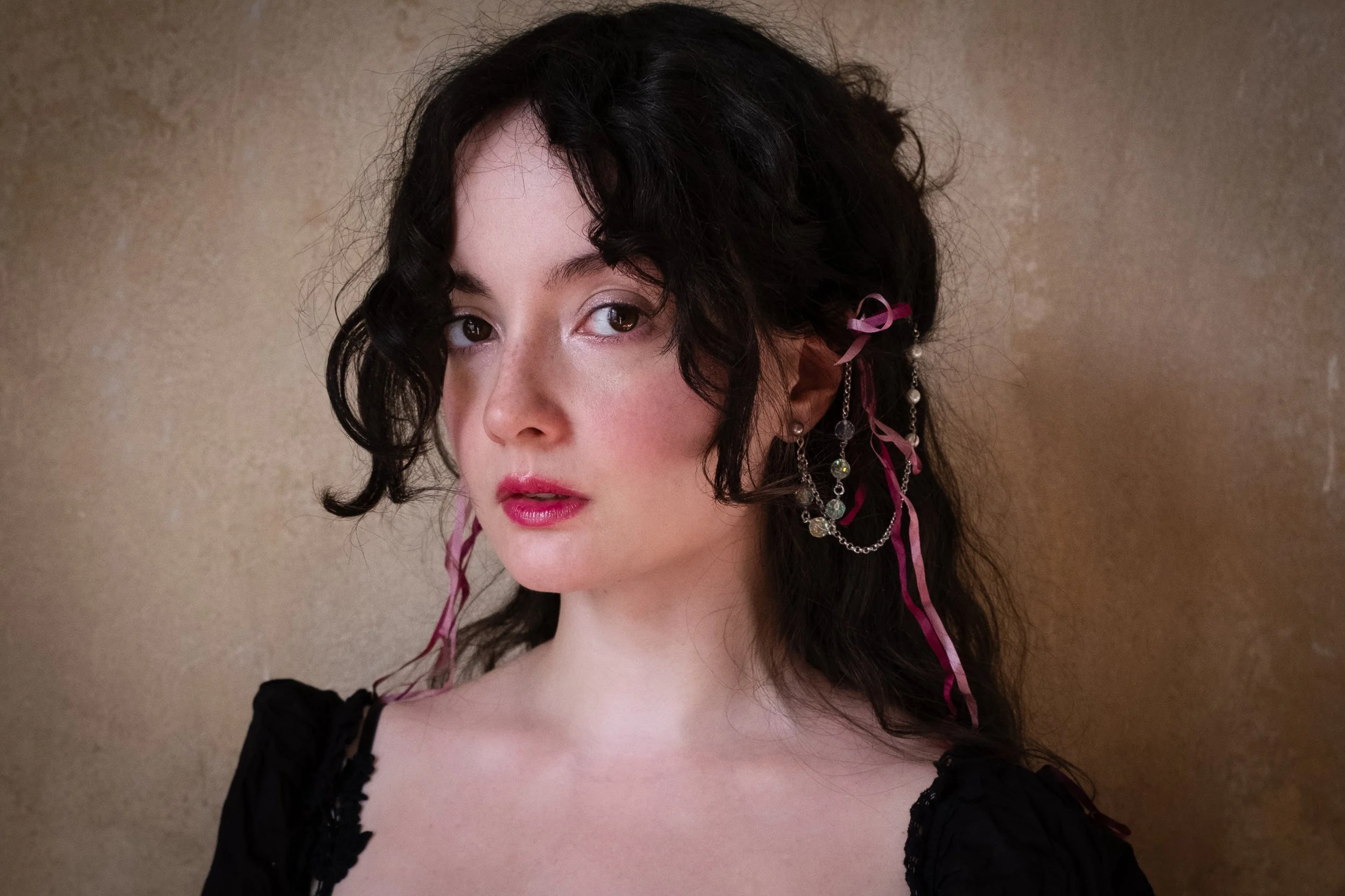
A fresh start in a new flat, a gifted piano and a summer turning to autumn set Gloria de Oliveira on the path towards The Lying Swans. The Berlin-based musician and visual artist found inspiration in everything from swan mythology to the records that reminded her of home, alongside the films she shared with producer Randall Dunn. Here, she talks about finding her way back to writing, the appeal of the flute and the stories woven through her new album.
For those unfamiliar with your music, can you tell us who you are, where you’re from and about the music you make?
My name is Gloria de Oliveira, I hold three nationalities (Brazilian, Portuguese and German) and I currently live in Berlin. I make music and visual art, among other things. Describing myself and my work is hard for me, I suggest browsing my YouTube channel for a better impression than I could put into words.
You wrote much of this album after moving into a new flat during the pandemic. What do you remember about finding your way back into writing in that space?
You know those romcoms where a woman finally gets a fresh start in her own place and there’s a montage of her renovating in dungarees? That’s truly what it felt like for me. I found it quite healing when the lockdown lifted and I was able to move on from a toxic situation, going to the hardware store with my girlfriends, buying some new plants and paints. And then, just after settling in, I was gifted a beautiful vintage piano that someone my sound engineer friend Linda Dağ knew wanted to get rid of. After getting it tuned, I started improvising and writing songs on it as summer turned to autumn, laying the foundation for my new album.
Where did the title The Lying Swans come from, and what drew you to the story of Leda as a way of thinking about these songs?
The title actually came first, before writing any of the songs, and is a multifaceted play on words. It references the idea that swans as a species are famously pair-bonded and monogamous with their mate for a lifetime, thus becoming ubiquitous symbols for romance, depicted on wedding invitations and such. However, there are several tales involving swans, deception, abuse and betrayal in many different cultures throughout history. Perhaps by projecting our romantic ideals onto them we must also discuss their downfall. There’s Leda and the Swan from Greek antiquity, of course, wherein Zeus tries to charm a Spartan princess by disguising himself as a swan. As with all myths, it can be looked at in different ways, as a tale of magical seduction, or an account of a violation. The question of Leda’s consent has remained a topic of debate for centuries among scholars. I felt it was an apt parallel to many of the things I went through before making the album. There’s also the Dying Swan(s) in Tchaikovsky’s Swan Lake, also following a story of deception. Other tales coming to mind are the Irish Oidheadh Chlainne Lir (The Children of Lir) and the Grimm Brothers’ Die Sieben Schwöne (The Six Swans) and Prinz Schwan (The Swan Prince), as well as Hans Christian Andersen’s De vilde svaner (The Wild Swans). And so much more. Swan lore is a rich well to draw from.
There’s a recurring theme of learning to trust your own perception again. Did writing ever help you recognise something you hadn’t quite been able to put into words?
That happens a lot, in general, even beyond this album. In ways that are quite eerie, too, in a foreshadowing way. Sometimes like transmissions from the future. Keeping notes, writing things down immediately as they occur to you is one of the most valuable tools for getting in touch with your subconscious, something I am very interested in, as it harbours so much wisdom.
You’ve mentioned listening to Nara Leão, Milton Nascimento and Baden Powell on sleepless nights. What were you finding in their music at that point in your life?
One aspect is the way the music of that particular era (1960s-70s) was recorded (and how that fed back into the performance). So spacious yet intimate at the same time, you can feel the room and the textures of the instruments and voice. That was something I rejoiced in particularly during the pandemic, where we spent so much time isolated, in front of screens, in digital realms. These albums also remind me of home and my family.
‘The Wind Took it Away’ deals with the end of a relationship, but there’s a lightness to its rhythm. How did you arrive at that feeling for the song?
At some point you’re just done with the heaviness. You’ve done all the crying, you’ve shed all the tears there are to shed, you have asked all the questions, said everything, expressed your pain over and over.
The title refers to this as an organic process, part of life, part of nature. Just like the wind carrying away the leaves from a tree, everything is in constant motion. To be alive means to change, to love means to accept the possibility of loss.
You sent Randall Dunn films alongside musical references. Can you give us an example of how a particular scene or image became something you could hear on the record?
When we were working on one of the songs (‘The Voyager’), we talked about a specific scene in Akira Kurosawa’s film Dreams from 1990. A little boy walks into a forest and before him unfolds an enchanting scene beyond his comprehension, involving a wedding procession of foxes, based on Japanese folklore. This feeling of mystery and wonder is something we wanted to capture musically. Another film we talked about a lot was Phenomena by Dario Argento. There’s this piece on the soundtrack called ‘The Valley’ by Bill Wyman and Terry Taylor. It has this beautifully strange combination of a sweetly pastoral synth line with dark guitars coming in, a tension that I was very interested in.
Following your work with Dean Hurley on Oceans of Time, what were you curious to try with Randall? Was there anything he encouraged you to do that surprised you?
What fascinated me about Randall’s work in particular, and what drew me to him, is how it often feels so oneiric yet textured and haptical at the same time. Like a lucid dream you can walk around in. So I was really happy when he agreed to take on the album. Randall encouraged me to step out of the fog somewhat, to try and make the words I sing more clear to the ear. Also, he might be known as this black metal icon (which he is), however, in the studio, he would come up with the sweetest little melodies and sounds imaginable. Often quite humorous ones, too.
The flute has a prominent role on the album, with connections to both Brazilian music and Italian horror soundtracks. What appeals to you about the different moods that instrument can create?
To me, the flute as an instrument is inherently enchanting, in the literal sense of the word. Take Mozart’s The Magic Flute or the Pied Piper of Hamelin. Fun fact: The phrase ‘pied piper’ has become a metaphor for a person who attracts through charisma or false promises. Which is a theme throughout the album. Furthermore, there is something birdlike and at the same time reminiscent of the human voice about it, which was very interesting for me to play with.
What do you love right now?
Talking to my little nephews, apples from my parents’ garden, LULA WINNING THE ELECTION IN BRAZIL!!!
What do you hate right now?
Gloomy Berlin weather, the dire political situation and societal divide in Germany (and lots of other places), not finding the time to properly take care of my mental health & physical health.