
Start Listening To: Tommy Lefroy
The duo discuss recording together in Los Angeles, the books behind the songs and what it means to imagine a future when everything feels uncertain.
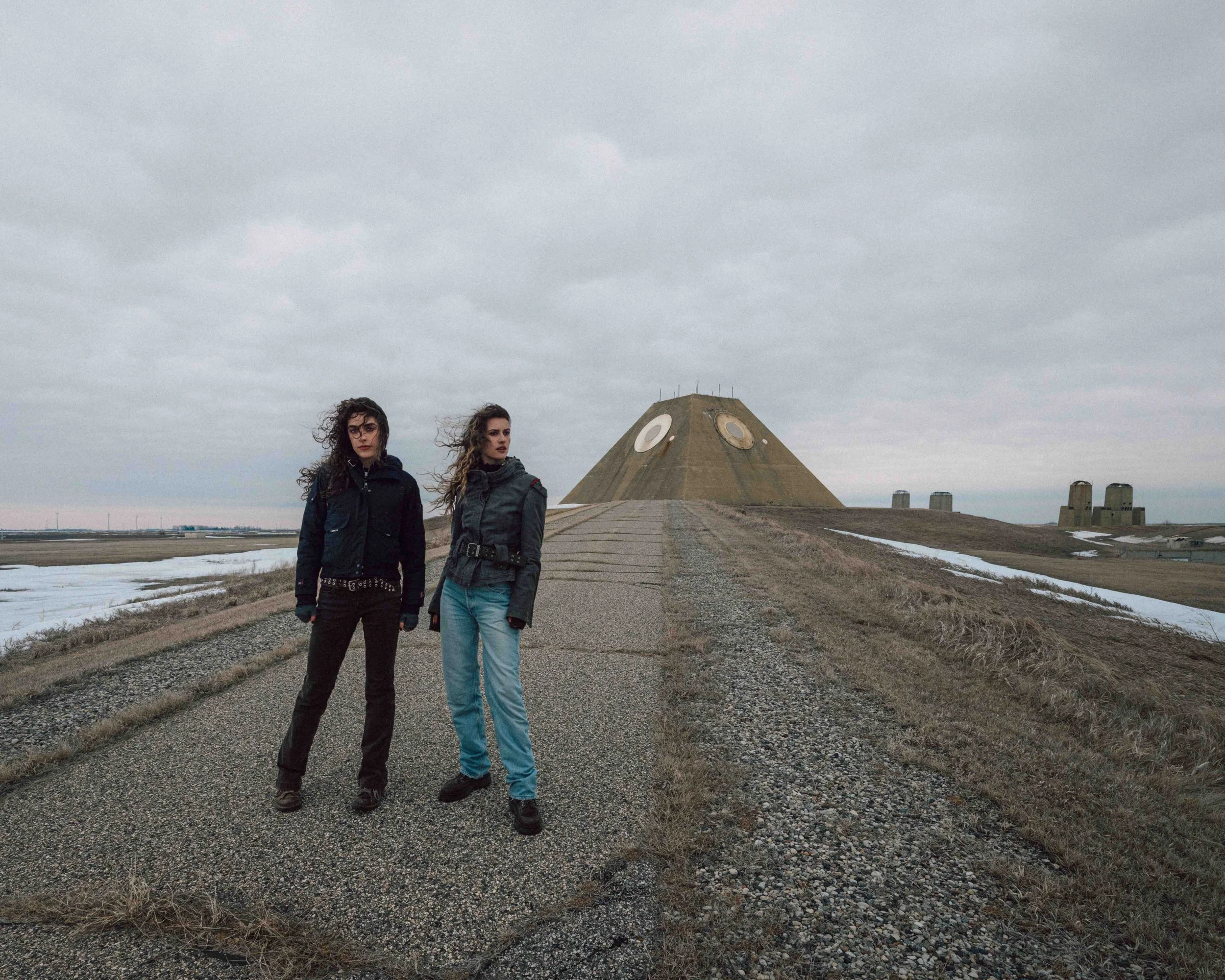
Tessa Mouzourakis and Wynter Bethel met in Nashville while writing songs for other artists, then began keeping some of their work for themselves. After three EPs, Tommy Lefroy have made their first full-length record, The Precariat, with Stephen Sesso and Mike Crossey. Its title names a feeling of insecurity they recognise in their own lives and those of their friends. Here, the pair talk about building the album’s sound in the studio, the literature that shaped it and the importance of finding other people to face an uncertain future with.
For those unfamiliar with your music, can you tell us who you are, where you’re from and about the music you make?
Tessa: I’m from Vancouver, BC. I met Wynter in Nashville while we were both working as session songwriters for other people’s projects. We formed Tommy Lefroy as an outlet for our own stories, and an opportunity to grow as indie rock musicians and producers.
Wynter: I grew up in the States, in Northern Michigan. Songwriting for me started as a way to synthesise the big, complex experience of being alive into something more graspable. I think with Tommy we continue to do that, to contend with the hard thoughts and feelings.
After three EPs, what did you want your first full-length record to give you room to do?
Tessa: We recorded The Precariat at Blue Canyon Studios with Stephen Sesso and Mike Crossey. Mike works out of a proper old-school studio in Los Angeles with an incredible live room and robust collection of instruments and analogue gear. Recording the full-length was our first time working in such a big space, and we used a lot of room mics to establish a consistent sound and feel across the record. Everything in the studio could be run through pedals, which encouraged us to be a little unorthodox in how we chose to process and affect live instruments and vocals.
Wynter: For all of our previous EPs, we’d had a much more scattered recording process, putting things together across various apartments, friends’ studio spaces and sometimes remotely, apart from each other. Our experience of recording The Precariat was our first time recording everything in the same room (except for some samples from travels), and we wanted to take that opportunity to create a cohesive world with the record, an atmosphere the listener can step into and spend time in.
This record and its themes also feel the most timely, the most political and influenced by the external, while also having very personal and intimate moments.
You’ve described precarity as a feeling shared by almost everyone you know. Was there a particular conversation or experience that made it the starting point for this album?
Tessa: The first time I heard the word ‘precariat’ was in conversation with a friend. We’d been talking about precarity feeling like an existential threat, something forcing us into corners and scrambling for survival. He’d mentioned the precariat to describe this growing class of people, particularly young people, who felt futureless. I immediately wrote it down and pitched it to Wynter as the name of our record. It felt like the perfect thesis.

In your album statement, you talk about anxiety pushing people into short-term thinking. How has that affected your own ability to imagine a future, both personally and as a band?
Wynter: It feels like such a common experience, at least amongst our friends and our generation. Our experience working in such a volatile and unpredictable industry certainly doesn’t help. We’ve very much been living season to season since starting the project. For me, I find it fluctuates. On one hand, I’ll have periods of feeling very focused on the work we’re doing, and then I’ll have weeks or months when I get pulled under by dismal news, swept into panic or cynicism. We wanted to speak to this experience on the record and be honest about it. It’s so many things at once.
Tessa: When you’re constantly in survival mode, it’s hard to see beyond what’s immediately in front of you. It’s been hard for me to conceptualise futures, and it’s remarkably easy to get lost in nihilism with constant news of climate catastrophes, economic instability and political turmoil. I’ve been trying to focus less on outcomes and just enjoy the process.
When something as vast as political or economic insecurity finds its way into your songwriting, where do you begin? Is there a song on the record that helped you find a way into those subjects?
Tessa: Insecurity is proving to be such an undeniable part of the human experience, so it felt natural for it to leak into the writing. ‘Slush Puppy’ has a very distinctive thesis, exploring topics like consumerism and the surveillance state. It felt like an important introductory single to the broader themes on the record.
Wynter: We had been, and continue to be, reading a lot about political and economic instability and the driving factors behind it. We wanted to feel we had some understanding of the subjects before writing about them. ‘Slush Puppy’ started as a joke, but some of the underlying inspiration included The Coming Insurrection by The Invisible Committee and the work of Yanis Varoufakis.
You first met while writing for other artists. What do you remember about the point when writing together became something you wanted to keep for yourselves?
Wynter: It was pretty instinctual, just a gut feeling. We’d written together a couple of times, then some months later I asked Tessa if she wanted to start a band, half joking, as we didn’t live in the same place so the viability felt limited. The first batch of songs we wrote with a project in mind became a lot of our first EP, and a couple of them, ‘Thief’ and ‘Threat’, are on The Precariat.
Tessa: ‘Trashfire’ and ‘Shoot’ were some of the first songs we ever wrote together. We immediately wrote very personal music and leaned on specificity in the lyrics. It was clear that no one else could release these songs as their own, so we had to do it.
You’ve spoken about wanting to subvert the broken woman trope and become the heroic leads yourselves. Has your idea of what makes someone a heroine changed through writing this record?
Tessa: At times, the heroine trope is a lonely one. So much of what we explore in this record, and so much of what we offer to counteract insecurity and precarity, is community. It’s about the relationships we have with each other and the ways we rely on each other to survive and ultimately fight against the systems that try to control us. In making this record, my idea of the heroine has shifted away from this sort of main-character hyper-individualism. It’s about supporting each other and developing class consciousness through our shared experience.
What did Stephen Sesso and Mike Crossey bring to the record?
Wynter: We knew we wanted to work with Mike because he cared about The Precariat, and saw an importance in it that was really valuable and encouraging to us. We’d just been through a season of transitions and challenges, and it was a slow start to begin recording. Mike and Stephen believed in the songs in a way that brought all our ideas back to life, bigger and better than before.
Mike is brilliant, really thinks about sonics in a big way. We were able to describe how we wanted things to sound visually, conceptually. It worked really well with how we’ve approached things in the past, and allowed us to get things feeling both nuanced and cinematic.
Stephen and I went to the same university but had never met prior to working together. There were so many funny synchronicities. We were listening to so many of the same bands in high school. Stephen’s technical skills elevated everything and educated us so much in the process. He’s ended up becoming one of our best friends.
Tessa: Stephen is such an engineering wizard and was down to try anything to get a cool sound. I really appreciated his willingness to be unorthodox with it, to break the rules and have fun. Mike is an incredible mixer. He pays such close attention to the placement of things, where they live spatially in the mix. He really helped elevate the overall sound and feel, and made the drums sound sick.
Your music makes room for both delicate acoustic playing and much noisier guitars. What were you most excited to try sonically on this album?
Wynter: We’d previously recorded most of our guitars direct or ‘in the box’, and this time we had a wealth of amps and pedals to choose from, which was so much fun and such an education. We had a lot of fun with the Kevin Shields Fender Blender at the end of ‘Angel in the House’, and the Chase Bliss GenLoss pedal on ‘Slush Puppy’. So many things we had only ever been able to use a plug-in to emulate, like tape, compression, reverb and synths, we were able to record analogue with the real thing this time around. It was such a treat.
Tessa: We got to experiment with a lot of incredible analogue gear that we’d never had access to before. Some of my favourite sounds on this record were taken from mod synths, like the DFAM or the Clouds granular synth. We also borrowed from Stephen’s extensive guitar pedal collection and ran almost anything through my favourite amp at the studio, a vintage ’60s Magnatone.
Literature has been part of your connection from the beginning. Was there a book, poem or character that stayed with you while you were making this record?
Wynter: I read Art Monsters by Lauren Elkin and immediately wrote down ‘Rokeby Venus’ and ‘Angel in the House’ as titles we should write. Both stories had such humour and were rich with wider themes and metaphors. The destruction of the feminine ideal, both figuratively in Virginia Woolf’s 1931 speech ‘Professions for Women’, and more literally with Canadian suffragette Mary Richardson’s slashing of the Rokeby Venus painting in protest against the oppression of female autonomy. Both continue to feel relevant. The tendency of British museums to refer to international paintings by the names of British manors in which they were displayed feels emblematic of colonialism, and the unconscious ways we perpetuate colonial themes in language.
Tessa: We both read Lauren Elkin’s Art Monsters, which directly influenced the songs ‘Rokeby Venus’ and ‘Angel in the House’. We read The Precariat, written by Guy Standing, the British economist who coined the term. I was also reading a lot of Kurt Vonnegut Jr. while we were working on the record. His satirical tone and social commentary were really influential on songs like ‘Slush Puppy’.
You made your early music between London and Los Angeles, and you’re now both based in LA. What has being in the same city changed about your friendship and the everyday experience of being a band?
Wynter: Our first experience of living in the same city was when I came to London in 2021. I intended to go for a trip and ended up spending years there. I hadn’t been to the UK before, and I didn’t know anyone else there besides Tessa. It allowed us to have this sort of laser focus on the project, but also put a lot of pressure on the band and our relationship, because we were both so far from our homes and communities. The song ‘Vacuum’ is about those early seasons, this sort of pressure cooker we existed in. Of course, we’ve lived through so many seasons together now, so many ups and downs, and we’ve been so fortunate to have the music take us so many places. The move to LA was such a big, transitional season, and LA has such a different feel and pace than London. It’s taken a little longer to find our footing here, but the biggest blessing has been the opportunity to record at Blue Canyon Studios. It was really a dream experience. And we’re very excited to get back on the road with this record.
What do you love right now?
Tessa: I love Channel 5 News, espresso tonics, a good swim, Annie Ernaux.
Wynter: I’ve been loving reading Peter Gowan essays and taking film photos of people I love. I just got back from a family wedding in Alaska and we were all in absolute awe of the mountains.
What do you hate right now?
Tessa: Generative AI and data centres.
Wynter: This week I’ve been thinking about the Paramount and Warner Bros. merger, and other threats to free media and independent journalism happening in the US and across the world.
Name an album you’re still listening to from when you were younger and why it’s still important to you.
Tessa: I love Joni Mitchell’s Blue. My mum used to play it all the time in the kitchen growing up. Joni is such a masterful storyteller, so sharp and introspective and strong. I love her so much.
Wynter: The National’s High Violet is a record I return to over and over. It’s got me through everything from my first break-up and leaving my hometown to my worst homesickness while living in England. It’s a record you can cry to, dance to, drive home to.
When someone hears your music for the first time, what do you hope sticks with them?
Wynter: I hope taking time to listen to the music might afford someone a safe space to process the absurdity of everything going on in our world these days: the joy, grief, confusion, existential longing. I was just reading about solastalgia, coined by Glenn Albrecht, homesickness for a place while you’re still in it, or a sort of nostalgia or grief over a rapidly changing world. Things are changing faster than we can comprehend and we all need space to process. I was thinking about that a lot as we were making The Precariat.
Tessa: Hopefully some sense of knowing, or some reassurance in a shared experience. Mostly that whatever you’re feeling, you’re not alone in it.
Photography By: Brendon Burton