
Start Listening To: M. Woodroe
The Brighton band talk about their debut EP, the city’s DIY scene and making space to feel too much.
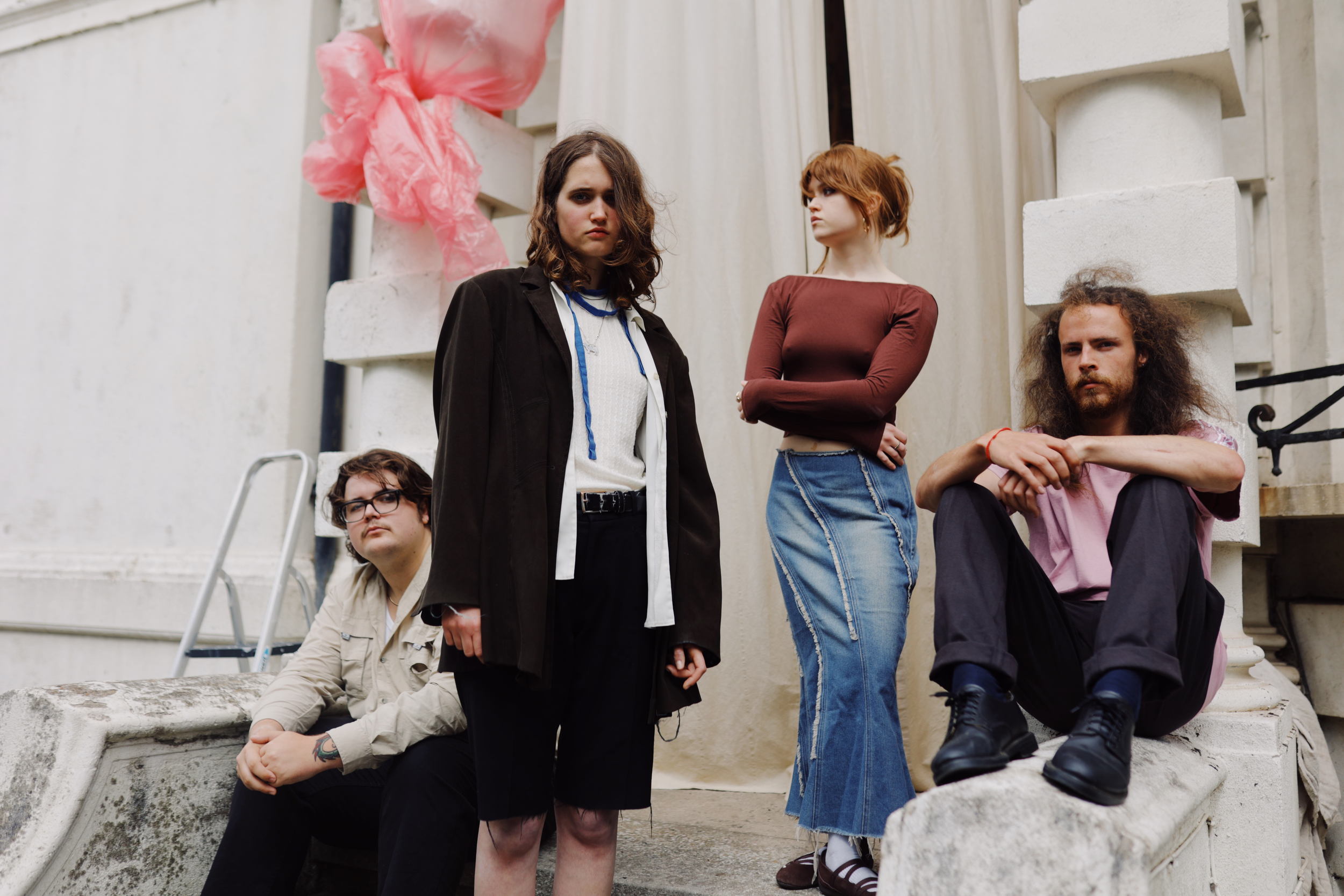
M. Woodroe’s debut EP, The Treatment of Fractures, takes its name from a vintage medical textbook, one of several the Brighton band have drawn on for their imagery. Their songs began in different places: some were written before the band got hold of them, while others took shape together in the rehearsal room. We spoke to M. Woodroe about finally letting the EP go, working with Strut Safe on ‘Statue’, and the things they love and resent about Brighton’s DIY scene.
For those unfamiliar with your music, can you tell us who you are, where you’re from and about the music you make?
We’re M. Woodroe from Brighton and we make angular alternative music in the vein of PJ Harvey, Mannequin Pussy and Sonic Youth.
Where did the name M. Woodroe come from?
M. Woodroe was the name of the author at the back of a Scientology leaflet I was given. Thought it had a good ring to it, so I stole it. A lot of people think it’s my name.
Your debut EP, The Treatment of Fractures, is out now. What’s it been like letting people hear it, and has anyone’s response surprised you?
It feels like a weight off my shoulders or a secret that I can finally let go now that it’s out. It’s like unblocking a pipe or unclogging a pore, something that has been on me for too long. My dad always told me that once songs are out (or played to other people), they’re not the writer’s songs anymore. They belong to the listener, the dancer, the crier, the work-out-er, the sitting-on-the-bus-er, the walking-to-work-er. It’s almost a relief that these songs aren’t ours anymore. It’s completely out of my hands.
We had a really lovely review from The Sound of Violence that talked about every track on the EP being a different form of violence reflected in the body, an interpretation that makes so much sense but, admittedly, I was not aware of. It reminded me of an interview that PJ Harvey did with David Byrne in which she said that it takes her years to actually understand what she was trying to say in an album. I feel like that with the EP. I feel like I’m only just starting to understand it.
Marcie, you’ve described the EP as a 15-year-old, full of feelings that threaten to make you explode. What could your teenage self express that you find harder to let out now?
I miss my teenage attitude and backbone. I’m too afraid of other people’s perceptions of me, especially men’s. There’s a million things about my teenage years that I’m very glad to be out of, but I miss that selfish, egocentric part of me. I’ve been worn down by the dress that I wear. I’m too scared of how people perceive me and the reasons for their perception. I feel lobotomised.
What does the title The Treatment of Fractures mean to you, and when did it become the name for this collection of songs?
I have a small collection of vintage medical textbooks that I lift all the band’s imagery from. ‘The Treatment of Fractures’ was a chapter title in one of them. I thought it sounded pretty cool, so that was it.
Which song on the EP changed the most between its first idea and the finished recording?
‘Statue’, 100%. Everything around (most of) the lyrics, the chords and the heart of the song changed. I wrote it at 16 (a year after I got my first guitar) and still have the original phone recording of when I wrote it in my bedroom, singing so quietly my family wouldn’t hear me. The recording is pretty cringey to me now. I was putting on a voice and was terrible at guitar. Obviously, I play it on piano now, but it was written on guitar and I used to play it at a lot of open mics on guitar, in a more Patsy Cline/Tammy Wynette style. I would always play it at the end of my sets, but the performance would differ so much. Sometimes I would really go for it at the end and scream and wail a little, and sometimes I would just whisper it.
There also used to be a whole other verse at the end that I cut out and sometimes miss a little bit (but it’s better that the song is more concise and simple now):
Oh, oh
What are you doing here?
I see my sister in his eyes.
Oh, oh
She cries, she cries
Your lyrics explore gender, sexuality and desire. Is there a particular line on the EP that took you a while to feel comfortable singing in front of other people?
I think performance is like a desperate grasp at asking people to see you for yourself, and most of the time people don’t. I don’t think it matters much what I say. They will either hear their own voice or what they assume my voice is. A lot of it gets tuned out and misunderstood, which I guess is my job as a songwriter. Songs need to be authentic and real but ambiguous enough that they see themselves reflected on my face. So what I sing holds no more worth than the mind the listener turns the words over in. Which I guess gives me a lot of relief. Nothing matters to me; it matters to you.
Anyway, it’s probably: ‘Virgin urine poured on my skin. Girls opened, chew and spit.’
When you bring a song into the rehearsal room, how much is already decided, and what tends to happen once everyone gets their hands on it?
It’s such a mix. For the EP, I had already written ‘Carte Blanche’, ‘Statue’ and ‘Stalactites’, and the songs just got improved by the band going crazy with their amazing instrumentation. I have no say in what they do other than ‘yes, I like that’ or ‘no, I don’t like that’.
With ‘Sweetness, Sweetness’, I wrote none of the music. They all just did their thing whilst I sat in the corner scribbling in my notebook. I’m not sure if it’s just because I know that it’s different, but I feel like it leads to such a different sound. A more riff-based sound over a chord-based one. ‘Sweetness, Sweetness’ was very collaborative. It was such a fluid process.
‘Statue’ was released in partnership with Strut Safe. How did that connection come about, and what did you want the partnership to do beyond the release itself?
I knew about Strut Safe already after they put up some bus stop ads in Brighton a few years ago. It took me a while to put two and two together. The connection was just some lightbulb moment that came to me randomly.
When we got the green light from Strut Safe, I kept speaking to people about it (because I was so happy and excited) who had no idea about the service. My main aim was just to get the name out. It’s such a wonderful service run by an amazing team of volunteers that more people should be aware of. You never know when you’re gonna need a friendly voice to talk to late in the city. I’m really proud of the partnership and to be the reason people know about Strut Safe.
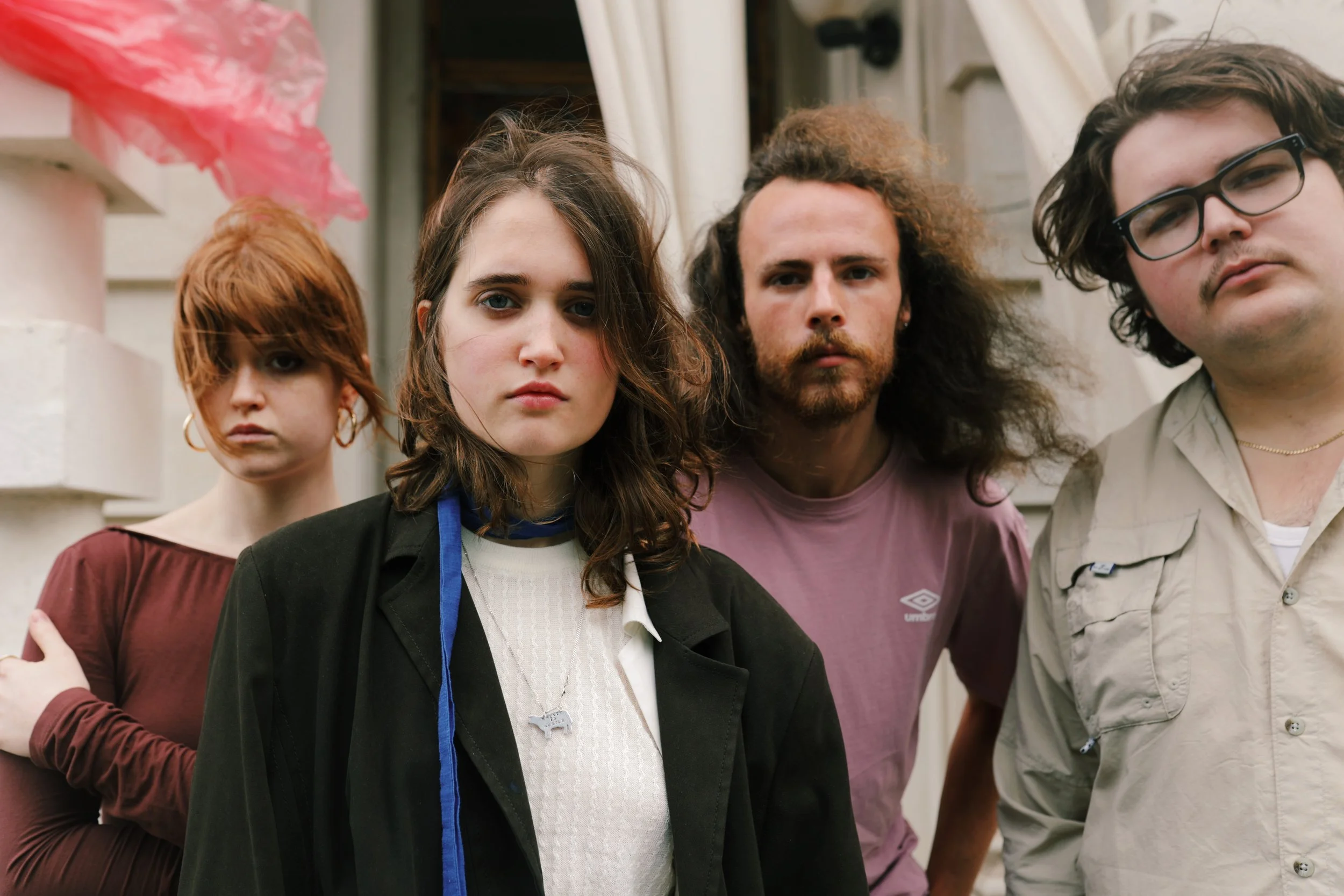
What’s happening in Brighton’s DIY scene that people outside the city might not see? Are there bands, spaces or people who have been particularly important to you?
Brighton’s scene changes all the time and I can flip-flop between loving and resenting it. Sometimes it feels like a boys’ club. I mean, out of every city in the country, is Brighton the worst for gender diversity? Definitely not, but I get so tired of seeing a million all-boy band line-ups.
But then again, there’s so much about it that I love. Most significantly, the overwhelming number of fundraiser shows that happen every week. Some promoters include REVOLT, who raise money for Medical Aid for Palestinians, Agenda Collective, who raise money for causes surrounding women, and ctrlaltdel, who raise money for numerous trans fundraisers.
You’ve played alongside mclusky and Prostitute. Was there anything about watching either band up close that made you rethink your own live show?
Prostitute and mclusky are so cool. They were some of my favourite shows we’ve played. But those bands are so different to us, so I’m not sure if anything made me rethink the show other than wondering how they cope with the heat up there! I need to build up that resilience. I always feel like I’m gonna pass out.
You’ve said, ‘Maybe we should all be more intense.’ What would that look like for you outside of making music?
I think that statement applies to me too. Like I said before, I miss that opinionated, egocentric teenager I used to be. Everyone’s too scared of conflict. Arguing can be great. What’s that quote? ‘When everyone thinks the same, no one thinks at all’? Obviously, don’t go around picking fights with everyone, and don’t be rude, but we should all have a little more backbone, me included. A relationship with anyone should be a push and pull. Put up more of a fight.
What do you love right now?
God, I fucking love Kali Malone. I’m seeing her in January in London and I’m pissing myself from excitement right now. She’s the best. I want to be her.
What do you hate right now?
Israel.
Name an album you’re still listening to from when you were younger and why it’s still important to you.
My dad used to play me Bright Eyes and Conor Oberst’s (Bright Eyes’ singer) solo stuff when I was a kid, but it never stuck until he took me to see Conor Oberst on his Ruminations tour at the Palladium when I was 14. Everything changed.
Letting Off the Happiness is Bright Eyes’ second album and probably one of the most life-changing pieces of music that I’ve come across. It might not be the best album of all time, but it may be the most important to me. There’s this constant feeling in the album of waiting for things to get easier, for spring to come.
It was released when Conor Oberst was 18, around the age when it was most pertinent to me. Sometimes it can be pretty painful for me to listen to, since it coincided with some incredibly dark periods of my life. Sometimes I enjoy screaming along to it. Sometimes I wonder where I’d be without it.
When someone hears your music for the first time, what do you hope sticks with them?
I hope it’s a safe place for them to feel things. Nothing needs to stick; I just hope they can have a moment to themselves. Be too much.
Photography By: Arune Daukantaite