
Andrea Dee of Amplify Her: 'I don’t Just Like the theory'
Founded in 2023, Amplify Her is quickly taking root as London's most accessible and connected spaces for female and nonbinary-identifying artists to network and improve their craft.
July of 2026 found 87% of British youth telling Roundhouse that they feel ‘disconnected from and locked out of creativity’; and the portion of those who are throwing themselves into creative careers regardless of the challenges are relentlessly reminded that success is all about ‘Who you know.’ To conjoin a bleak statistic with another, a 2024 roundup by Help Musicians found that 51% of female musicians in the UK have faced direct gender-based discrimination in their professional work, with 33% having endured sexual harassment within the industry. Andrea Dee, a France-bornfounder and CEO of London-based Amplify Her, has approached the two problems as inseparable: if women in the industry want to fight together for equity, they need to find each other first.
Starting in 2023 as a monthly live music event featuring female musicians, Dee noticed that the artists’ desire to speak with each other was overshadowed by time constraints and show-related duties; soon after the first live Amplify Her event, she coordinated recurring Friday morning coffee meetups and encouraged all who identified as female or nonbinary to join. With an accumulating base of regulars and Dee’s drive to uphold accessibility, the early events soon faced two options: either be defunded or Dee-funded. ‘I started the coffee morning, and I ran all the events and everything for one year, free, on my savings, because I wanted to see if there was something there’, Dee tells me. ‘When I was doing it, I was really on it. It kind of caught up very quickly.’ Though the meetings have notably expanded in reach and size since the community first took notice of the events, the coffee morning meetups are still easily afforded at only five pounds per ticket.
‘I started in the music industry a little bit more than 20 years ago’, she recalls. ‘My first professional opportunity was as a showgirl in Las Vegas. I was part of a huge production of 50 dancers. I was 18, and it was work, but it wasn’t hard. I thought, ‘I’ve got this.’ Six months later, I got bored and didn’t really like Las Vegas, so I moved to New York; I really wanted to be a songwriter, and I felt that in order to write, you need to have a story. Part of my story was to live and see what it was all about.
I came to New York not knowing anybody. I knew a friend of a friend who lived in an apartment, so I stayed there. I found a job on my second day because I knew New York was expensive and I needed to survive. I was singing in a bar and waitressing at the same time. From then on, I just kept going.
I think it’s changed for the better since then’, Dee later reflects. ‘There is definitely more awareness about inequality in the world we live in today. In situations where labels were included, or I was mixing my songs or doing a live show, it was only men that were taking care of all those things; I felt like I didn’t have a voice.
Whenever something happened, I had to go to my music producer or my manager and get him to communicate for me - when I told them something, they looked at me like they didn’t understand what I was saying. I felt very much unheard. Or I’d go on stage and have an engineer show me how to plug in my keyboard - like, are you kidding me?
I lived in the US for 10 years. I think in the U.S. gender inequality is a lot stronger than in the UK - but when I moved here, I really felt like something needed to happen. If you asked the general public whether they thought there was gender discrimination in the music industry, most of them would tell you, ‘Are you kidding me? Look at Beyoncé, look at Rihanna’; but those are the top of the top within the industry. It’s much better than it was, but we’re still not at an equal phase.
The thing about the music industry and women in the music industry is that it goes in waves’, she later adds. ‘So at some point we go up and suddenly we see a lot of female artists and we see a lot about “supporting women,” et cetera. And then, at some point, it dips back down: and then all the numbers that we built up, like the percentage on equal play on the radio or festival headliners, suddenly go from a 30% average to then dip down to a 14% average. These are the kind of waves we’ve seen. I would say it goes up three years, then dips down three years again.
I felt the only way to really make a difference was to really come together as a community, because numbers make people listen, and I feel like the more numbers we have as a community, the more we can make an impact in the world of music as women.’ She later adds: ‘A big thing of mine for Amplify Her is that there’s no age you have to be. You don’t need to be 20, and you also don’t need to be thirty, forty, fifty, or sixty; it doesn’t matter because at the end of the day, music is universal, and we all speak the same language of loving something.’
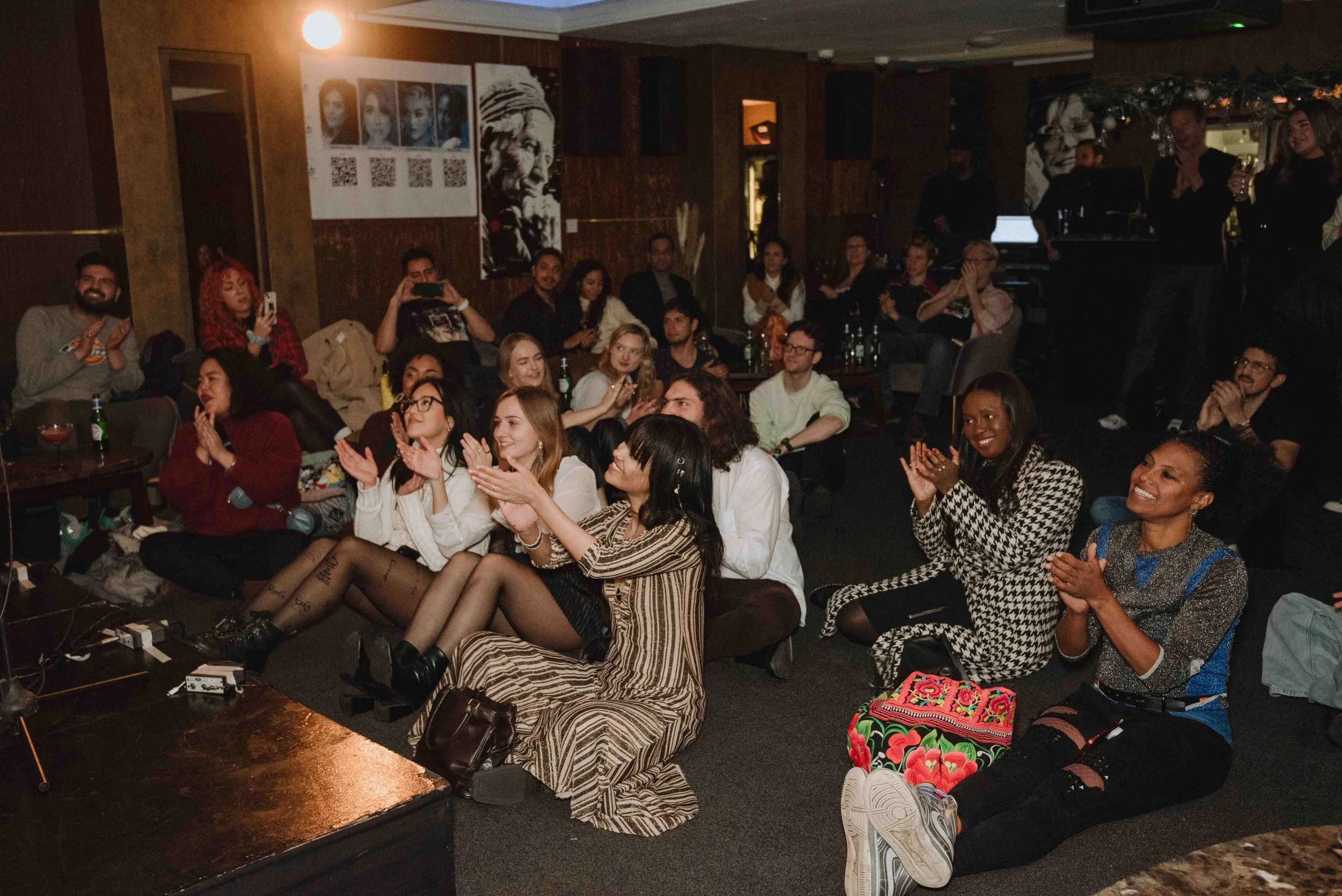
The networking events and panels pull in a range of artists and industry professionals, formed with the simultaneous aspirations of connecting artists to each other, and linking them with representatives in PR, media, label strategy, or other related vocations. ‘I would say the events have around 70% creatives and 30% industry people; but that’s also because my background is as a creative, so when I started Amplify Her, I attracted them’, she shares. ‘We’d love for it to be a 50-50% situation and do more partnership events in the future where there’s a bit more opportunity for everyone. Our masterclasses through virtual meetings are something that I thought was needed; knowledge is always power’, she enthuses over the program’s recent expansion.
‘We have creative writing workshops, which are all about finding your voice as a writer. I know there’s ChatGPT and it’s so easy now, la la la. But knowing your “why” is very important in terms of what you want to do and how to move into your next stage. So it’s really about owning that: ‘Why am I doing this? What is my voice saying?’ And a lot of that, from my perspective, comes through writing.
We’re really focused on workshops at the moment. We have the Amplify Her bootcamp coming up: it’s an eight-week workshop that focuses on live stage training, but it’s also about growing a fan base and building your branding. Then we put everything together because I’m very action-oriented. I don’t just like the theory. I mean, I like the theory, but I really like putting it into action.
You have to use everything you’ve learned to actually bring people in, because talking about building a fan base is great, but if nobody comes to your show, then we need to figure out why. I can show you how to bring people in after doing twenty million events.’
Amplify Her currently runs online social media workshops, hybrid songwriting workshops, and more.