
Start Listening To: DIVIL
DIVIL emerge from grief and reconnection, turning midlife urgency and long friendship into emotionally charged, forward-moving guitar music.
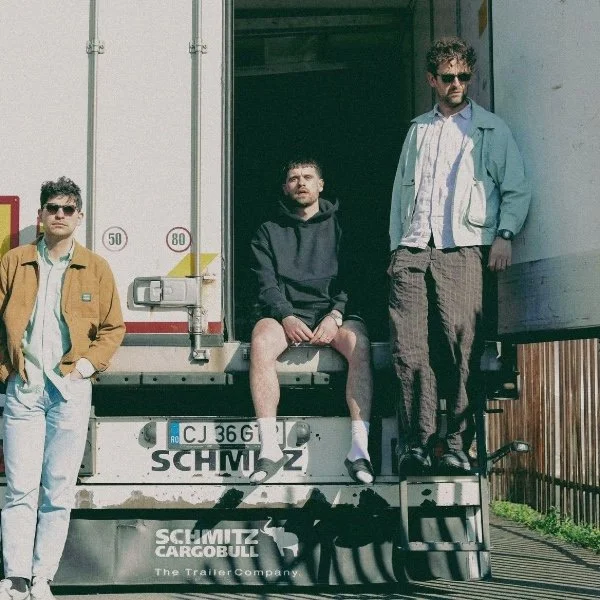
Existential shock invokes a common realization: ‘What should’ve been my Plan B became my Plan A.’ The grieving of a life unlived typically flexes toward the mourning of trading passion projects in exchange for practicality and financial security, opting for a life that provides spurts of meaning - a partner, a family - in between long stretches of work. Whether this epiphany metastasizes into action typically depends upon the privilege of time and the capacity to reshuffle their hierarchy of priorities.
DIVIL, a Dublin-based band born in the wake of the lead singer’s father’s death and news of bassist Conor Cusak’s rapidly multiplying stage IV cancer, challenges this narrative. In the high school best friends’ case, the tragedies of life (which would have happened across any alphabetical letter in the lineup of Plans) mitigated the three adults living out their once-Plan B’s contentedly - with loving partners, children, and established careers - back toward a more elemental version of what was perhaps considered to be Plan A in simpler years.
Conor, whose name has long been respected in Dublin’s artistic communities, has recently returned from Belgium for a tentatively life-saving surgery. Originally setting up a GoFundMe campaign with a target of 25,000 Euros to help fund the check-up trips back and forth from Belgium over the next few years, the fundraiser has amassed nearly 140,000 Euros at the time of writing. “He’s a really social person; he has friends in every city. I think over a thousand people donated money. People he didn’t know were donating a thousand Euros and stuff like that”, lead guitarist Jocelyn Vance attributed to its relatively anomalous outcome. Cramming sessions in between tumultuous daily lives to reconvene and make music together, the trio has just brought forth the three-pronged EP, aptly named DIVIL I, on June 19th.
You would expect the project to be sonically burdened by more of a gnawing angst than it is, considering that the nexus fusing reality and expression together was, most dominantly, a sudden forced proximity with the existential discomforts of liminality: a surprisingly endurant alt-rock brawn pushes through both the troughs and occasional bursts of documented relief. With burnished strings running perpendicular to a classically Irish boxing lyrical fortitude, the EP more than earns its square in the patchworked scene occupied by compatriots like Wunderhorse or, in its more unobscured moments, even Bell X1.

According to the band, the sudden reconvening was less in the interest of paying off the guilt of never fully committing to ‘making it’ as musicians, and more about honoring meaningful moments from the past that can only be resurrected in shared memory: and, slightly more primitively, carving out time for each other without forcibly upheaving their lives. “The core reason why we’re doing this is to carve out some time to hang with each other, when you really boil it down”, lead singer Danny McMahon admitted. “We’ve known each other since we were children, so it’s nice! It started out very low-pressure, because it was like, ‘Everyone’s got this big stuff happening. Let’s just meet up, and it’ll be no pressure.’ But pretty soon, Conor’s diagnosis got a bit heavier - and we also kind of realized that we had something decent.
When we started hanging out with each other, my dad had just died, and Conor had his diagnosis,’ he continued. “So we all had to kind of give equal time to all of those intense conversations at each practice before, after, and during. I’d use my experience caring for my dad, and try to talk with Conor about his illness; but we’d also be happy and talk about the joys of fatherhood and how Conor was looking forward to that. So all of those things had to be batted around with and juggled in the conversation.”
“And then you rock out. Emotionally-charged rock”, Jocelyn interjected. Danny: “Emotionally charged rock is sometimes the best, but often the worst. Like, imagine a really shit emotionally-charged rock band.” Not for the first time in the conversation, Jocelyn doubled down. “Yeah, they’re called DIVIL”.
“We were in bands throughout our twenties, but we never really properly released anything or got written about”, Danny later continued. “For me, one of the reasons is to just do this right. I know we can all do it, and now is the time. So the reasons are just to meet up and hang out, and also to achieve something and be able to look at it and say, ‘We did that, and we did it well. We belong in the mix.’
“If you’re asking whether we’re launching our music careers, the answer is kind of ‘yes’ and ‘no’”, Jocelyn clarified. “We are launching our music and taking it all seriously, but we’re not quitting our jobs. So there is a sort of limitation there. Conor has a child, Jocelyn has two children, and life started a long time ago. We’re already settled into our Plan B, and it’s going fine. But Plan A is coming back around now.”
“When Conor got his diagnosis, it obviously came with an existential shock”, Danny shared. “He looked at his own life and his work, and I remember him saying he needed to pare down to his wife, his friends, and his music. So the profound nature of music was something he could cling to during these moments of existential dread. It’s one of the few things that really means something to him - in moments of absolute life terror, music is actually strong enough to help in that situation. That’s a pretty amazing thing given that it’s just strings wobbling on a piece of wood, you know what I mean? Making music with your old school friends is like holding a teddy bear or a blankie.”
While the three friends have known each other since the age of four, they largely lost touch with Conor until the funeral of Danny’s father brought them back into the same room - all three are musicians in their own right, but it was mostly Jocelyn and Danny who played together in high school and beyond. “Danny wasn’t allowed at our graduation for very hilarious reasons, but I did play in a band with Conor at graduation”, Jocelyn added. Danny’s version of the story was similar: “Since I wasn’t allowed to attend graduation, I had to peer through the door as my best mate was rocking out on stage. I was walking around having a beer on my own.”
“Boy, was it scary meeting the full adult version of Conor for the first time ten years later at Danny’s dad’s funeral. He was intense, dude”, Jocelyn continued. “Danny and I played music together a lot since high school, but we were extremely undisciplined, free-flowing, pick up an idea and drop it - and Conor can’t bear that. He’s like the nightmare guy from an office who comes by to make people more productive. He kind of had to drill-sergeant us up a bit. It was like water hitting a rock. I was like, ‘This is not fun. Music is supposed to be fun.’ But then I suppose all of the actualities of what we could do with it started hitting, and I was like, ‘Maybe we’ve had enough fun.’
I think Conor is probably the one with his foot on the gas the most. Danny and I would be similar in that we would throw out 20 or 30 songs, still waiting for the one that’s like ‘This is it.’ He was a sort of in-house cheerleader for the songs. When there’s one person who rubs off on you, then you’re like, ‘Actually, yeah, these are deadly.’
But yeah, this band is in a rush; there’s no doubt. It’s just because we’re in our mid-thirties and everyone has got a full life. When we were in bands before, we’d be hanging around all day together for days on end. That’s not the reality for us now, so we just have to be businesslike about it and be productive with the time we have.”
When asked whether the sense of urgency - and the inherent emotional heft of the content - endowed them with significantly more creative pressure compared to past projects, Danny somewhat countered the assumption. “I actually think that the nature of how heavy the stuff is takes pressure off of me, because trying to come up with lyrics when I had nothing to talk about - that was pressure.
I suppose the lesson is that songwriting is a tool; for me, personally, it was the best tool for processing, and I recommend it so highly. I can’t just sit down and think about some of this shit. Maybe when I’m 40, I’ll be dancing to Van Morrison and thinking about my dad with a safe distance from the grief, but for now it’s too heavy.
I think when people hear the word ‘grief’, they think you mean that you have to sit down and think about the person you lost. That’s a really hard and intense thing to do, and there aren’t many places one can do that. In the bathroom, maybe. Songwriting for me has been a great way to look back on memories - because a memory comes up when you’re thinking, and then you’re trying to think about what to put in the song. I’ve found from it that I miss my dad - a lot - and that music is probably the only way that I can process it. It has been so cathartic and good for my health.
Still, they’re wary of letting the story eclipse the music itself - and are especially cognisant of how being known primarily as “The Cancer Band” may cause future projects to be permalinked with a band identity that they consider transient. “It’s a fine line between that being a part of your story and having it inform the music, but you don’t really want to be leading with that all the time, you know?”, countered Jocelyn. “It’s about the music, and every band is full of people who have complex lives. We’re no different from any other band in that way. We did get a very unlucky start, but hopefully things will become better and that will slowly be forgotten about, you know? We have come out of the trap talking about it, though, so it’s quite hard.
Check back later if we’re still writing about the same stuff; I hope we would have evolved. But I don’t think it’s possible to be stuck in a negative emotional loop just through making songs. There’s a natural balancing act that happens. If we’ve written a song that’s maybe on the heavier side, then with the next one that comes out we’d be like, ‘Ah, come on, lads, we’re not doing another.’ So there’s a natural course-correcting that goes on,” he reprised. “DIVIL is basically an ongoing mood check with all three of us. It will fluctuate. We’re not the grief band.”