
Start Listening To: Myer U Clark
Myer U Clark finds beauty in dissonance and the unexpected.
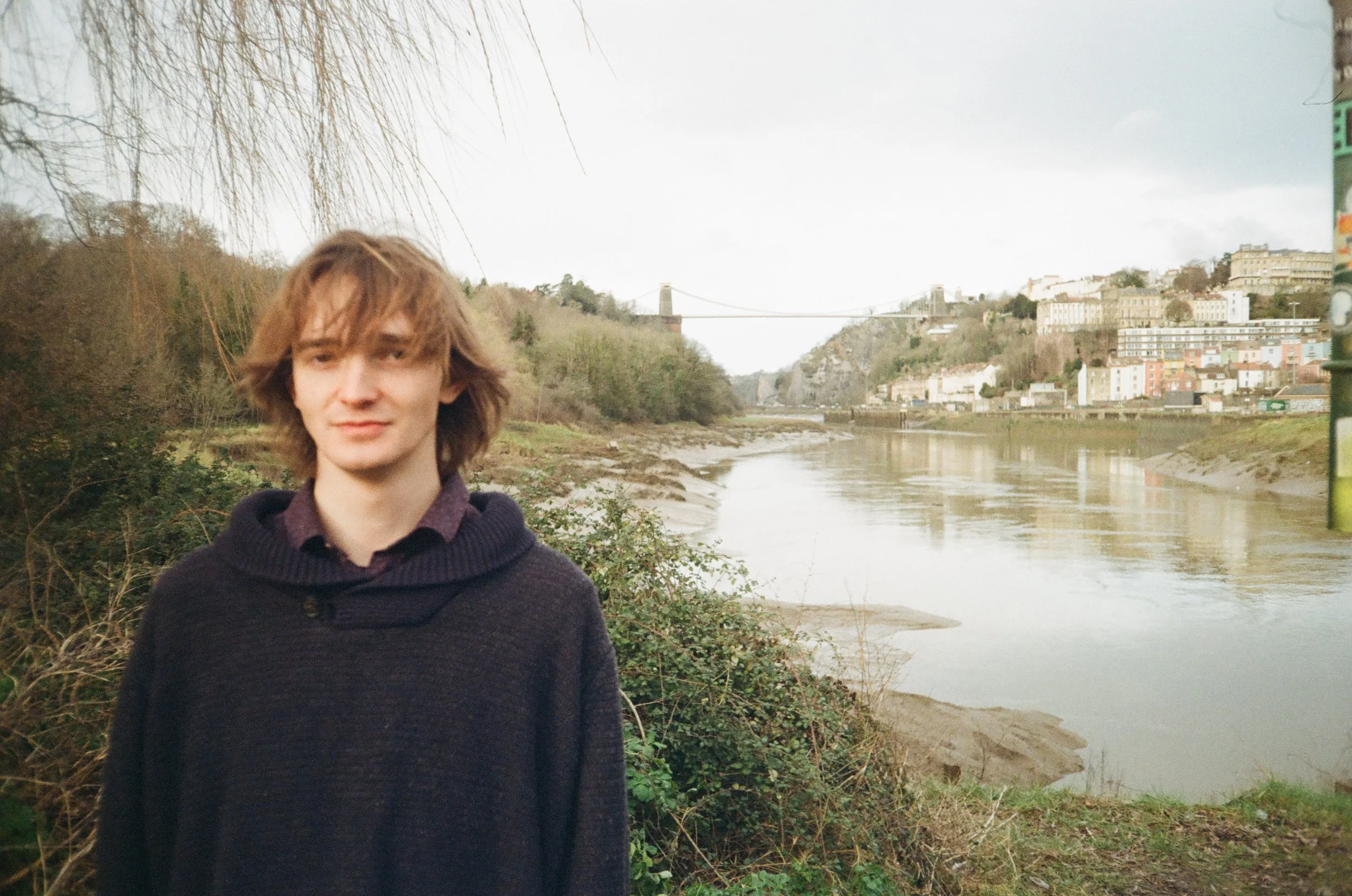
Bristol-based songwriter Myer U Clark makes music that drifts between the familiar and the uncanny, where folk melodies bend under the weight of strange chords and instinct takes precedence over expectation. With a new album that leans into disorientation, dense arrangements and an almost subconscious approach to songwriting, Clark is carving out a space that feels both deeply personal and quietly expansive. We caught up with him to talk about embracing unpredictability, following feeling over form, and finding something lasting in the unexpected.
For those unfamiliar with your music, can you tell us who you are, where you’re from and about the music you make?
I’m Myer, I enjoy writing songs and I’m from a village in North Devon called Swimbridge where they made Jack Russells. My music is a mixture of my favourite types of music, mostly folk and pop and 1930s Broadway show songs but a lot of other loose ends too.
You’ve said you feel “at home” in disorientation. What is it about that feeling that draws you in creatively?
Dissonance as part of an otherwise very harmonic thing is really satisfying to me. I find it just often more appealing and interesting than very simple and formulaic stuff. That’s not to say there isn’t very beautiful paint by numbers songs too.
Your upcoming album constantly shifts and bends in unexpected ways. Do those twists come instinctively, or are you consciously trying to wrong-foot the listener?
Generally music where I can tell it has been written very consciously considering an audience’s reaction to it is irritating to me, especially when that is done in a formulaic way. I am never trying to wrongfoot the listener in these songs because I’m not concerned about how the listener will react to them - I write the songs from and for myself. The unusual chords are more of a feeling-based thing and I can’t really speak much as to why I need to write this way but it’s just how it happens.
There’s a huge range of instrumentation across the record. How did you decide what each song needed without it becoming overcrowded?
The simple answer is that I didn’t decide. From the start of recording, I sort of let musicians play on my songs if they asked me and I liked their playing, and let them play how they saw fit with very little intrusion - this is particularly true of the ‘band’ songs which we recorded in my friend Harry Wright’s living room in a single 12 hour session (Make a Bet, Simple Sailing, Sense by Sense, As a Sparrow, For Fortune), where, aside from some arrangements where I wanted the guitar part to be heard more, the band were let loose! Later, too, me and Jack had to dial back and cut lots of instruments out because I’d added too many while doing overdubs. I found it easy to get carried away with adding whole tracks of baby pianos and zithers to songs like Simple Sailing which had to go - it’s because, I think, I’m used to listening to very dense jazz band recordings from a long time ago when many instruments would amalgamate into a single, thick sound from the old microphones they used. We ended up going for a much more separated sound with Jack’s production which I’ve since fallen in love with and think is more appropriate for these songs.
You’ve spoken about being inspired by the chord changes in E.T. the Extra-Terrestrial soundtrack. What stuck with you from that early experience?
I was terrified of the film when my Mum showed me it as a 4 or 5 year old and used to have really bad nightmares about E.T. trying to get me. But later, my brother bought it on DVD when I was about 12, maybe purely to taunt me, but I managed to watch it and ended up being absolutely spellbound by John Williams’ score, whose other work of course I was very familiar with as a kid. This one was just jam-packed with emotion and wonder and love and I would get goosebumps hearing most of the songs. The chords were outrageous, but also built into them were melodies that seemed to have always been there, straight from the course, which Williams has an uncanny knack for. I was strangely thankful to my brother.
Your influences stretch from Nick Drake to A. G. Cook. How do you reconcile such different approaches to songwriting?
It’s strange, I don’t see those two artists as very different from one another, in the sense that they are both wholly dedicated songwriters that have carved so completely their own worlds out of the songs that we can all go to.
You reference the idea of the Romantic “sublime” in your work. What does reaching that feeling look or sound like for you in practice?
It’s not really a conscious thing I aim towards but it is a nice thing to think about and I do like reading books that rattle on about the Sublime. I think maybe I have experienced it a few times when you stumble into something very special and precious and secret when you’re making something that tells you something you didn’t know without saying anything directly to you.
You’ve mentioned being influenced by Carl Jung, particularly the idea of the anima. How did those ideas shape the album, even subconsciously?
I can’t say they did in any way consciously, as I only stumbled across Jung’s book ‘Memories, Dreams and Recollections’ outside my neighbour’s house after the album was long finished, but unconsciously I do think I am guided by things to make songs and it’s hard for me to put that into words and tell other people about it.
Much of the record came together quickly and somewhat spontaneously. Do you think that loose, instinctive process is essential to what the album became?
I tend to see these songs as in some way altogether different entities from the versions of them that appear on the record, but yes, definitely I do- and to tell the truth I don’t value as much the way a song is recorded and got down, even produced, so long as the material that’s being played and recorded is worthwhile. The looseness is probably a reflection of that ethos.
What do you love right now?
I love confronting fear and meditating and making all manner of different things. And I love people and animals and plants and Ancient Egypt.
What do you hate right now?
I hate hate and I hate getting glass in my hands. I hate smokey chuck the soundcloud rapper.
Name an album you’re still listening to from when you were younger and why it’s still important to you?
Astral Weeks by Van Morrison, also Another Thought by Arthur Russell. Both albums hit me so hard over the head when I was 17 and have a magic to them, both jam-packed with wonderful melodies in the same way I feel about the E.T. soundtrack too.
When someone hears your music for the first time, what do you hope sticks with them?
I hope they get the tune, the melody and are able to feel something from it. That’s all I’d hope I’m able to give, because all of my favourite music has done that for me and it’s just very nice.