
Mandy, Indiana - Urgh Review
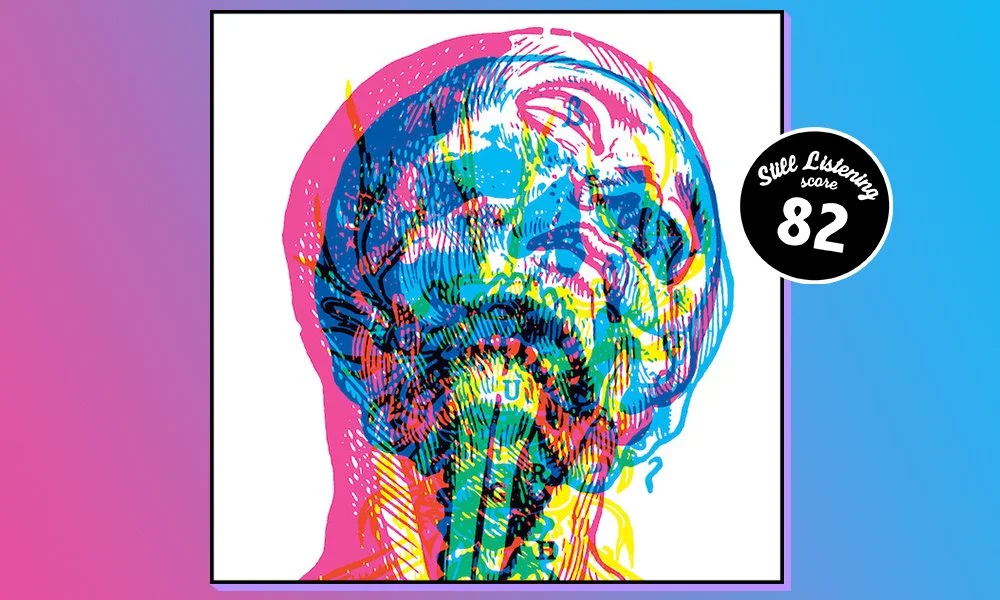
Mandy, Indiana do more with less in straight-to-the-point, intense sophomore album.
There are, it could be argued, two ways a band can go about crafting a second studio album. One path builds further upon what has come before, taking advantage of lessons learnt and routes well-practiced, to polish and refine and add a new chapter to an already open tale. The other goes in the opposite direction, taking a sharp turn to experiment with something altogether new, trying a new sound on like a new coat, uncomfortableness of the unfamiliar and all. It is a credit to Franco-British noiseniks Mandy, Indiana that their second album, URGH, soon to be released for Sacred Bones, somehow manages to avoid the choice and successfully follow both paths at once.
The all-caps expletive chosen as a title for this record represents in a way both a summary and a warning. This is not a philosophical deconstruction of intellectual malaise but a deliberate attempt to tap into the most immediate, most visceral kind of feelings, including (and perhaps foremost) unpleasant ones. Where the album’s predecessor, 2023’s I’ve Seen A Way, played with the dissonant and the disconcerting in a way that relied on minute detail to function properly, here the sound feels much more direct, straight to the point and deliberately unpolished around the edges. From the very first bars of opening track ‘Sevastopol’, leaning into noise almost instantly, the writing is on the wall: there’s been a very clear and purposeful trimming of the fat here, resulting in an almost industrial-rock quality in the way the building pieces of this sound are strung together. Scott Fair’s guitars in particular, are rough and full-bodied, cleverly playing with an almost modular repetition of phrases, both relentless and self-restrained. Considering that Fair is also the producer on this record, this feels like an interpretative key for the whole thing: a deliberate attempt to do more with less, privileging focus over sprawl. Tracks like ‘Magazine’ or ‘ist halt so’ - the latter’s political undertones amplified by this greater weight of sound and embracing of sharp edges - are excellent examples of this process, although this new approach to the band’s collective voice is very much the red thread running through the whole record.
Where URGH most clearly succeeds, however, is in managing to take this more self-contained approach to composition and leverage it so that the emotional punch packed in the music is arguably enhanced, not lessened, by it. Valentine Caulfield’s vocals carry much of the weight in this respect, teetering always on the right side of the very thin line that separates raw expression from aggression. Language may be a component here: in terms of sheer sound, French, the dominant language in the record, works better for this kind of in-your-face earnestness than English does. ‘Dodecahedron’, one of the stand-out tracks in the whole album, perhaps best exemplifies this interplay between the sturdy structure of the music and the emotional sincerity of the vocals. It is an interplay rather than a balance, because often in the record a feeling sneaks in that the two elements are almost fighting with each other for dominance. When the beat prevails, you get ‘Cursive’, a track it would be very easy to imagine played in the early hours of the morning in a certain type of leather-heavy Berlin basement club. When vocal experimentation comes out on top, the result is ‘try saying’, where vocals play with vocals through a clever, and unsettling, use of sampling and distortion. This latter track also makes the case for the effectiveness of the bits of experimentation peppered through the album; every now and then a track does something unusual in a very effective way, breaking the pattern and catching the listener by surprise, another example being the repeated changes in pace in ‘Life Hex’. ‘Sicko!’ features a guest appearance by billy woods, which ultimately feels a little constrained by the heft of the sound surrounding it. In a way this works partly in favour of a track that feels distinctly claustrophobic, but it is still just a little bit jarring.
The album closes on the same tight, intense pace it has kept throughout with ‘I’ll Ask Her’, a track that starts thrumming from the get-go and becomes if anything more hectic as it rushes to its end. It feels less like an ending than an unresolved question, leaving a door wide open onto a future chapter of the band’s trajectory. It is, certainly, a showcase of Mandy, Indiana’s growth in confidence: in spite of the tensions in the music, there is an almost relaxed quality in the ease with which the band works around those challenging bits of sharp-edged sounds, without almost any props to lean onto while doing it. The result is a record that is challenging in a good way, partly echoing bits of experimentation done at the intersection of industrial rock and EDM from the mid-90s onwards (more than a hint of Prodigy, a touch of Bowie’s Earthling), partly doing its own thing through a pleasantly demented patchwork of riffs and samples. Its greatest success, it could be argued, lies in the demonstration that music can sound immersive and layered in the best kind of sticky way, without the need for excessive embellishment.