
Moby - Future Quiet Review
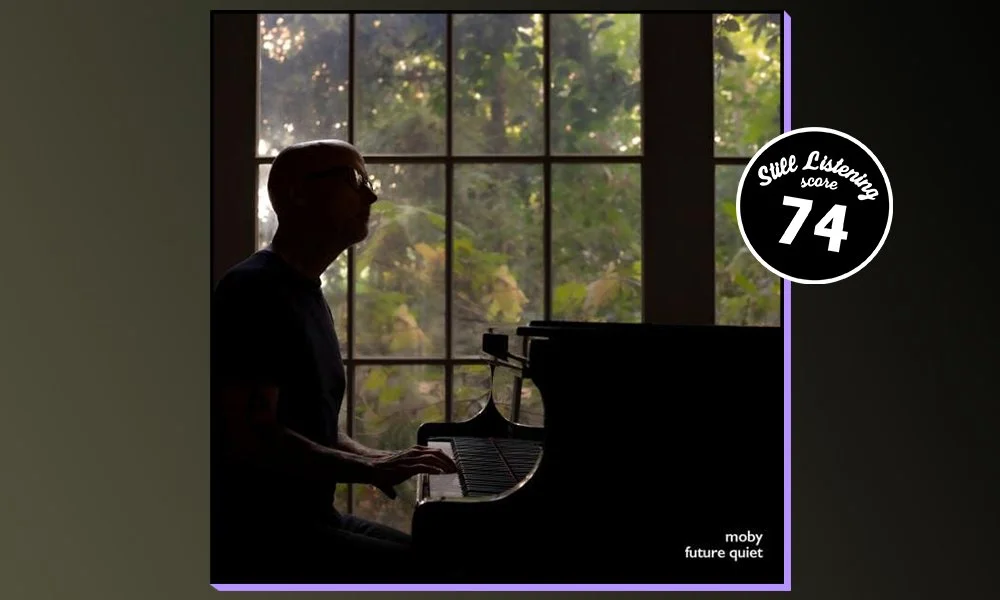
On Future Quiet, Moby leans into solemnity, faith and stillness, revisiting old ground while searching for something like redemption.
One of electronic music’s most unlikely figures - rave pioneer, committed Christian, vegan, punk, activist - Moby achieved international stardom, not to mention tens of millions of album sales, after allowing his music to be licensed in hundreds of TV commercials. Now in his 60s, Moby has found yet another new audience, after his 1995 track ‘When it’s Cold I’d Like to Die’ was featured in the Netflix smash and global phenomenon, Stranger Things. Its use was apparently nothing to do with Moby, if his earnest Youtube takes are to be believed, and he was as surprised as anyone that this “obscure track” (his words) had found its way to the soundtrack.
Never one to pass up an opportunity to bring his music to a wider audience, Moby seized the moment and re-recorded the track, this time featuring Jacob Lusk, gospel singer and one-time American Idol runner up. The updated version doesn’t offer a particularly new aspect on the track, but to be honest there’s only really one way to play a song called ‘When it’s Cold, I’d Like to Die.’ It’s an arresting and singular piece of songwriting, which is lent both fragility and depth by Lusk’s tenor, which begins softly, before swelling majestically with the suggestion of hidden depths of power; and when his voice soars for the final verse, it’s impossible not to feel the hairs raise on the back of your neck.
Like the other most powerful moments of Future Quiet - a record intended to offer refuge from the chaos and carnage of modern life and comprising largely ambient pieces and minimalist piano works - it’s the product of Moby laying on it thick with the emotions. Similarly, ‘Retreat’ takes a simple repeating piano refrain of the kind Moby has deployed dozens of times in so many hits, layered with strings and a plaintive vocal sample. With no specific reference it speaks to a generic kind of emotional anguish, which some might find bland, but is what makes Moby’s music so universally relatable and ultimately, popular.
Paradoxically, another way Moby plays to his strengths is by letting his collaborators take the limelight, as he did to excellent effect on 2024’s, Always Centered at Night. A record that gave a platform to more than a dozen artists of colour, with Moby happy to sit back and provide tasteful but unobtrusive productions spanning trip-hop, drum’n’bass, jazz and downtempo. The tracks ‘Precious Mind’ and ‘On Air,’ featuring India Carney and serpentwithfeet respectively, appeared there and are here reworked, the “Quiet Future” versions stripped down to piano, brushed percussion and intimate vocals.
One could quibble that these reworked - but very similar - versions of previous tracks have been included as filler. But without them, Future Quiet could buckle under the weight of its own solemnity. At 85 minutes, it’s a long listen and the last half an hour is given over purely to minimalist piano pieces or sparse ambient soundscapes. Moby’s Christianity rarely comes through explicitly in his music, but Le Vide (a French term for ‘the void’) feels like the most overtly “religious” piece he’s recorded, as sparse piano is pulled aloft by strings and an angelic choir, in a way that feels very ‘ascending to heaven’. Touches like this, and the gospel strains of serpentwithfeet and Jacob Lusk, add a striking religiosity to proceedings.
Dialling up the God-vibes could be a brave artistic choice, as is dedicating quite so much run time to pure solo piano pieces. No beats, no samples, no big synth pads to hide behind. As someone who’s begun suffering from insomnia pretty consistently, maybe these pieces will end up bringing me comfort (and peace) at 3am. Pieces such as Ruhe, Selene Mono No Aware are all lovely, and soothing but they begin to weigh heavy on the album as a whole, and I feel Moby would do better playing to his strengths and laying it on a bit thicker now and then.
Moby’s taken more than his fair share of flak over the years, occasionally being cast as a scapegoat for Everything that’s Wrong with electronic music. Profiting from music that sampled poor black artists. Licensing tracks for use in commercials. Not to mention his claim to have dated a famous Hollywood actress (characterised by her as ‘creepy’). Even in his own memoir, Porcelain, a memoir surely being an opportunity to paint oneself in the most flattering light possible, Moby still came off as sleazy. My impression was of an outsider who never fit comfortably in any of the worlds he found himself in. And who continually has sought to justify his place, torn between setting himself apart or instead, doubling down on his knack for creating the kind of music so widely loved, it’s enjoyed by the kind of people who only buy one album a year.
But for all that, one has to ask: is Moby really the bad guy? The guy who’s been a vegan since 1987, has given hundreds of thousands of dollars to charity, and who used his last album to spotlight several lesser-known musicians of colour. Considering all this, you wonder if all the shade thrown at Moby is justified. He’s found himself in the wilderness many times - before the release of 1999’s global mega-smash Play, Moby was about to be dropped by his label after recording an abysmal hardcore punk record. Stranger Things have happened than this latest resurrection from relative obscurity. And given how frightening and unsettling the world is 2026, a place of refuge and quiet could be just what’s needed.