
The First Sustainable Vinyl Moves Into Commercialisation
As vinyl sales hit modern highs, a new generation of manufacturers are questioning whether the format’s cultural revival can continue without confronting its environmental cost.
The vinyl renaissance has resonated across generations. For older collectors, the comeback affirms vinyl’s long-held cultural value and roots its appeal in nostalgia; for younger audiences raised on streaming and TikTok factory-line soundbites, the format is countercultural in its resistance to denigrated musical payoffs. More so than ever, records now serve as both a listening medium and an act of rebellion against the high-speed digital culture that encourages the disruption of intended artistic delivery.
Larry Jaffee, co-founder of Iceland’s geothermal-powered sugarbeet vinyl startup Thermal Beets and author of Record Store Day: Ushering In The Most Improbable Comeback of the 21st Century, affirmed the longevity of the industry’s rebound: “Vinyl is no longer a fad, and that’s because your generation embraced vinyl. It started with my generation - the baby boomers - who were recapturing our youth, so there was a nostalgic angle. Initially, you were the ones buying the records. But about eight years ago, the market shifted. You could see it in the top-selling records: classics like Abbey Road, Dark Side of the Moon, Thriller, and Purple Rain were still big, but soon contemporary artists started dominating. Beyoncé, Taylor Swift - they fully embraced vinyl and helped make it mainstream. For example, Adele’s release that Sony expected to be massive actually sold around 400,000 copies, which, in context, was less than Jack White’s Lazaretto, which set records at the time.” This observation isn’t merely qualitative or hopeful - According to the British Phonographic Industry, vinyl sales experienced an increase last year in 9.1% compared to 2024, selling over 6.7 million LPs in the United Kingdom - a record high since 1990.
One would be hard-pressed to find a modern industry that skews more overtly toward political progressiveness than music; yet, the environmental toll of vinyl production remains severe, with little economic cushioning to allow small artists to opt for sustainable alternatives. PVC - the plastic compound used in vinyl records since the medium’s inception - is environmentally destructive at every stage of its lifespan. During the melting process, known carcinogens such as chlorine and ethylene are released, and the material itself must be stabilised with phthalates and heavy metals - additives that can account for over 50% of a finished record’s weight. PVC is also costly and inefficient to recycle, typically ending up in landfills where it leaches toxins into soil and water systems: one recent estimate places the carbon footprint of a single vinyl record at roughly 1.15 kg CO₂e (measured up to the “factory gate,” excluding shipping), a figure that often rises dramatically once global distribution is factored in.
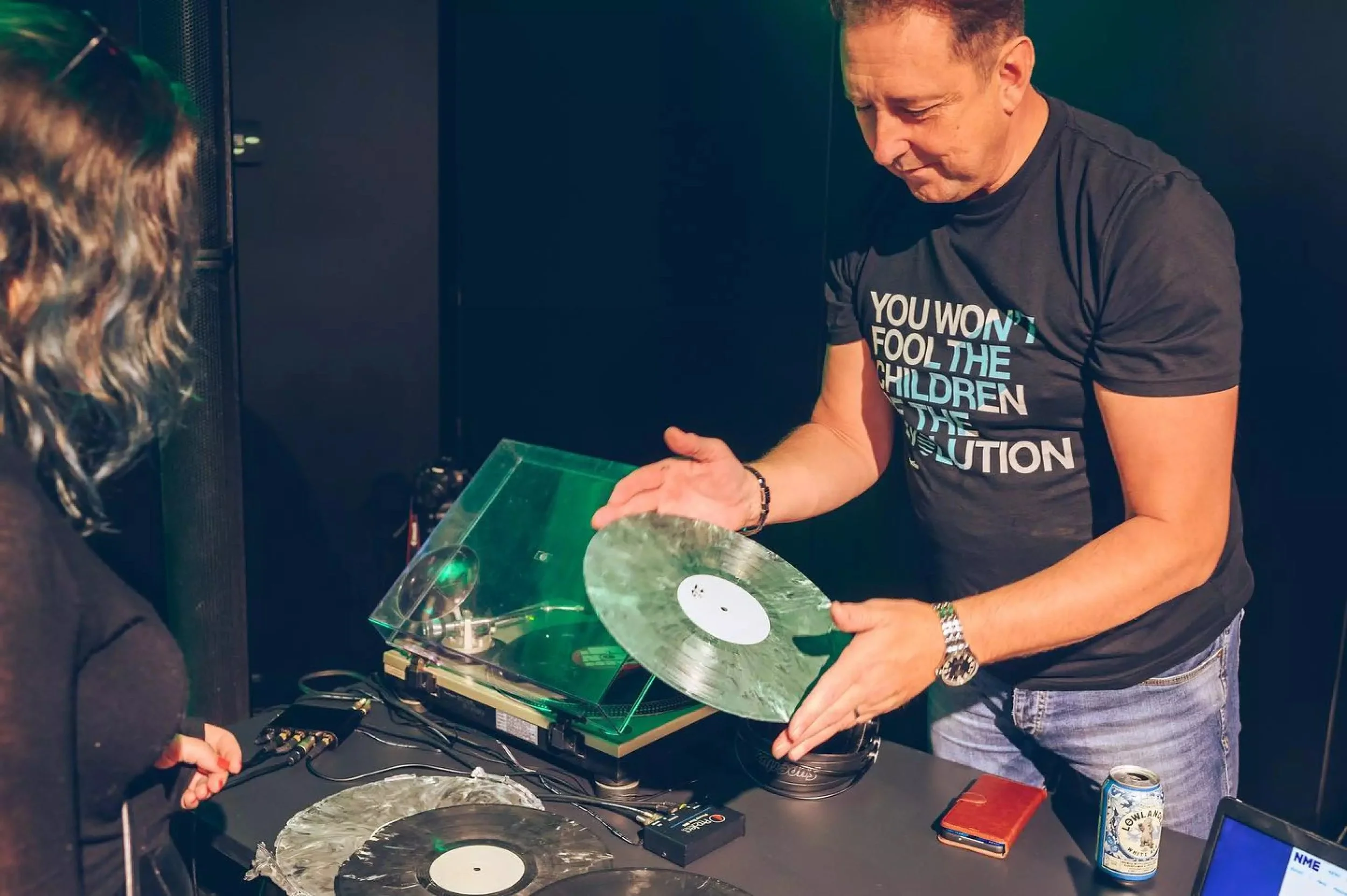
UK-based Evolution Music and its partner, Iceland-based Thermal Beets - geographically distanced, but working synchronously to develop parallel technologies - have innovated a vinyl made of biodegradable plant compound with a sound that sits on a similar plane of quality as PVC. “It’s an odd idea, we know. That’s one of the things that Siggy (drummer from The Sugarcubes) said at the press conference: when he first heard about us making vinyls out of sugarbeets, he thought we were mad. I had friends in the vinyl manufacturing business who thought I was absolutely crazy to do this. And I was like, "That makes me even more determined to prove you wrong!” Curious about the particulars of the project after speaking with Larry Jaffee, I interviewed CEO Marc Carey just after Evolution celebrated moving into commercialisation.
“It started out as a project within our company, Roulette Records. Our slogan was ‘Earth Care, People Care, Fair Share.’ We were doing well on the other parts; it was just the Earth Care project that needed work, so we created Evolution as a business. With our supply chain partners - who are based in Germany - we’ve developed a compound, literally from the ground up. We sell the compound to the market, and it can be pressed in the traditional pressing plants around the world. We took our bio-compound to a pressing plant in Luton called Diamond Black. We were hand-mixing it on-site; I didn’t know if it was going to ruin their machinery. It was nerve-wracking - but it worked. There was a bit of surface noise on the run-in and run-out. Otherwise, sonically it was amazing, and at that point we thought, okay, this is great - we’ve got something we can use.”
As longtime fixtures in the music industry, the founders of Evolution figured that one of the more obtuse roadblocks would be speculation from audiophiles on the quality of the record’s sound. “This was between lockdowns during COVID, around 2020–2021. It was when I asked Rob Cass at Abbey Road Studios to listen to it. I didn’t tell him it was made from plants - it just looked like a regular coloured vinyl. He said, “Yeah, this is great. It sounds all right. There’s a little bit of surface noise. I really like the colour. It’s solid.”
Then I said, “Well, it’s made from plants - and it’s completely organic.” He said, “Mate, this is huge. I work in the industry, and it’s crying out for this.” That was the point we realised we had the tiger by the tail. This was bigger than we thought; we went, okay - this is more than just us.”
The quality of the material extends past sonic quality; it’s also resilient to external factors. “The National Physical Laboratory, which serves as the EU’s primary testing body for materials research, benchmarked our compound against traditional PVC. They artificially aged both materials for the equivalent of fifty years, subjecting them to extreme heat and pressure. While the overall performance was comparable, a key difference emerged in durability: aged PVC becomes brittle and prone to snapping, whereas our compound retained flexibility and did not become fragile. What surprised us during testing was that our compound also dissipates static. Static is a persistent issue in PVC manufacturing, particularly in vinyl records, so discovering that this problem was addressed inherently - without intending to - was an unexpected but significant advantage.”
Despite intentional movement from other pressers towards sustainability, Evolution’s core mission statement remains the most committed to environmentally-friendly PVC substitutes of any company in the industry. “We’ve seen the big players attempt to move into the sustainable arena. We’ve got companies that have designed new manufacturing processes like Green Vinyl, Good Neighbor Records, and Sonopress. But that’s a completely new manufacturing process that’s not able to utilise existing infrastructure. It’s definitely a step in the right direction. Then you’ve got existing compound makers that have moved towards bio-attributed versions of their compounds, or recycled PVC. I do think these are all steps in the right direction.
However, the whole point of calling the company Evolution is that we’re strong believers that in order to evolve, you need to make paradigm shifts. Einstein said you can’t fix a problem using the same thing that created the problem in the first place. Similarly, Buckminster Fuller’s approach says if the system’s not working, there’s no point trying to break it or fix it - you just create a new system that makes the old system defunct. That’s our approach. To have a more evolved product come into the market, I don’t think it would be unfair to say that we have the most evolved product. That’s why we called the whole project Evolution in the first place: We’re not thinking, “How do we make our existing product more sustainable?” We’re saying, “How do we make the best, most sustainable product from the start?”
Naturally, paradigm shifts don’t come for free. “The price point currently is a little bit more expensive, but obviously economies of scale will kick in - that’s why we’re going for the global market. We’re confident we can achieve price parity. But we’ve also got our own pressing plant, and are currently building one in Brighton. Furthermore, while the compounds may be more expensive like-for-like, once you start pressing - if you’re pressing out of cycle times and quicker, pressing more per hour and using 15-30% energy to process - then the manufacturing cost comes down, and that should pass on to the client as well.
For now, artists can apply through our website; but the hope is that within the next couple of months, pressing plants will be offering EvoVinyl compounds, and labels and brokers will be offering EvoVinyl as part of their menu of compounds. But, in terms of who we work with directly, it’s really about the NGOs, labels, and artists that are already vociferous around questions of true sustainability. Ninja Tune is a great label, and Beggars Group is also good. You’ve got artists like Coldplay, Massive Attack, and Mini Island - they’re all talking about and trying to make a difference around sustainability.”
While having collaborated with legacy acts such as The Cure’s Robert Smith, Brian Eno, Camilla Cabello, and Niall Rodgers was concept-affirming for the company, the goal of Evolution Music - and Marc Carey’s record label from which the project sprung, Roulette Records - is rooted in accessibility for smaller artists. “These are the sort of people you target at the high end, but really, it’s the grassroots side wanting to make a difference that will be our focus as we move forward. The smaller indie labels and the artists that are really trying to say something and make a difference - that’s ultimately our tribe”.
Evolution Vinyl just celebrated its movement into the commercialisation stage in November after years of innovation, testing, and solidifying business connections. For artists of any size interested in sustainable alternatives to vinyl, you can fill out the form here, and Evolution will get in touch with you about collaboration opportunities.