
Ninajirachi - I Love My Computer Review
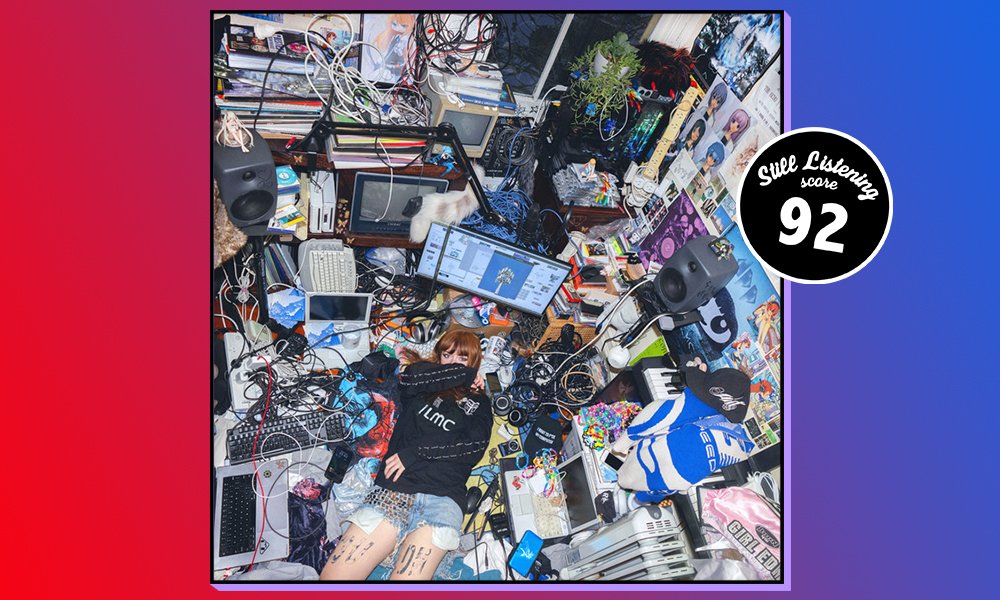
Ninajirachi’s debut is a kaleidoscopic, nostalgia-soaked sugar rush that maps out pop’s future while paying tender tribute to the internet culture that shaped her and the strange, luminous feeling of growing up online.
Ninajirachi’s I Love My Computer might be the most purely joyful release of 2025, and it lands as the year’s strongest debut album. It is drenched in mid-2000s dance nostalgia, pulling from Crystal Castles, chiptune textures, Nintendo and PlayStation sound palettes, nature ambience and scattered field recordings. It taps into early-internet aesthetics too, channelling MySpace, iPod nostalgia and the days of LimeWire, clutter into a record that feels young, bright and buzzing with energy. At times it feels like a lost soundtrack to an episode of Skins (the original Euphoria - if you’re not familiar with it), all rush and colour and impulsive adrenaline. The record never really slows down. It’s sharp, abrasive and crafted with a meticulous ear for the tiny details: those glinting edits, the micro-glitches, the clever sequencing that lets the whole album surge as one continuous hit of energy and emotion. Beneath the maximalism, there is the sense of someone who has thought very carefully about how each song is constructed.
Running through it all is a streak of escapism and fantasy. Ninajirachi has long cited nature, sci-fi, magic and the occult as part of her imaginative wiring, and those influences flicker through the album’s digital glow. She has spoken often about growing up making music entirely on her laptop, teaching herself FL Studio and Ableton through YouTube tutorials, and I Love My Computer doubles as a tribute to the machine that raised her.
The album opens with “London Song,” a ferocious jolt of glitchy euphoria that immediately sets the pace for everything that follows. Lyrically, it plays with fantasy and projection, imagining a place she’s never been and offering to go only with the person she’s singing to, blurring desire with early-internet escapism. Lines like “anything is possible with fingers, eyes, a mouse and a screen” frame connection as something mediated by her computer, folding intimacy and distance into one. It’s hyperpop-adjacent, coarse and playful, the perfect entry point into a record obsessed with how love, fantasy and identity get filtered through screens.
‘iPod Touch’ works as Ninajirachi’s most direct invocation of adolescence, using hyper-specific details to tap into a universal kind of digital nostalgia. The song traces the origins of her creativity back to a single secret track she found online at twelve, a song that “nobody knows” yet somehow changed her entire world. Each verse piles up sensory memories: school gates, beach days, cracked screens, late nights lost in FL Studio, a Pikachu phone case tucked under her pillow when she should have been asleep. They sketch the formative ecosystem that shaped her as an artist, where early internet discovery, emotional escapism and cheap DIY tools braid themselves into the foundation of her sound.
One of the most striking things about I Love My Computer is how openly emotional it is beneath all the chaos. “Fuck My Computer” is a perfect example, turning a provocative line like “I want to fuck my computer, because no one in the world knows me better” into something surprisingly tender. Rather than cynicism, the song carries a sweetness that reflects her own upbringing on the Central Coast, where the computer wasn’t just a tool but a lifeline, a friend and a creative partner. The lyric lands because it feels true: in a digital age, the machine we spend our whole lives with often knows us more intimately than anyone else. Here, that intimacy becomes both the punchline and the beating heart of the track.
‘Delete’ is where the Skins reference lands most clearly, its quieter moments echoing the hazy mood of the show’s theme song. The track hinges on an instantly sticky, singalongable vocal melody, but the sweetness of the hook sits in sharp contrast with what the lyrics are actually doing. They sit right in the tension between desire, self-exposure and the strangely public intimacy of online life. The narrator performs for one person, yet the stage is the entire internet. When she repeats “I’ll delete it” and “I only posted it so you would see it”, it exposes the self-consciousness behind the gesture, as if she is torn between embarrassment and the desire to be noticed.
Immediately after ‘Delete’ the album drops straight into another banger. The melody on “ฅ^•ﻌ•^ฅ” is ridiculously catchy, and it flows so neatly into the lead single ‘All I Am’ that the two almost feel like one continuous track. The hook in ‘ฅ^•ﻌ•^ฅ,’ “choose me the way I want it” forms the emotional centre of both songs. It suggests a new kind of confidence, or at least the desire for agency, a shift from wanting to be chosen to wanting control over how she is seen.
‘Infohazard’ carries a faint 90s Underworld quality, with staccato synths that drive the track forward at a quick, almost breathless pace. Over that pulse, Ninajirachi drops one of the album’s most memorable melodies, pairing it with lyrics that feel like a shard of early internet horror. Her image of “the man without a head” reads like something stumbled onto online long before she had the emotional framework to make sense of it. It is the kind of accidental encounter that lodges in the subconscious, resurfacing years later in dreams and intrusive flashes. The song’s loop between “in my dream” and “on my screen” blurs memory with imagination, capturing that eerie confusion between what you actually saw and what your mind has been replaying and reshaping ever since.
‘All At Once’ closes the album on a surprisingly shadowy note. It begins as an instrumental, almost as if withholding the thing Ninajirachi does best, which is write melodies that lodge themselves instantly in your head. Chopped, spectral vocal samples move through the mix like synth textures, creating a sense of unease before her real voice finally arrives. Lyrically, it pulls the curtain back on the album’s emotional core. She sings about the hours spent alone at her desk, the late nights lit only by a screen, the strange mix of devotion and isolation that shaped her life as a young producer. It feels like a final acknowledgement of how much her computer has given her, and how much it has taken in return. As an ending, it is darker and more reflective than the sweeter moments on the album but it makes perfect sense, a closing moment that recognises both the freedom and the loneliness baked into the digital world she came of age in.
Taken as a whole, I Love My Computer is a coming-of-age story told through circuits and late-night screens, a portrait of an artist who grew up online and learned to turn that strange, private world into something loud, bright and communal. Every song is built from the textures of her past, yet the album never feels backward-looking; it feels like someone using nostalgia as raw material to carve out a future. This is an album fizzing with feeling and imagination, and it confirms Ninajirachi as one of the most exciting new pop producers working today.