
By Storm - My Ghosts Go Ghost Review
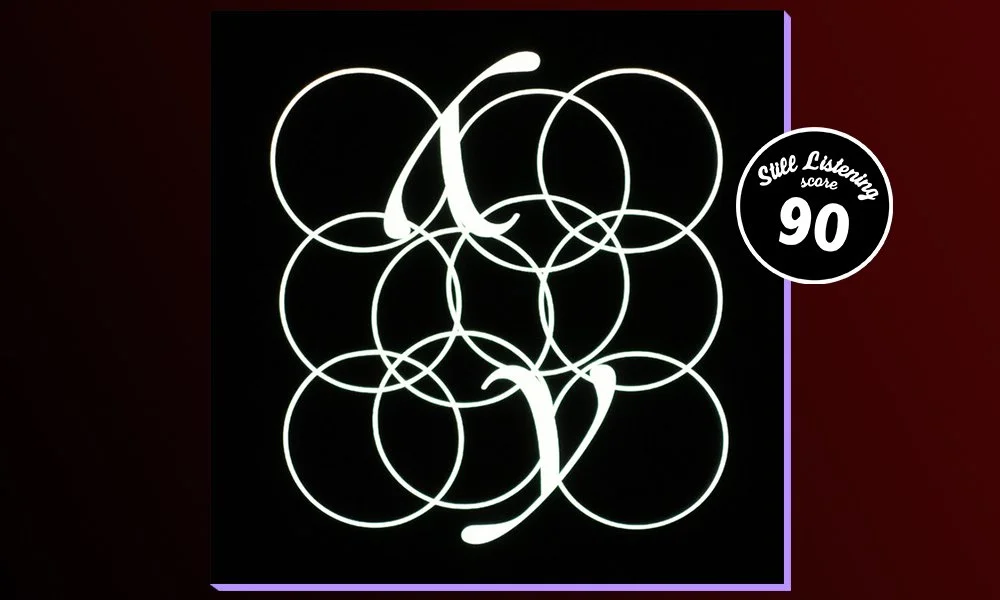
By Storm take the scorched-earth experimentation of By The Time I Get To Phoenix and turn it inward on My Ghosts Go Ghost, shaping grief, intimacy and abstract psychedelia into their most human record yet.
Is there such a thing as the post-posthumous album? How many tries did it take New Order to shake the ghost of Ian Curtis? Did they ever manage to? Certainly, they never acknowledge quite as heavily as By Storm. The new project by rapper RiTchie and producer Parker Corey is named after the final track from their previous project. A rippling wave of hazed out depressive neo-psych built around a yearning Brian Eno sample as RiTchie raps ‘It rains, it pours, but dam, n****, it’s really pouring’. That track, and the album it closes By The Time I Get To Phoenix acted as both a sonic memorial to Steppa J Groggs, who rapped with RiTchie over Parker's beats as part of Injury Reserve, and a grander sonic exploration. A mix of chopped and distorted samples across the wide history of experimental rock distorted through post-apocalyptic production into a haze of a record where the ghastly appearances of Groggs remaining recorded verses were matched by its grim vision of the incoming 2020s.
In crafting Phoenix’s follow-up, RiTchie and Parker have neither fully embraced nor abandoned its sound but rather continued it.By Storm was announced as a project in the form of a music video for that final Injury Reserve song that then led into their debut single ‘Double Trio’. With titles like these, you might expect a record entirely indebted to its sonic legacy, but that’s not quite what My Ghosts Go Ghost is. Rather, it takes the lessons and techniques Parker and RiTchie have learnt and uses them across a suite of songs more intimate, grounding, and at points soulful than anything they’ve done before. The result is a group that is rooted in rap the same way experimentalists like Still House Plants are rooted in rock. Sure, the core tools of the genre are being used, but the result defies easy explanation.
What remains consistent is the raw heart of the project. RiTchie’s continuous growth as a vocalist lends the album its most grounding element. Compared to his early work and even Phoenix, he sounds decidedly more aged, contemplative, and deeper. Hia vocals lend the album a soulful edge, enhanced by his near-spoken word flow. It works perfectly with Parker’s production, which has now shifted into the realm of abstract psychedelia. This is an album marked by ricocheted beats, Spanish guitars, glittering synths, and violins. Hints of folk, boom bap, and jazz shift amongst one another in a hazy mirage, yet RiTchie’s vocals deftly move through these soundscapes. On tracks like ‘Deadweight,’ it almost feels as though the beats and vocals were recorded simultaneously. The looping acoustic guitar weaves in and out of RiTchies vocals as the rapid drums patter underneath. Yet neither overtake each other.
It’s a work of incredible chemistry, the duo's years of sonic exploration and experience working together paying off through a series of tracks that are incredible in their sonics, whilst lacking pretension. Single ‘Zig Zag’ begins as a murky piece of loner folk that gradually evolves into an oceanic atmospheric ballad. ‘Grapefruit’ carries an uncanny swagger with RiTchies rapid bars collapsing into unnerving backing vocals across a shimmering harp loop. Maybe the most impressive is ‘Double Trio 2’, a titanic slab of horns and rapturous synths that gradually overwhelms RiTchie’s vocals.
These songs are maximalist in ways both subtle and unsubtle, but all of them carry a clear emotional intimacy. RiTchie’s lyrics are so grounded in the personal day by day that through Corey’s production, they take on an uncanny quality. Opener ‘Can I Have You For Myself’ is a gentle meditation on incoming parenthood that becomes a subtle cry for intimacy, his fear of the future reflected in the shift from fingerpicked guitar to quaking electronica. ‘In My Town’, with its reflections on the struggles of touring life, is a ghastly piece of folktronica. The subtle horns and strings, with their near martial pace, recalls the creeping industrial folk that Coil would often produce. But unlike Coil’s esoterica, RiTchie’s lyrics feel grounded in the present day; these are songs about family, about providing, yet he’s more than capable of presenting subtle glints of something beyond. The ambiguity of ‘They say anything goes in my town.’, or the ghostly ' And I Dance’ with its visions of ‘the soul train right beneath the smoke’, there’s a sense of the uncanny underneath it all, but RiTchie is careful not to overstate it.
In fact, RitTchie remains understated throughout most of the album. His delivery mumbles, rushes, and aches in a manner that feels organic in its spontaneity. Even when paired with the similarly semi-conversational flow of Billy Woods on ‘Best Interest’, his style appears remarkable in its abstractions and nuances. It feels intimate and personal in a way that Injury Reserve touched on but never quite explored to this degree. It comes together with the Parker’s rich production in a near symbiotic harmony. Each exposing different sides of the other, the personal is rendered universal and uncanny. The maximalist turned grounded and relatable. With My Ghosts Go Ghost, By Storm has crafted a remarkable album. One that feels a step apart from their previous work, both solo and in Injury Reserve. It’s one of those rare albums that’s boundary pushing without sounding like it's trying to be. Coming across not as a grand experiment but rather a work of passion and chemistry. Two long-time collaborators coming together to craft something out of the immediate, which shimmers with a glint of eternity.