
PVA - No More Like This Review
PVA’s No More Like This, is a brooding and atmospheric slow build that gives you cold honesty and stark realism.
The post-punk inspired synth trio’s second album is a more laid back, softer and smoother expression than their darker, faster, slightly harsher first, Blush, but by no means less direct and intense.
The final line of Blush’s final track, ‘Soap’ leaves us gazing at the night sky, “the same sky you see,”... “talk(ing) about the stars,” while ‘No More Like This,’ opens with the words, “Good morning/Following the moon,” the lyrics standing alone, spoken word style, the continued content sliding seamlessly into this new iteration.
As the music fades in, the lyrics continue, “Ambience again/good morning to the spit on the street/ fading kick in the distance.” As if introducing us to what we are about to hear over the rest of the record: progressive, ambient samples over the faded percussive kick that drives them forward, providing the backdrop to the words which are bleak but relatable, rooted in common experience and willing to get into the grit.
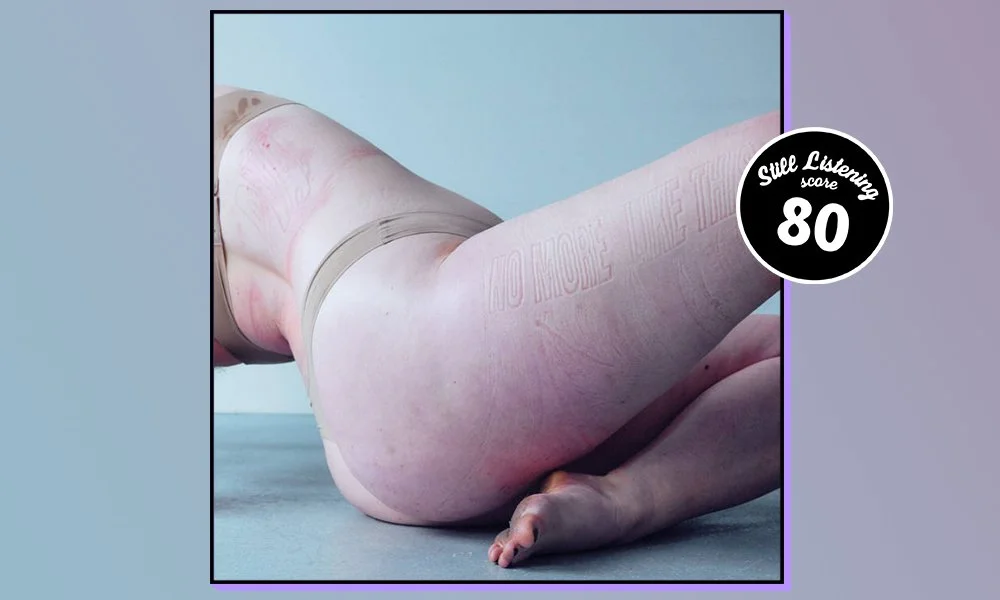
It is worth mentioning the album’s cover, which features the lower half of a woman’s body, posed in a style evocative of a greek statue, in underwear, bruised, the title, No More Like This, branded in thin lettering onto her thigh. The image is provocative but understated, at a glance you see a woman's semi nude body, but as you keep looking you see the bruises.
The album’s lyrical content can be seen in this light, stripped back and minimalist, with gentler, rythmic, repeated refrains that frequently reference nature, the sky, the birdsong, the stars, and the tides. The first track is named ‘Rain,’ the last ‘Moon,’ ending the album where it began. Getting closer, these primal and natural images are intertwined with a passionate sensuality that is close, intimate and revealing.
All of this, though, is interspersed with lines which evoke jagged, sometimes pornographic, sometimes violent images that suggest control and even cruelty. This blurring in songs like ‘Boys Face,’ and, ‘Okay,’ explores and questions gender, sex and relationships in a brutally modern context.
To deliver this Ella Harris provides vocals which are sometimes speaking, sometimes near whisper, sometimes melodic, always just holding back the emotion which is hinted at, not quite allowing itself to be fully realised, despite asking, “Allow me, allow me an anger song,” over and again. This vulnerability, exposition and contradiction create a sense of tension which pervades the album, building into urgency and releasing.
The samples which fade in and out match this juxtaposition, similarly minimal and stripped back, the pace ebbing and flowing throughout. Patches of silence and stillness give way to drawn out, progressive builds and breaks that sometimes resolve back into dreamy, ethereal soundscapes, sometimes build into heavy, bass and percussion lead grooves, never staying in either place for long. Warm reverb gives way to almost glitchy, almost distorted, almost industrial sounds that lurk and lear, just almost echoing an old video game.
All of these tensions create an album which is rich: tense, harsh, haunting, eerie, darkly funny, closely critical and introspective, laying everything bare. With all of these elements, it still remains clean, tight and coherent, and most importantly for an outfit who made themselves as a high energy live show, manages to produce hooks and beats that will have you moving even while you’re sent back to your most fragile place.