
Gorillaz - The Mountain Review
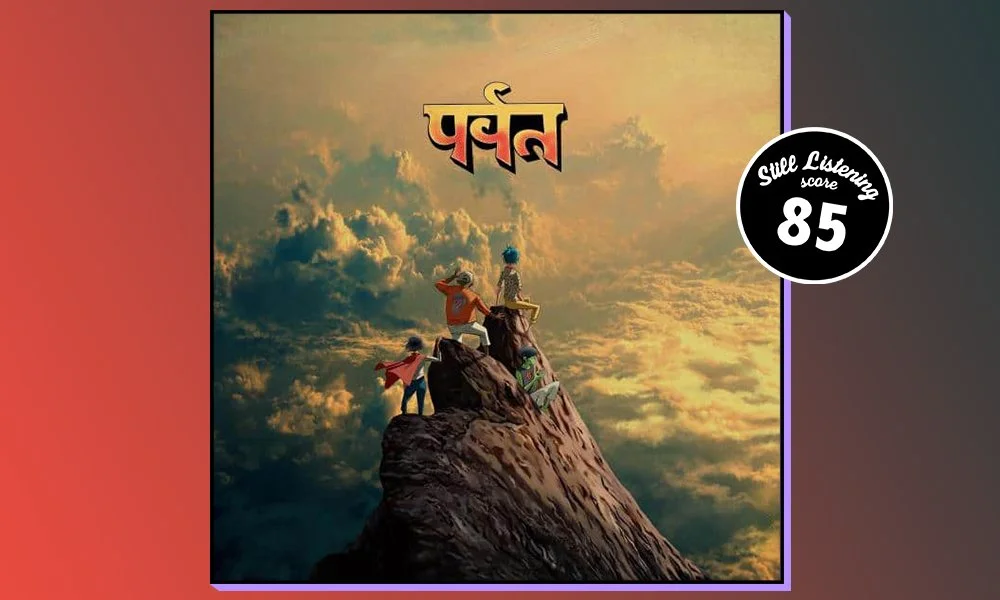
Gorillaz confront loss and transcendence head-on, turning personal grief into a kaleidoscopic meditation on life, death, and renewal.
Coming off the pop-radio sounds and half-baked thematic ideas explored in 2023’s Cracker Island, Gorillaz latest release is a breath of fresh air into a concept that was seemingly on the cusp of growing stagnant. Exploring the dichotomy between life and death and the journey in between, The Mountain is a beguiling, kaleidoscopic collection of contemplative celestial tunes, sticky hooks, and vocoded vulnerability that offers a cathartic insight into the way that grief reinvents us.
An album born out of shared personal tragedy and directly informed by the existential challenges that accompany the human predicament, The Mountain is sonically as ambitious as the subject matter it attempts to tackle. Blending Indian sounds and stylings with Damon Albarn’s signature melancholic melange and visually immersed in Jamie Hewlett’s frenetically detailed and ornately lush hand-drawn artwork, the record offers a vulnerable insight into themes of life and loss following the pair’s turn toward Hinduism, reincarnation, and spirituality in the wake of their fathers’ deaths only days apart in March 2023.
The 15-track record sees Gorillaz return to their culturally probative roots, and if there’s one thing Gorillaz knows how to do, it’s an album opener. From the ominous foreboding instrumentals of Demon Days ‘Intro’ to the orchestral strings overlaying brief sounds of the sea on Plastic Beach, Gorillaz once again recapture their tact for worldbuilding and sonic storytelling on their ninth studio album, where the Indian-influenced instrumentals and symphonic strings of the record’s titular opening track aurally immerse the listener into the thematically rich and gloriously technicolor world of The Mountain.
Inspired and “truly in alignment” by their time and spiritual reckoning together in India, Gorillaz’ latest release is musically and thematically cohesive in a manner unseen from the virtual band since 2010’s Plastic Beach. While at first glance, the album’s expansive roster of collaborators might appear daunting, The Mountain abandons the traits that made Humanz or Song Machine feel discombobulated and disjointed, reigning in the band’s collaborative ethos in a manner that works to transform the disparate cross-cultural sounds and five different languages [Arabic, English, Hindu, Spanish, Yoruba] into an emotionally transcendent listening experience grounded by Albarn’s tact for mournful melancholic vocal performance. This is on full display on tracks like the ‘The Moon Cave’ and ‘The Empty Dream Machine,’ where shimmery synth funk grooves are seamlessly suffused with Indian instrumentals and luminaries such as legendary disco queen Asha Puthil and masterful sitarist Anoushka Shankar with the thoughtful rhymes and wordplay of American rapper Black Thought as Albarn lyrically ruminates on the nature of life and loss.
‘The Sweet Prince,’ an achingly beautiful and tenderly ethereal elegy to his late father, stands out as one of the most emotionally poignant songs on the record as Albarn’s vocoded vocals swoon: “The sword you hold in your head/Well its mighty blow will set you on your patterned path into the next life.” ‘Delirium,’ featuring the late Mark E. Smith, is an immediate stand out from the rest of the tracklist. An 80s-esque dance-pop track with bright synths, operatic vocals, and revving bass topped with the distinctively sardonic vocal stylings of Smith banging out inchoate instructions that evoke the memory of Bill Nighy’s Davy Jones; the song feels akin to The Mountain’s version of ‘DARE’ imbued with the playful psych-pop of The Now Now. The opening instrumentals and intermittent sampling of distorted vocals on ‘The Plastic Guru’ too recall the arrangements of the underappreciated record, The Fall, with Albarn’s distinctly bleary vocals weaving around shiny sitar strings and Johnny Marr’s springy guitar before unraveling into a barrage of India’s urban noise as he contemplates: “We believe what we choose/Is that not the truth?” Capturing the disorientation of the human predicament, the album closes on ‘The Sad God,’ a minor-key track with snoozy charm and spacey harmonies that lyrically ruminates on the failure of mankind from the perspective of an unnamed deity. A summation of the thematic underpinnings of the record as a whole, Albarn abstractly reprimands humanity’s corruption of nature and abandonment of community in favour of individualistic greed, deflatedly lilting over Prasanna’s meditative flute: “I gave you atoms, you built a bomb/Now there is nothing and I have gone/No more mountains no more song/No more prayers sent up into space/Only screens left to see your face.”
The Mountain is a glorious return to form for the virtual band, a natural progression from the more culturally cutting and poignant symbolic stylings of Demon Days and Plastic Beach that reanimates the anarchic animated four-piece whose success, as this album proves, emanates from the creative alignment and unity of its co-creators more than anything else. Arguably more of a globalist record despite its overtly Indian influences, Gorillaz latest release is a triumphant mingling of disparate cross-cultural sounds and stylings galvanized by Albarn’s pacifist roots and humanist perspective. Grappling with questions surrounding life, death, and the great cloud of unknowing, The Mountain captures the transcendent power of music in the face of tragedy, searching for meaning in hopelessness as a way to hold on to faith in existence.