
Start Listening To: Pedestrian Band
A trio turning chaos, comedy and sheer volume into a world that shouldn’t work but absolutely does.
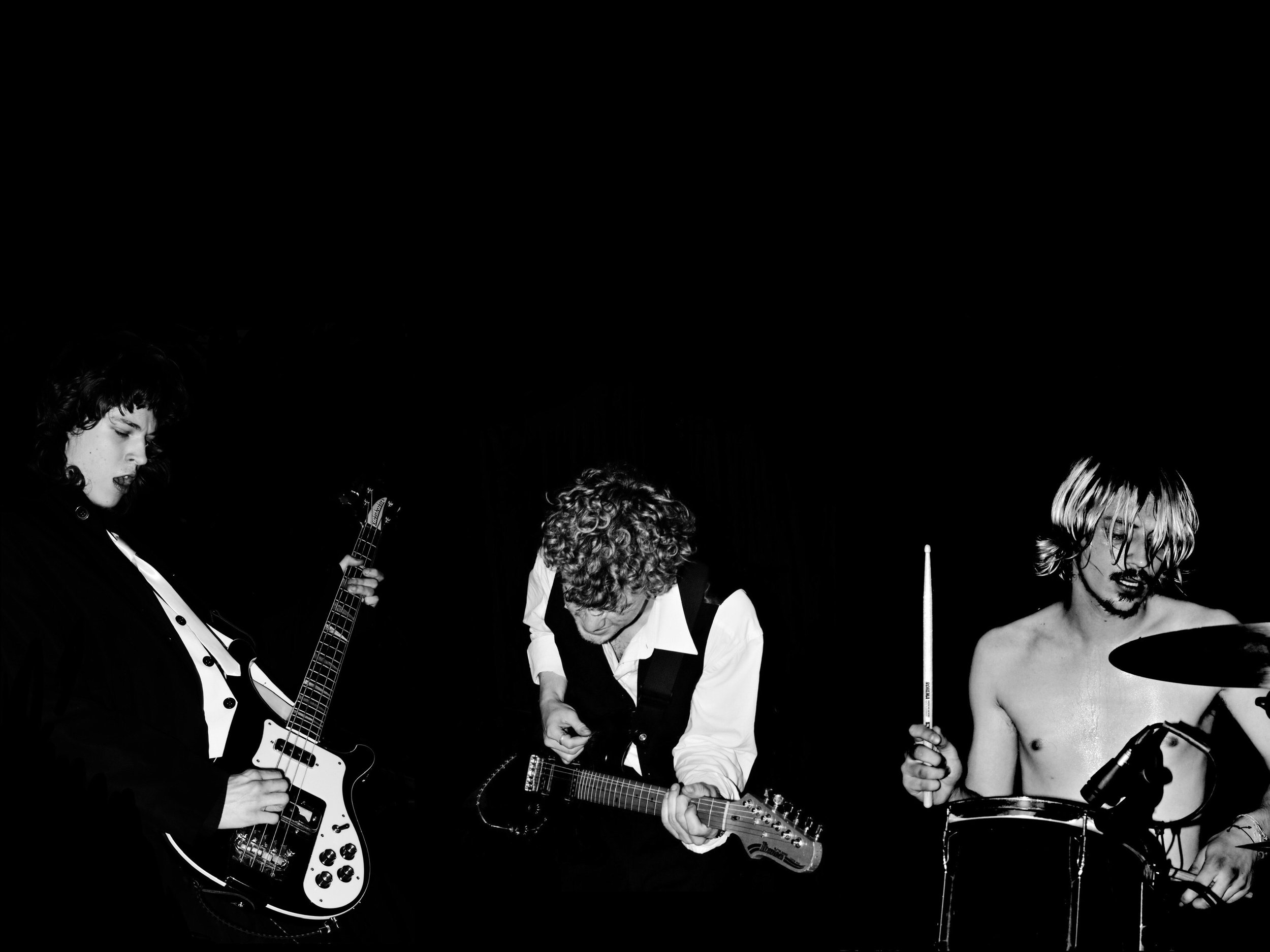
Pedestrian Band operate somewhere between a noise trio, a surreal sketch show and a philosophical argument about what it even means to be in a band. Formed through what they cheerfully describe as a “mildly lacklustre process of elimination”, the London three-piece mash together classical training, punk eccentricity and an almost Lynchian appetite for strangeness. Their debut EP, BAND!, lands like a fully built universe: chaotic but precise, theatrical without winking too hard, guided by a sense that anything trivial should be treated with absolute seriousness and anything serious should be held at arm’s length. Across six tracks they stretch the limits of what three people and far too many decibels can achieve, building a sound that swerves from mania to mathematical control and back again. In this interview, they talk spy-punk slander, blood-bag gigs, the art of boiling a frog, and why world-building matters just as much as the songs themselves.
For those unfamiliar with your music, can you tell us who you are, where you’re from and about the music you make?
We are Pedestrian Band. A trio with a decibel reading you might more reasonably expect from a group of 33. Comprised of Enzo (lead vocals and guitar), Ace (bass guitar) and Milo (drums and occasional lead vocals), we each land at slightly different points on the musical spectrum, drawing influence from a variety of different places. From noise to classical we mash it up, like a complex yet despicable smoothie.
There is a vague, early attempt at a USP somewhere near the heart of the band as a dissociated concept - that we didn’t choose to be pedestrians, no one does, but we did choose to be in a band. It was what we like to call a ‘mildly lacklustre process of elimination’ that consisted mostly of circumstance that brought us together, but we like to think we’ve made the most of what the Lord almighty has gifted us.
Your debut EP BAND! feels like a fully formed world, even at six tracks. When did your realise “spy-punk” was more than a joke between friends and actually the core of what you were building?
We reject the label ‘spy-punk’ - it was definitely not our idea at all. It’s completely destroyed any sense of anonymity we wanted to maintain with regards to our actual shared profession.
There’s a real sense of theatre and surrealism running through your work. How much do influences like David Lynch, Stewart Lee and Chris Morris filter into the songwriting, and how much comes out more in the live show?
From David Lynch and Chris Morris, blurring the lines between surrealism, horror and comedy is something that has been hugely influential for us. While we take the music itself quite seriously, other things we consider slightly more trivial are treated with a little bit of tongue and a whole lotta cheek. Stewart Lee has definitely affected us in a similar way, however his main impact has been lyrical. His command of language and ability to be politically humorous are things we greatly admire, and have attempted to channel in our lyrics.
Hopefully now that people have that expectation of us, we’re able to play around with the cliches in music a bit more on the assumption that people know that we know that they know that we’re doing it on purpose.
Or maybe not and everyone just thinks we’re idiots.
Your gigs already have this reputation for oddball intensity. What’s the wildest or most unexpected thing that’s happened at a Pedestrian Band show so far?
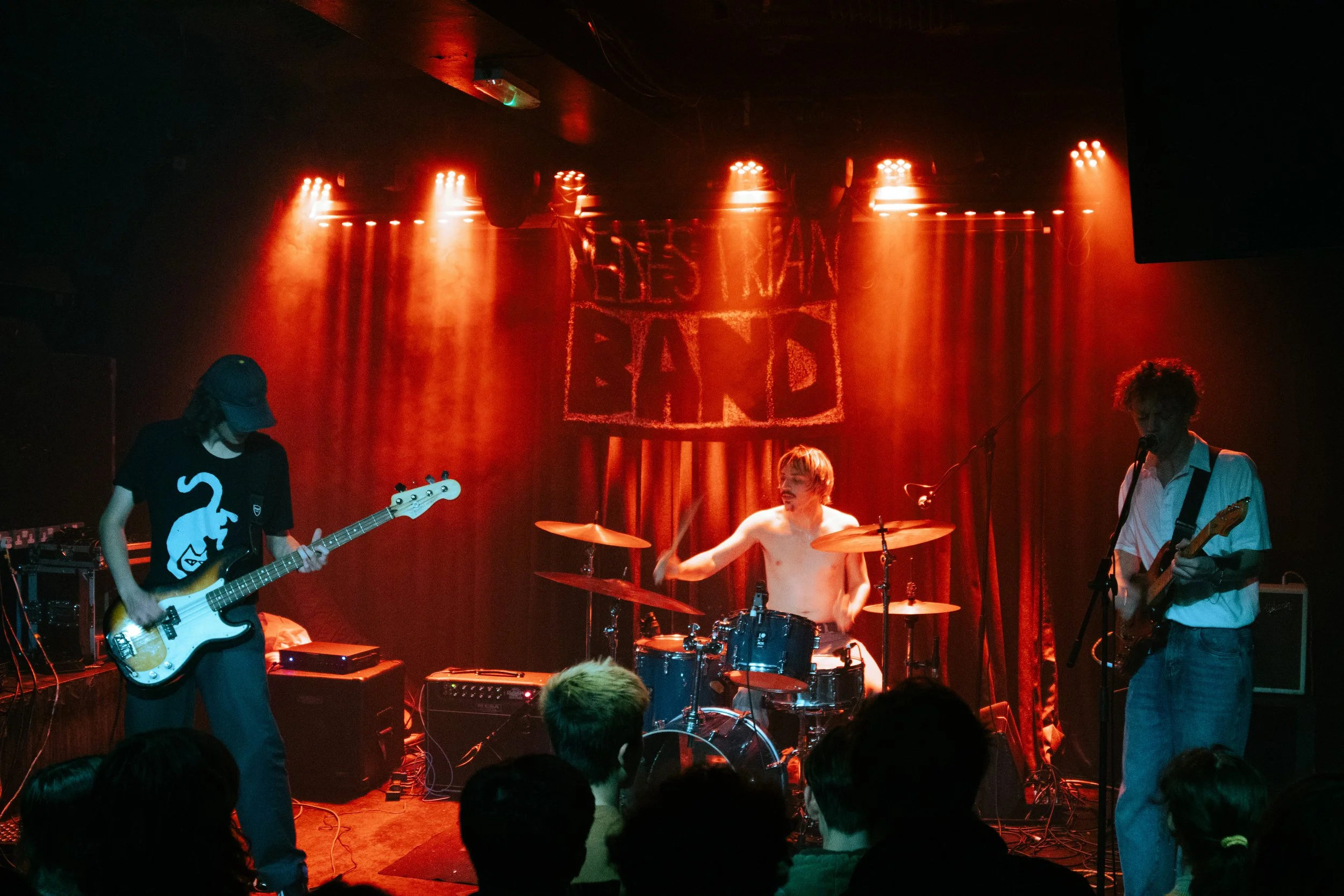
Very early on we performed in a very red room with blood bags dangled from the ceiling, preceded by a spinning scissor pretend stabbing performance art piece. We did not expect this.
As for the intensity of our set, we definitely relish in our somewhat controlled musical mania, and like to reflect it as best we can onstage. We think of our set as being a bit like boiling a frog. Starting out as a warm bath, we slowly turn the screws and raise the temperature until the audience suddenly realises their blood is boiling. When we inevitably take over the world and have more of a budget, we intend to employ a thermostat operator before a sound or lighting engineer.
The EP sounds chaotic but extremely controlled in places. How did you balance that scrappy, reckless energy with the precision needed to make these songs land?
This was achieved purely through relentless rehearsals and revisions. We take our time with writing, but always try to have a handful of tracks in simultaneous development so that we’re never short on new material. The great benefit of there only being three of us is, while it’s sometimes harder to scale the sound up, it’s much easier to scale it down, so control has really become the operative element of our music and performances at this point. We started out as quite frantic and I suppose a lot more punky, but our answer to how to make a three-piece work has been to get as tight as possible and really scrutinise individual parts so that we can dictate the performances as completely as we can.
You’re in the studio with Shuta Shinoda right now. What has that brought out of you that you didn’t expect, either in sound or in how you communicate as a band?
It’s our first time working with a producer of his calibre, so has been an extremely interesting and valuable experience. There’s a lot of attention to detail with regards to things like snare tuning and mic positioning to achieve the best room sound, which is something we haven’t explored too much up to this point. We also recorded one track to a click which we don’t usually do. By the end of the sessions we had 3 songs which we really felt captured the energy of our performance and the subtleties in our individual parts, something we’re extremely grateful to Shuta for.
The analogy we keep using is that a really good chef doesn’t need to cover their dishes in spices and flavouring to make it taste nice, they just know how to get the best out of the ingredients. Those ingredients being us - Garlic, Onion, and Chicken Mince (you can decide who’s who).
Can you talk about the track ‘Danang’?
Even just in the title, it hints at a bigger, stranger narrative world. Where did that one begin?
Danang is essentially make a wish for our drummer, so he gets feel what it’s like to be the star of the show for 3 minutes. The song came about because of a riff Ace had, then Milo came along ruined it and now it’s a completely different song. The lyrics are as inconsequential as you’d expect from ‘The Glistening Boy’, literally detailing his quite serious addiction to going to the cinema on his own. We would like to reiterate, it has absolutely nothing to do with Vietnam.
Danang also provides a great opportunity for things to go wrong technically when we play live, as every drum vocal mic stand in the UK seems to not work properly.
‘Headshakers’ feels like a mission statement. Was there one track on the EP that really defined the direction for everything else?
Headshakers is probably the most us song on the EP, but since it was actually written years ago, we consider The Winston Blues and - joking aside - Danang as more informative to the direction we ended up taking. Those songs were written more recently, the mania more entrenched.
Our second EP, which we’re recording with Shuta at the moment, follows on from Danang and Introducing stylistically, as they were the first songs we wrote where we really felt we’d figured out how to write for the instrumental arrangement that we have.
Pedestrian Band already feels visually distinctive, even just through the EP and your live presence. How important is world-building and aesthetics to what you’re doing right now?
World building is very important, but we’re still trying to hone in on what exactly that world is from an aesthetic standpoint. We’ve leaned in to our differences as time has gone on, and we’ve tried to set ourselves up as a band in such a way that we could come out with basically anything and people wouldn’t be surprised. We’ve especially embraced the Lynchian influence and gone in a more absurd, surreal direction with promotion. We’ve found ourselves a couple of mascots in The Human Man and Wrestler. We did ask them to comment but Wrestler is wrestling some serious internal demons, and The Human Man is genuinely a gorilla.
Looking ahead to the new music you’re making, what part of the Pedestrian Band sound are you excited to exaggerate or completely reinvent next?
We are definitely beginning to write some slower songs. Slower not quieter. As we said, there is now a much more developed sense of what kind of a live performance we are trying to create, so we’re trying to augment and experiment with that moving forward.
As for continuity, something we enjoy is how abrupt our songs can be, springing into action after a gentle passage or calming down after a heinous assault on our respective limbs. It takes a bit from the BCNR or Black Midi influences that have attached themselves to the London music scene in recent years, but we feel like often the non-sequiteur based tribute acts that come out of that are more showcase or gimmick than resolved artwork, so we’re trying to bridge that gap essentially.
What do you love right now?
Sweet and hot beef jerky, Cats, Red Stripe, Bugonia, Telecasters, Tim Heidecker, Red Stripe, Captain Cabinets, going to Japan whenever we can, our parents, Lego architecture, Manaka Yaji, Red Stripe, Korg synthesisers, Shogo, Lime bikes, Thee Psychick Bible, and Red stripe.
What do you hate right now?
Regular beef jerky, Ants, Desperados, Edgar Wright’s The Running Man, Flying V and Explorer guitars, Jared Leto, Teslas, Diet Coke, not being able to go to Japan whenever we want, Lego friends, the Austin ‘comedy’ scene, bad promoters and shaving.
Name an album you’re still listening to from when you were younger and why it’s still important to you?
If we had to agree on one it would probably have to be Spiderland by Slint.
Milo: I heard it for the first time when I was around 13 and i didn’t really get the hype. I’d watched a video about math rock and thought it sounded cool, and one of the main bands featured was Slint so i checked em out. I was a bit let down by how slow it was, but still intrigued enough by the sound of it. It probably took me another year until i listened again, but pretty soon i was listening to it all the time. The speed at which the songs move suddenly felt much more purposeful, i realised how well recorded it was. Still my favourite snare sound ever i think. It’s just so inspiring to me that they made that album when they were 18 years old, and didn’t think very much of it. Such a mature sound coming from a gaggle of deranged nerds.
When someone hears your music for the first time, what do you hope sticks with them?
Really we just want people to recognise how much fun we’re having. In the lyrics there are traces of the ‘grand’ ideology that comes with being in your early 20s, but I don’t know if there’s a greater message in the music itself other than just trying things, and not being self conscious or restrictive about creative ideas. We try not to let the pursuit of making things exactly perfect get in the way of them being interesting, so if we sometimes miss the mark, at least it won’t be dull.