
Electric Wizard - Dopethrone Review
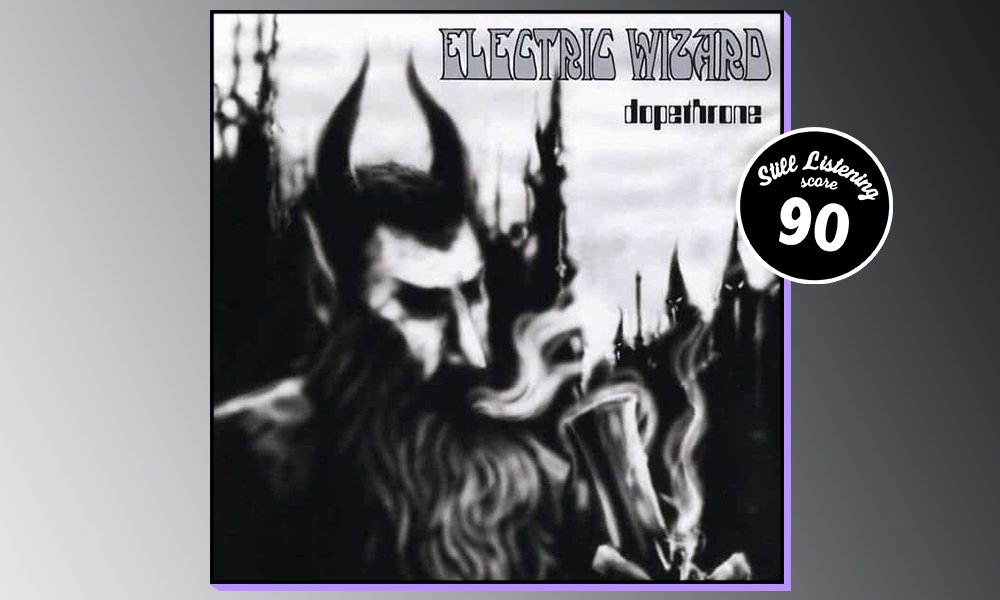
Over two decades after its initial release, Electric Wizard’s Dopethrone maintains its status as a defining album within stoned, sludge, and doom metal, solidifying the Dorset band as one of the greats.
Some albums transcend the genres that they’re trying to fit into, while others do away with them altogether. In some cases, a band will make a record that becomes the pinnacle of its genre, achieving legendary status above its contemporaries — something that few can ever hope to attain. Electric Wizard’s Dopethrone is one such album that has singularly raised the bar for what stoner metal can be, remaining on an untouchable pedestal since its 2000 release (though, maybe contested by Dopesmoker by SLEEP).
Inspired heavily by horror films, occultism, witchcraft, H.P Lovecraft, and of course, cannabis, Electric Wizard saw its beginnings in1988 – initially under the name ‘Lord of Putrifaction’ – with vocalist/guitarist Jus Oborn. In 1993, after the departure of members James Evans and Gavin Gillingham, Oborn went on to name the project Electric Wizard, recruiting drummer Mark Greening and bassist Tim Bagshaw. Now, as Dopethrone receives another reissue just over a quarter of a century after its initial release, it’s clear that the record continues to enrapture stoner metal enthusiasts new and old with its heavy, rhythmic, hypnotic riffs that brutalise you for its entire duration.
The album opens with its shortest song — and the only one in the album that can reasonably be called a single — ‘Vinum Sabbathi’, which has a comparatively diminutive runtime of only three minutes and five seconds. The track begins with an audio clip ripped from an episode ABC News’ 20/20 titled The Devil Worshippers that aired in 1985, at the height of the satanic panic, in which a police officer says: “When you get into one of these groups, there's only a couple of ways you can get out: one is death, the other is mental institutions”. It gives you a hint, a warning of the odyssey you are about to embark upon as you are immediately bulldozed by the oppressive bassline, the slow, crushing drums keeping you conscious as you are shot into the stratosphere. The song sets up the album perfectly, not hiding anything or spending any time trying to build suspense. It is short, sharp and brutal, hopefully giving you enough time to take a suitably large bong rip as the album now begins in earnest.
It is utterly impossible to write about this album without talking about its star track ‘Funeralopolis’, a seemingly unending march through a miasma of smoke into the bowels of hell itself. You wouldn’t be wrong to describe this as a wall of sound, as it is, but equally, it possesses a nuance of its own. You can really lose yourself in this song, the undulating bass line repeating the same riff again and again with occasional variation, mesmerising you, drowning out all external sound. The drums encourage you to put one foot in front of the other, following the slightly offbeat guitar deeper and deeper into oblivion until you are loudly and rudely awoken by the breakdown. The bass and guitar pummel you, fighting for dominance over your ears while the drums beat you into submission. Oborn’s distorted voice screams incoherently at you in a tone that almost sounds shrill when compared to the downtuned instruments that accompany it. Then, just like that, as suddenly as it started, the march ends, leaving you raw, incoherent and unable to conceive the idea of a world in which what you have just heard does not exist. The song perfectly encapsulates the very essence of this album, exhibiting all of its best traits
This by no means implies that the rest of the album is lacklustre in comparison. The song is so intense that hoping to continue in its vein throughout the rest of the album’s seventy-one minute runtime would ultimately be fatiguing, potentially even unpleasant. Much like an acid trip’s peak occurring relatively early on, briefly overwhelming and disorienting you, dragging you through the mud and tossing you out on the other side makes the rest of the still rather lengthy and intense experience seem more manageable - ‘Funeralopolis’ chews you up and spits you out, making the rest of the album ultimately seem tamer (but by no means tame) in comparison.
While describing the songs contained within Dopetheone as a ‘wall of sound’ is true, the amount of depth and texture that producer Rob Startin (RIP) manages to bleed out of it is genuinely staggering. At no point do the songs feel flat or two-dimensional, despite the heavy, low, almost suffocating guitar and bass. He manages to give the mix surprising depth by allowing the stringed instruments to come slightly lower in the mix and allowing them to do their job of enrapturing you while the drums demand that you bang your head to the beat. Oborn’s voice, despite being reasonably low in its own right, is nothing short of a shriek compared to the droning instruments surrounding it, piercing through everything else and assisting the drums in forcing you to maintain a modicum of focus, lest the bass and guitar hypnotise you. Oborn’s vocals also give the sound a sense of urgency that it might otherwise lack, allowing you to get a better grasp of the rage and despair that the band are clearly trying to convey.
It is simply impossible to write about this album in an unbiased fashion, in the nearly twenty-six years since its initial release, Dopethrone has defined stoner, sludge and doom metal as genres, influencing and inspiring a generation of contemporary musicians. Bands such as Windhand and Uncle Acid and the Deadbeats have cited Electric Wizard and this album specifically as a major source of inspiration in their own work. The album’s blend of undulating, psychedelic grooves, crushing drum beats and soul rending vocals solidify it as one of the all time metal greats, maybe even one of the greats full stop. This is not an album for everyone, but if it is for you, strap in and get ready for one hell of ride. (Vast quantities of marijuana recommended for listening. Not essential)